Teaching Your Cat to High-Five Using Clicker and Treat-Based Training
Train your cat to high-five when they’re calm and alert, ideally 30–60 minutes after a nap. Use a clicker to mark the exact moment their paw lifts, immediately rewarding with a 1–2 gram high-value treat like freeze-dried chicken. Conduct 2–3 short sessions daily, each lasting 2–3 minutes, in a quiet, low-stimulus environment. Shape the behavior gradually, only clicking for higher lifts, then introduce a flat palm signal just before the lift occurs. Guarantee clean timing-delayed clicks cause confusion. Consistent reinforcement builds reliable response. Further refinements can enhance precision and command clarity.
Notable Insights
- Train your cat when calm and curious, ideally 30–60 minutes after a nap, to maximize focus and receptiveness.
- Use a clicker to mark the exact moment of paw movement, immediately followed by a high-value treat.
- Start by capturing any slight paw lift and reinforce it consistently before shaping higher lifts over time.
- Introduce a flat palm hand signal just before the paw lift to create a clear, predictive cue.
- Address hesitation or stalls by ensuring instant clicks, using strong treats, and avoiding physical prompting.
Train When Your Cat Is Calm and Curious
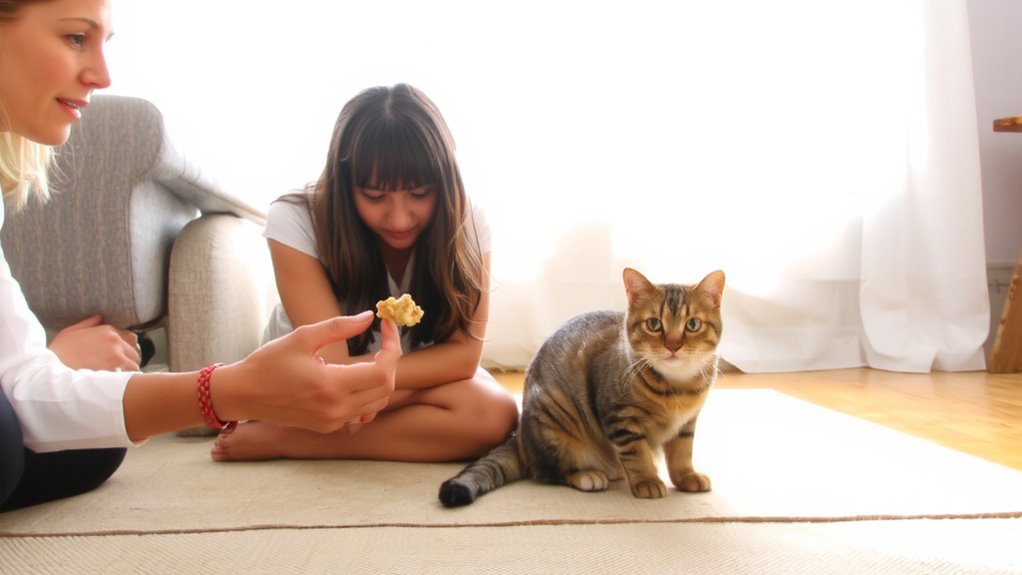
Generally, the best time to begin training your cat to high-five is when she’s calm and curious, not tired or overstimulated. A calm environment reduces distractions and enhances focus. You’ll achieve ideal results when your cat exhibits playful curiosity-her pupils dilated, ears forward, tail upright. These behaviors indicate engagement and readiness to learn. Begin training sessions when your cat has rested, ideally 30–60 minutes after a nap. Avoid high-energy periods, such as immediately after play or feeding. Keep sessions short-2 to 3 minutes-to maintain attention without causing fatigue. Use a quiet room with minimal auditory and visual stimuli. This controlled setting supports consistent behavioral responses. Training during states of playful curiosity increases receptiveness to new tasks. You’ll notice quicker associations between actions and rewards. A calm environment paired with attentive timing guarantees reliable conditioning. This precision maximizes learning efficiency in feline operant conditioning protocols.
Click and Treat: Start the High-Five Training
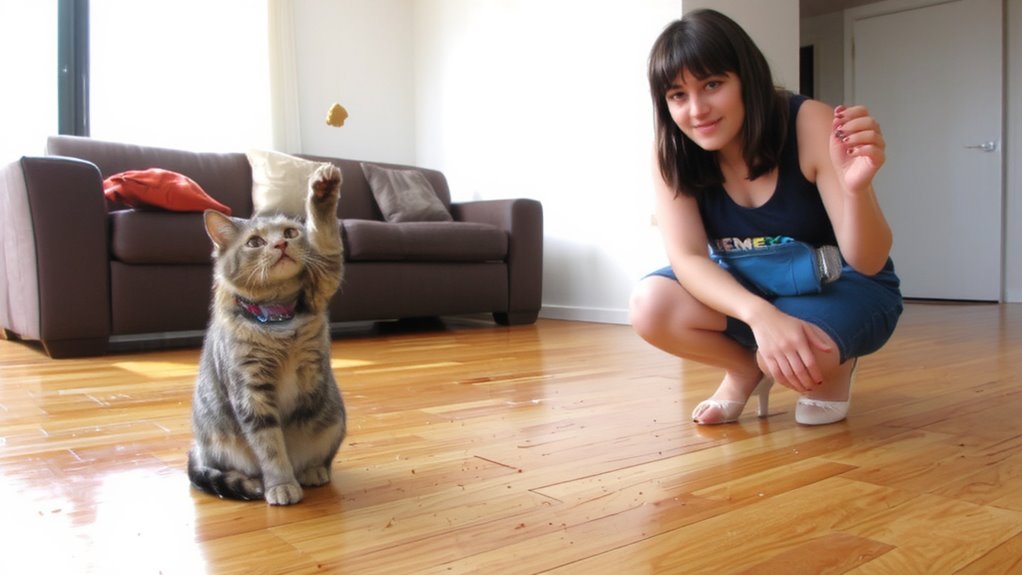
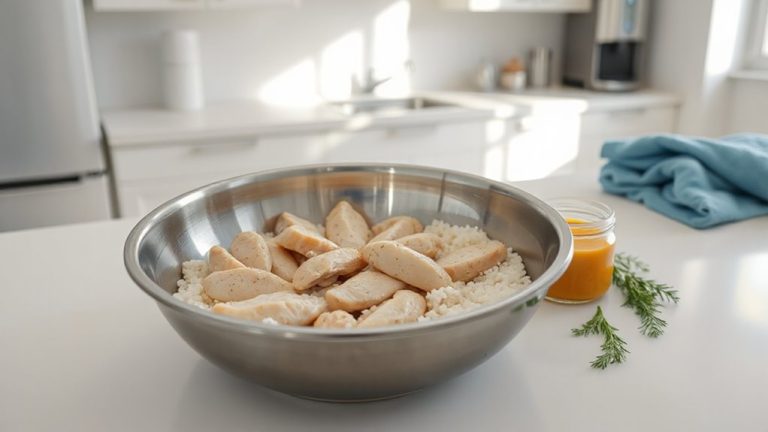
Once your cat is in a state of calm focus, you can begin shaping the high-five behavior using clicker training, a method grounded in operant conditioning. Timing precision is critical-click the instant your cat makes a relevant movement. Delayed clicks confuse learning. Pair each click with a high-value treat, ensuring consistent reinforcement. Treat selection directly impacts success; choose small, soft, strongly scented morsels your cat rarely gets.
| Phase | Action | Purpose |
|---|---|---|
| 1 | Present clicker | Signal correct behavior |
| 2 | Click + treat | Reinforce action |
| 3 | Repeat sequence | Build behavior association |
Conduct sessions in 3–5 minute intervals, 2–3 times daily. Overuse dulls responsiveness. Use a digital kitchen timer to maintain schedule. The clicker’s sound (2,800 Hz) must remain uniform. Never pair it with commands-only actions. Consistency in timing precision and treat selection accelerates acquisition.
Shape the High-Five Paw Lift
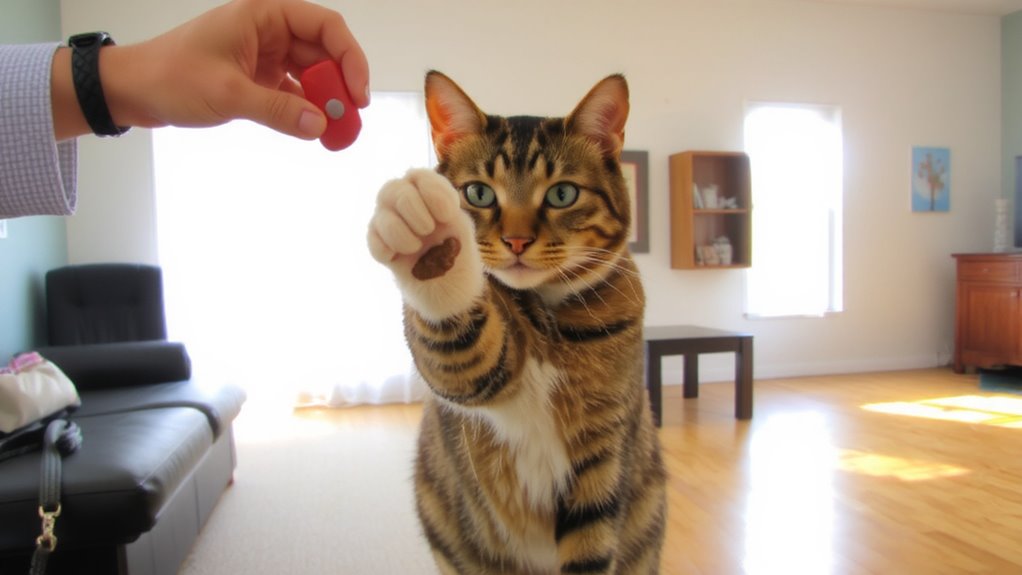
Start by capturing the moment your cat naturally lifts a paw, even slightly, off the ground. This initial movement is the foundation of paw targeting. The instant the paw begins to rise, activate the clicker. Precision in reinforcement timing is critical-rewards must follow within 0.5 to 1 second of the behavior. Delayed treats weaken association and slow learning. Use small, soft treats (approximately 1–2 grams) to maintain rhythm without overfeeding. Gradually raise the click threshold, clicking only for higher lifts. Ignore steps backward or lateral movements. Each session should last 3–5 minutes to prevent fatigue. Conduct 2–3 sessions daily for consistent progress. Reinforce correct limb elevation until your cat consistently lifts the paw 2–3 inches. This controlled shaping process guarantees reliable, repeatable responses essential for the next training phase.
Add the High-Five Hand Signal
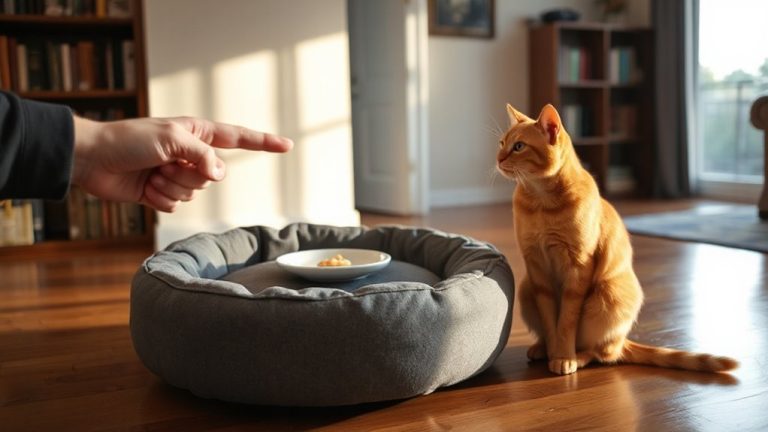
Now is the time to link a hand signal with the paw lift your cat already performs on cue. Present a clear, consistent hand signal-such as a flat palm facing your cat-just before the desired paw lift occurs. The signal must precede the behavior to establish predictive association. Use precise reinforcement timing: click the moment the paw begins to rise toward your hand, then deliver the treat immediately. Delayed reinforcement undermines learning accuracy. Practice in short 2-3 minute sessions, repeating 5–7 times daily to solidify neural pathways. The hand signal acts as a discriminative stimulus; over time, the cat learns to respond only when the signal appears. Guarantee the gesture is distinct from other cues-minimum 15 cm of hand movement-to prevent confusion. Consistent signal delivery and millisecond-level reinforcement timing optimize operant conditioning efficiency.
Fix Common High-Five Training Problems
Sometimes, your cat may hesitate to raise their paw despite mastering earlier steps. This stall often stems from poor reinforcement timing. Deliver the click the instant your cat lifts their paw, followed immediately by a treat. Even a half-second delay disrupts associative learning, weakening the behavior-reward connection. If progress halts, return to targeting exercises to rebuild the sequence. Distraction management is equally critical. Train in a quiet, consistent space with minimal auditory or visual stimuli-ideal sessions occur in a closed room with controlled lighting. Limit session length to 3–5 minutes to maintain focus. Use high-value treats, such as freeze-dried chicken pieces under 1 cm in size, to sustain motivation. Avoid over-handling; repeated physical prompting increases resistance. Instead, shape the behavior incrementally. Record each session to review technique and adjust timing. Patience and precision guarantee reliable performance.
On a final note
You’ve successfully taught your cat to high-five using operant conditioning. The clicker marks the target behavior with millisecond precision, while treats reinforce the action. Shaping builds the paw lift gradually. The hand signal acts as the discriminative stimulus. Consistency guarantees reliability. Sessions stay under five minutes to maintain focus. Success depends on timing, repetition, and immediate reinforcement. This method works because it aligns with feline learning psychology.