How to Use Clicker Training to Teach Dogs to Fetch Specific Toys
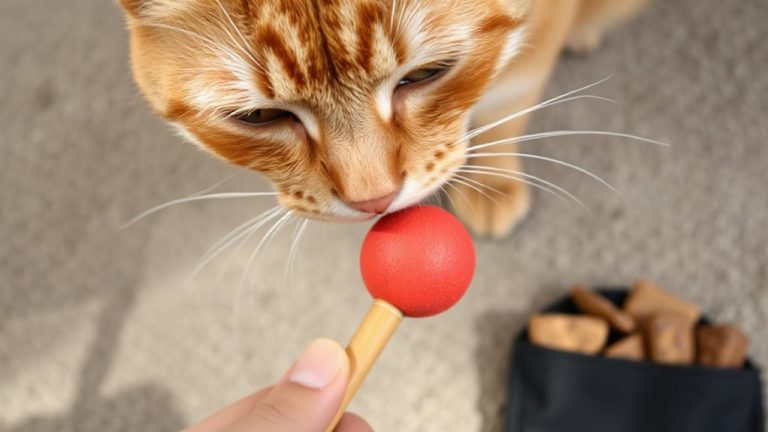
You pair a 2.8 kHz clicker sound with an immediate treat to mark desired behavior within 0.5 seconds. Start with a 3” soft plush sphere, clicking when your dog grips it. Toss it less than 5 feet and keep sessions under 10 minutes. Use single-syllable names like “ball” with consistent tone. Reinforce each correct fetch with a click-treat sequence. As accuracy exceeds 80%, introduce new textures and controlled distractions. Greater specificity emerges through structured repetition and sensory differentiation. Mastery expands gradually through incremental environmental challenges.
Notable Insights
- Use a clicker to mark the exact moment your dog grips the correct toy, followed immediately by a treat.
- Choose toys with distinct colors, sizes, and textures to help your dog differentiate between them easily.
- Start training with one toy, like a soft plush sphere, using short tosses and no verbal cues initially.
- Introduce consistent single-syllable names for each toy, spoken clearly and repeated the same way every time.
- Train in quiet spaces first, then gradually add distractions only after your dog reliably fetches on command.
How Clicker Training Works
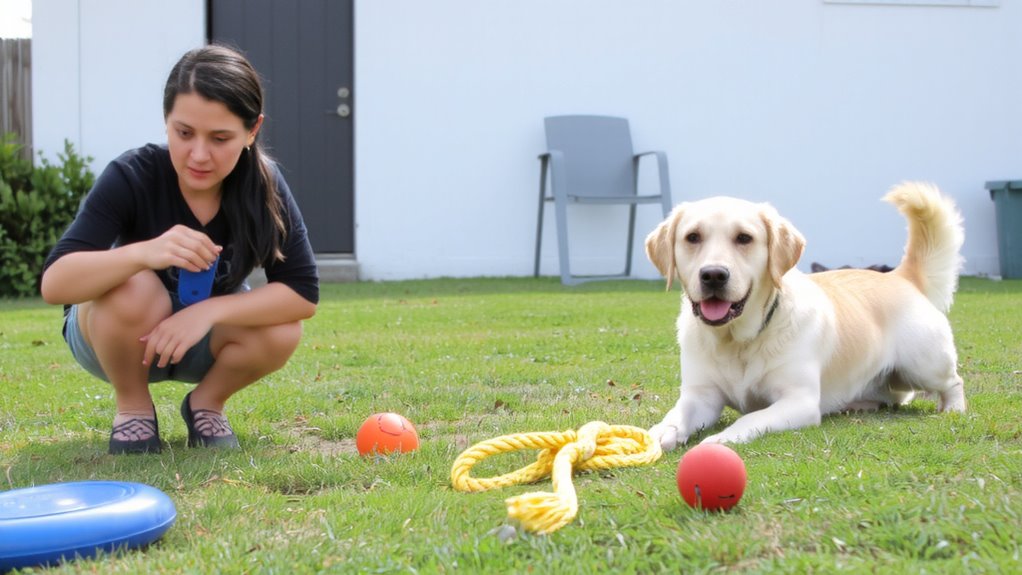
While timing is critical in shaping behavior, clicker training simplifies the process by marking the exact moment your dog performs the desired action. You use a handheld device that emits a consistent 2.8 kHz click sound, which acts as a bridging stimulus. This sound precisely communicates to your dog that they did something right, immediately before delivering a treat. The key to success lies in timing accuracy-ideally, the click must occur within 0.5 seconds of the behavior. Without this precision, confusion can occur. Clicker training relies on positive reinforcement, meaning your dog learns through rewards, not punishment. Each reward strengthens the association between the click and the treat. Over time, your dog begins to understand which actions lead to rewards. Consistency, repetition, and split-second timing accuracy are essential. The method works because it clarifies expectations and builds reliable behavioral responses.
Pick Toys That Are Easy to Tell Apart
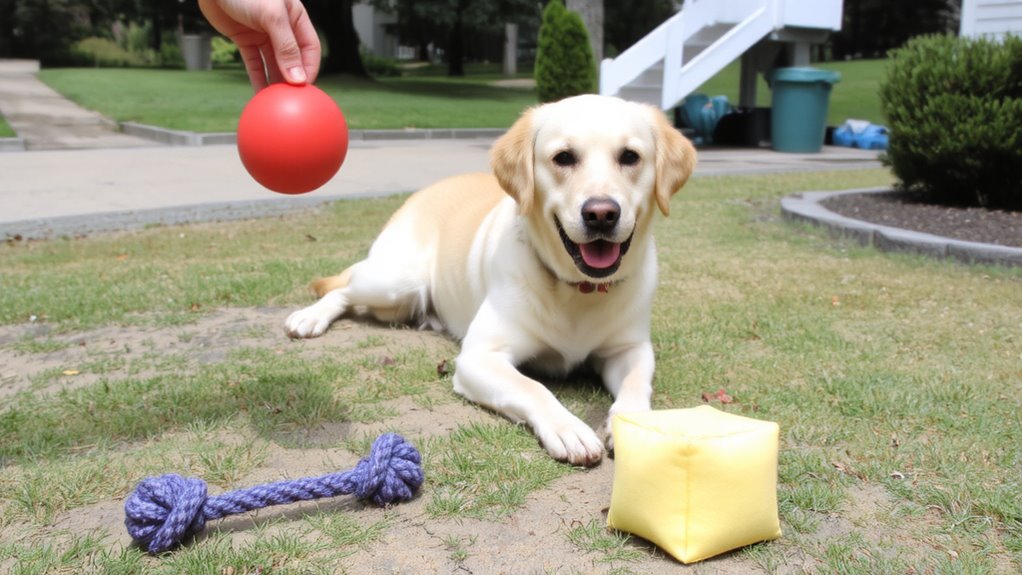
Choose toys that differ clearly in color, shape, and texture to help your dog distinguish between them during training. High color contrast enhances visual discrimination, especially at a distance or in low light. Select toys in opposite ends of the color spectrum, such as bright yellow and dark blue, avoiding similar shades. A minimum size difference of two inches between toys improves recognition and reduces confusion. Use a soft plush sphere (diameter: 3”) and a rubber dumbbell (length: 5.5”) to provide clear tactile and visual cues. Textural variation-smooth, bumpy, fuzzy-adds sensory distinction. Durable materials like natural rubber and fleece guarantee long-term use. Avoid reflective or translucent toys, as they distort under varying light. Consistent physical attributes allow reliable cue-response mapping. Distinct toy profiles support faster associative learning, establishing a strong foundation before introducing verbal labels. Each toy must be uniquely identifiable to enable accurate targeting.
Teach Fetch Using the Clicker and a Single Toy
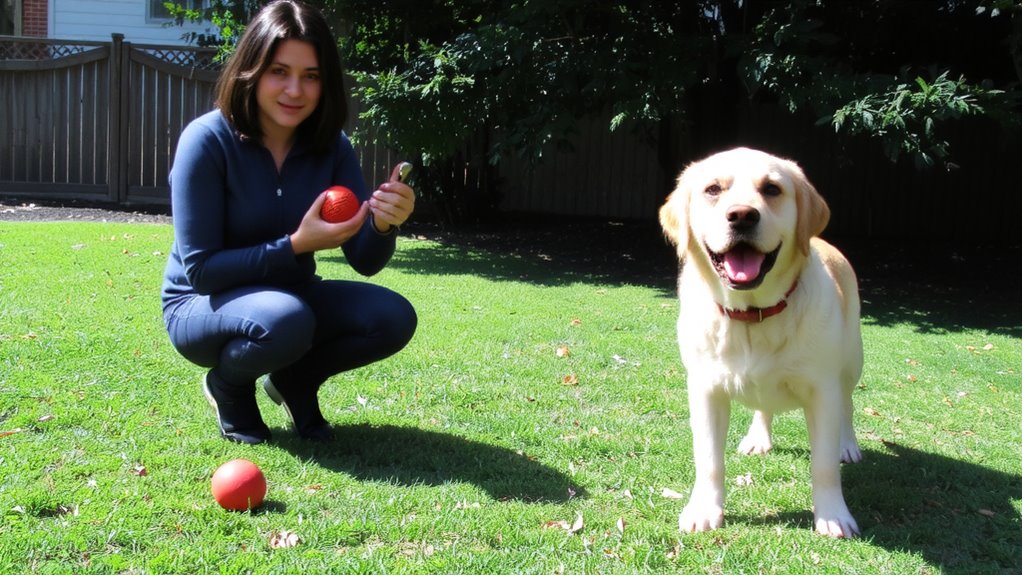
Once your dog can reliably distinguish between toys, begin shaping the fetch behavior using a single, clearly defined object-start with the 3” plush sphere, as its size and soft texture reduce injury risk and support secure carrying. Use consistent toy recognition cues by presenting only this sphere during initial fetch drills. Click the instant your dog grips the toy, ensuring precise reward timing to reinforce the desired action. Deliver a treat within one second of the click to solidify the association. Begin with short tosses under 5 feet to limit overexertion. Gradually increase distance as accuracy improves. Each session should last no more than 10 minutes to maintain focus. Limit repetitions to five per session to prevent habituation. The plush sphere’s 3.5-ounce weight supports safe indoor use. Consistent reward timing strengthens behavioral precision. Avoid verbal cues initially to prevent confusion.
Say Each Toy’s Name Clearly Every Time
Why do some dogs struggle to differentiate toys on command? Inconsistent verbal cues confuse learning. To build accurate toy recognition, you must say each toy’s name clearly every time-using the exact same word, tone, and cadence. This consistency strengthens auditory discrimination, a key component in advanced recall training. Pair each named toy with precise positive reinforcement when your dog selects correctly. Verbal cues act as discriminative stimuli, signaling which object earns rewards. Use single-syllable names for clarity-e.g., “ball,” “bear,” “rope”-to reduce phonetic overlap. Articulate each word distinctly, pausing before and after the name to prevent blending into background speech. Accurate vocal labeling improves stimulus control and reduces cognitive load. Over time, your dog learns to associate each unique verbal cue with a specific object. Clear, repeatable naming is essential for reliable performance in complex retrieval tasks. A well-timed click from a best cat training clicker can enhance precision in marking desired behaviors during object recognition exercises.
Link Toy Names to Objects With Clicker Rewards
When introducing a new toy, your dog relies on precise associative learning to form a reliable connection between the spoken name and the object, and that’s where the clicker becomes critical. You say the toy’s name once, present the object, and immediately click as your dog makes contact. Pair this with a high-value treat within 0.5 seconds to solidify the association. Repeat this sequence 10–15 times per session to minimize fuzzy discrimination, ensuring your dog doesn’t confuse similar-sounding names or textures. Over time, trained responses replace guesswork, laying the foundation for silent retrieval. The clicker’s consistent acoustic signal-typically 2,500 Hz-acts as a temporal bridge, marking the exact behavior you’re reinforcing. This method supports neural encoding of object-specific cues. Accurate timing, repetition, and controlled stimuli are essential. Eventually, your dog identifies each toy by name without verbal prompting, enabling reliable selection among multiple items.
Practice Fetch in Quiet Spaces
Start training fetch in an environment free of distractions to maximize focus and reinforce learned object associations. Choose a quiet environment, such as an enclosed backyard or empty room, where external stimuli are limited. Minimal distractions guarantee your dog maintains attention on the task, increasing the accuracy of toy retrieval. Use only the target toy and clicker during sessions to prevent interference. Keep sessions short-three to five minutes-to maintain mental sharpness. Conduct two to three sessions daily for best reinforcement. Position yourself ten to fifteen feet from your dog when tossing the toy. This distance balances visibility with mild physical effort. Use consistent verbal cues like “Fetch [toy name]” with each throw. Immediate click-treatment delivery at your dog’s return solidifies correct behavior. The quiet environment accelerates learning by isolating the behavior-response-reward sequence. Avoid introducing other toys or people during this phase.
Add Challenges in Real-World Settings
Once your dog consistently retrieves the target toy in quiet environments, it’s time to test the behavior under real-world conditions. Begin with controlled outdoor practice in a fenced yard, measuring your dog’s accuracy over 10 trials per session. Introduce one variable at a time to guarantee reliable data. Start distraction introduction with low-level stimuli-such as a person walking 20 feet away-then gradually increase intensity. Use the clicker only for correct toy selection, reinforcing precision. Test retrieval distance from 10 to 30 feet, noting response time and focus. Revert to quiet-space drills if accuracy drops below 80%. Outdoor practice should occur 3–4 times weekly, using consistent verbal cues. Surface type, wind, and ambient noise affect performance; record these variables to track adaptation. Maintain short sessions-5 to 7 minutes-to sustain focus. Each successful trial strengthens stimulus discrimination under real-world demands.
On a final note
You now have the tools to teach precise toy-fetching using clicker training. The clicker marks desired behavior with millisecond accuracy, enhancing learning efficiency. Start with high-contrast toys differing in color, shape, and texture-such as a blue rubber ball and a red plush bear-to aid discrimination. Reinforce each correct identification with a click and treat. Practice in low-distraction environments, then gradually increase complexity. Consistent verbal cues, paired with precise timing, establish reliable object-name associations.