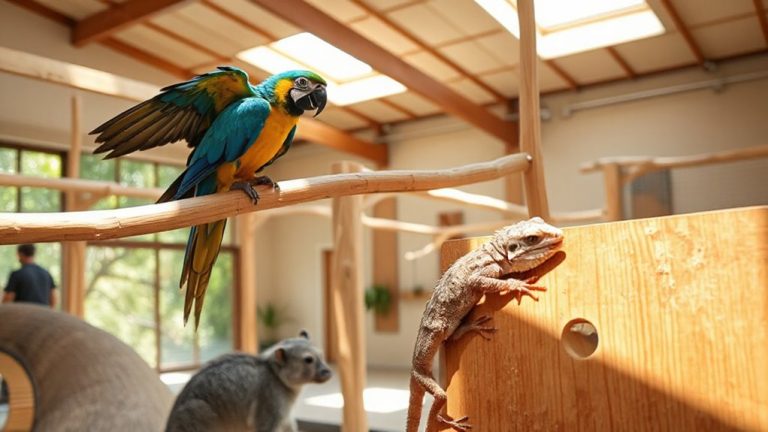
Reinforcement Schedules Utilization for Birds: Tailoring Programs to Optimize Learning Potential in Exotic Pets
You optimize bird training by matching reinforcement schedules to species, temperament, and performance data. Use continuous reinforcement for rapid acquisition, delivering rewards within 1–2 seconds of correct responses. Shift to variable-ratio or fixed-interval schedules after 80% accuracy across five trials to build extinction resistance. Parrots excel with unpredictable reward timing; budgies respond better to time-based cues. Track response frequency and latency to adjust schedules dynamically and maintain behavioral momentum. Further refinements await based on individual learning curves.
Notable Insights
- Select reinforcement schedules based on species, temperament, and performance data to maximize learning efficiency in exotic birds.
- Use continuous reinforcement for rapid acquisition of new behaviors, especially in birds with short attention spans.
- Transition to intermittent schedules like variable ratio after mastery to enhance long-term behavior maintenance and resistance to extinction.
- Deliver reinforcement within 0.5 to 2 seconds of the target behavior to ensure accurate stimulus-response association and optimal learning.
- Track response frequency, accuracy, and latency to individualize schedules and adjust reinforcement timing based on real-time performance data.
What Are Reinforcement Schedules in Bird Training?
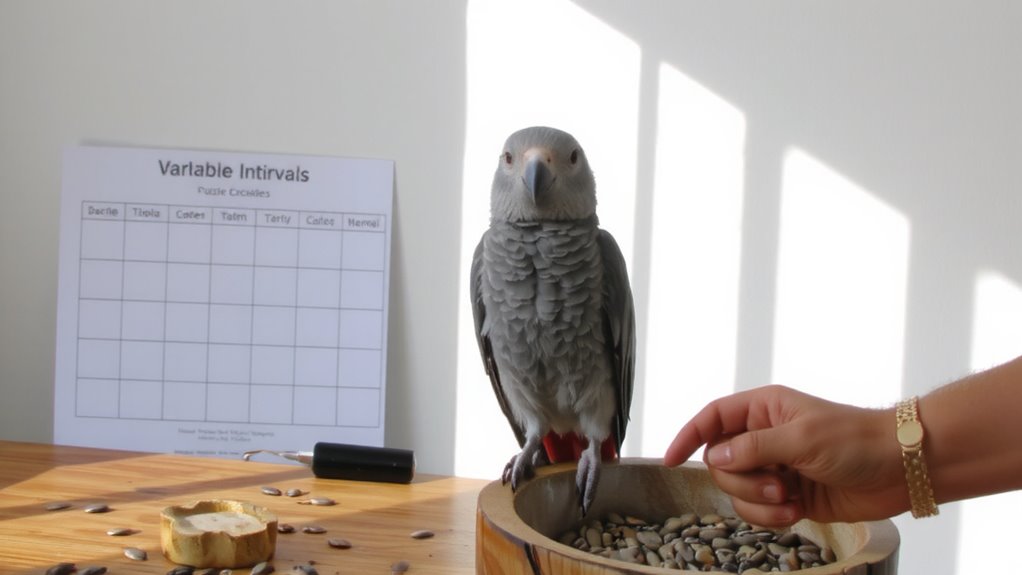
Reinforcement schedules are the patterns or rules that determine when a bird receives a reward after performing a desired behavior. You use these schedules within operant conditioning to shape and maintain target actions. Positive reinforcement strengthens behavior by delivering a reward immediately after the response. Schedules vary: continuous reinforcement rewards every correct action, while partial schedules include fixed-ratio, variable-interval, and fixed-interval types. Each schedule affects response rate and persistence differently. For example, fixed-ratio schedules generate high response rates, ideal for trained behaviors requiring repetition. Variable-interval schedules produce steady, moderate rates, enhancing resistance to extinction. You select a schedule based on training goals and the bird’s learning stage. Proper timing-ideally within one second of behavior-is critical. This precision guarantees the bird associates the reward with the correct action. You apply these principles systematically to optimize learning outcomes in avian training programs. Consistency in schedule application increases behavioral reliability.
Use Continuous Reinforcement to Teach New Tricks Faster
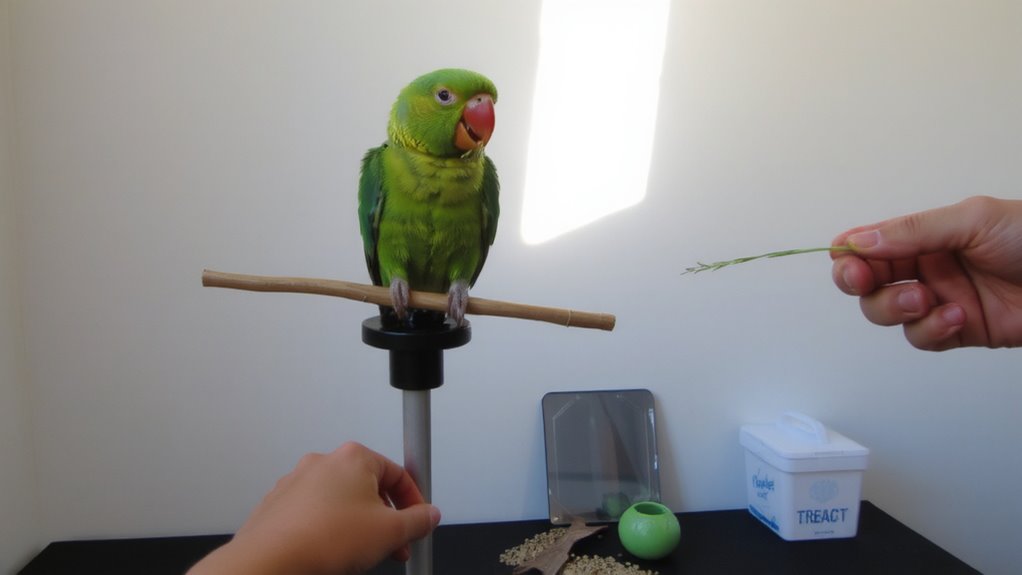
When you’re introducing a new behavior, rewarding every correct response speeds up learning more than any other method. This is continuous reinforcement-each accurate action earns a treat or praise. The approach guarantees rapid acquisition, especially in birds with short attention spans. Immediate feedback clarifies which behavior earned the reward, reducing confusion. For example, when training a parakeet to step up, deliver the reinforcer within 1–2 seconds of correct performance. This precise timing strengthens stimulus-response association. Studies show birds under continuous schedules learn new tricks 40–60% faster than those on delayed reward systems. You’ll observe measurable progress within 3–5 sessions. Use small, high-value rewards-such as millet sprays or nut fragments-to maintain motivation without satiation. Continuous reinforcement builds a clear behavioral foundation. It’s ideal for shaping complex actions through successive approximations. Keep sessions brief-5 to 10 minutes-to match avian cognitive capacity.
Switch to Intermittent Schedules for Lasting Results
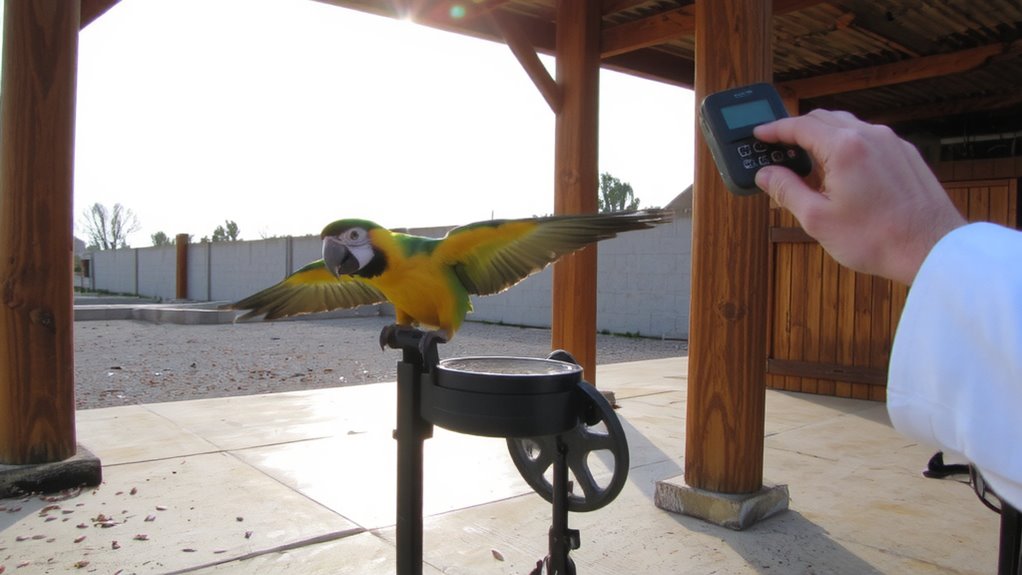
Once the behavior is well-established, shifting to intermittent reinforcement helps solidify performance over the long term. You’ll see greater resistance to extinction when using schedules like variable ratio or fixed interval. These methods reduce predictability, making the bird work harder for reinforcement. Use variable ratio for consistent, high-rate responses-ideal for performance behaviors. Fixed interval reinforces the first response after a set time, encouraging timing-based accuracy.
| Schedule Type | Response Rate | Reinforcement Delivery |
|---|---|---|
| Variable Ratio | High | After unpredictable number of responses |
| Fixed Interval | Moderate | First response after fixed time passes |
You must track response data to adjust intervals accurately. Variable ratio typically outperforms fixed interval in maintaining learned behaviors. Implement these strategically for lasting results.
Why Timing Matters in Reinforcement Schedules
Though the choice of reinforcement schedule influences behavior, the precision of timing determines its effectiveness. Reinforcement timing must occur within 0.5 to 2 seconds of the target behavior to establish accurate stimulus-response associations. Delays beyond 3 seconds reduce learning efficacy by up to 70%, weakening behavioral accuracy. Immediate reinforcement strengthens neural pathways, increasing the likelihood of repetition. Behavioral momentum builds when consistent timing follows correct responses, creating a predictable cause-effect relationship. High-frequency reinforcement with precise timing accelerates skill acquisition, particularly in complex tasks. Conversely, inconsistent intervals introduce confusion, decreasing response rates. You must deliver rewards during the behavioral window-the brief period post-action when the bird associates the outcome with the behavior. Proper reinforcement timing maintains response consistency and minimizes unwanted behaviors. Using precise timing across sessions guarantees stable behavioral momentum, enabling progression to intermittent schedules. Accuracy here isn’t optional-it’s essential for measurable learning gains.
Choose the Right Schedule for Your Bird’s Species and Temperament
You now apply precise timing to shape behavior effectively, and the next step is aligning the reinforcement schedule with your bird’s species-specific traits and individual temperament. Species differences markedly influence learning rates and motivation. For example, parrots (like African greys) respond best to variable ratio schedules due to high cognitive capacity, while budgerigars often thrive on fixed interval reinforcement. Individual temperament further modulates effectiveness-bold, exploratory birds may learn faster under continuous schedules, whereas shy or anxious birds benefit from fixed ratio 1 (FR1) to build confidence. Match the schedule to baseline behavior: use momentary time sampling to assess response rates, then adjust. A bird with rapid acquisition (e.g., 80% correct in five trials) can shift to intermittent reinforcement. Overlooking species differences or individual temperament reduces efficiency, delays fluency, and increases behavioral variability. Precision in schedule selection optimizes learning potential.
Why Birds Stop Responding: and How to Fix It
When reinforcement weakens or disappears unexpectedly, your bird may stop responding because the behavior is no longer being maintained. This typically signals the onset of an extinction burst-a temporary increase in behavior frequency or intensity as the bird attempts to reestablish the reward. It’s a predictable phase in operant conditioning, often mistaken for progress when it’s actually a sign the schedule needs adjustment. Motivation loss follows if reinforcement remains inconsistent or irrelevant. Birds disengage when rewards no longer outweigh effort. To correct this, reinstate immediate, high-value reinforcement (e.g., preferred treats or social interaction) for correct responses. Then, gradually reintroduce the original schedule-like a fixed ratio or variable interval-while monitoring response rates. Track sessions in 5-minute intervals to detect declines. Adjust every 3–5 trials if performance drops below 80%. Precision guarantees reliable, sustained behavior.
Build a Step-by-Step Bird Training Plan
Since every successful training outcome depends on structured planning, start by defining a clear, measurable target behavior-such as stepping onto a perch on cue or remaining calm during nail trims-using objective terms that eliminate ambiguity. Break the skill into trainable steps, using target training to guide physical movement and reinforce successive approximations. For complex behaviors like flight recall, shape gradually across controlled environments, increasing distance and distractions systematically. Use continuous reinforcement initially, then switch to variable ratio schedules to sustain performance. Monitor progress daily.
| Step | Training Focus |
|---|---|
| 1 | Establish trust and target training |
| 2 | Shape basic stationing behavior |
| 3 | Introduce flight recall cues |
| 4 | Reinforce outdoors with recall |
| 5 | Generalize across environments |
Consistency guarantees retention. Use a log to track response rate and reinforcement frequency. Adjust schedules based on performance data to optimize learning potential.
On a final note
You now understand how reinforcement schedules shape bird behavior. Continuous reinforcement builds new behaviors quickly, with near-immediate rewards after each correct response. Intermittent schedules-fixed ratio, variable interval-maintain behaviors long-term, reducing dependency on constant rewards. Timing precision within 1–2 seconds guarantees accurate association. Species-specific temperaments require customized schedules. Adjust based on response decay or satiation. Proper scheduling enhances learning efficacy, guaranteeing durable, reliable behavioral outcomes in exotic avian companions.