Boosting Motivation in Your Exotic Pets With the Right Training Approach
You boost your exotic pet’s motivation by aligning training with species-specific instincts. Birds engage with puzzle feeders requiring 5–15 seconds of effort; reptiles respond to slow-moving robotic prey at 0.5–3 in/sec. Reward within 1–2 seconds for birds, under 1.5 seconds for hedgehogs. Use high-value, low-volume rewards like 0.1–0.3g mealworms. Keep bird sessions to 3–5 minutes daily, reptiles 5–10 minutes twice weekly. Watch for alert posture or head orientation-signs of engagement. Adjust stimuli every 72 hours, increasing variety by 20% to prevent habituation. Trust builds through consistent, non-threatening proximity and hand-feeding with tongs. Disengagement shows in closed eyes or nose twitching-respond with immediate environmental or reward adjustments. Arousal and learning peak when simulations mimic natural challenges like foraging or hunting. Sustained success depends on precise timing, stimulus rotation, and behavioral monitoring. You’re seeing just the start of what effective, science-backed training can reveal.
Notable Insights
- Align training with species-specific instincts like foraging or thermoregulation to enhance engagement and motivation.
- Deliver rewards within species-specific timing windows to strengthen learning and maintain behavioral momentum.
- Use high-value, appropriately sized rewards to motivate without causing satiation during training sessions.
- Build trust through consistent, non-threatening interactions and positive food associations near the enclosure.
- Prevent habituation by increasing stimulus variety every 72 hours and adapting strategies based on real-time performance data.
Start With What Motivates Your Exotic Pet Naturally
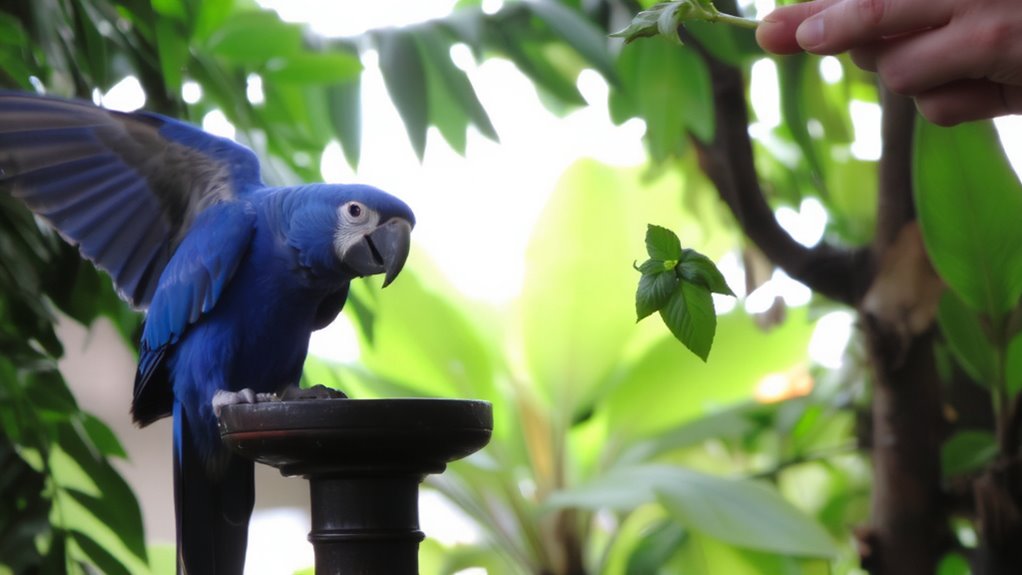
Motivation begins with instinct. Your exotic pet responds to natural instincts shaped by evolution. These innate drives dictate how they interact with their environment. Understanding species behaviors is essential for effective training. For example, reptiles rely on thermal gradients, using heat to regulate metabolism and activity. Birds demonstrate foraging behaviors, spending hours searching for food in the wild. You can use this knowledge to guide their actions. A crested gecko seeks shelter in dark, enclosed spaces-offer a snug hide box at 75°F to support thermoregulation. Parrots manipulate objects with their beaks; provide destructible wood toys to satisfy exploratory urges. Natural instincts determine what stimuli they pay attention to. Ignoring these patterns leads to disengagement. Aligning training with species behaviors increases responsiveness. You’re not changing behavior-you’re channeling it. Proper motivation starts not with rewards, but with context rooted in biology.
Match Rewards to Their Instincts: For Birds, Reptiles, and More
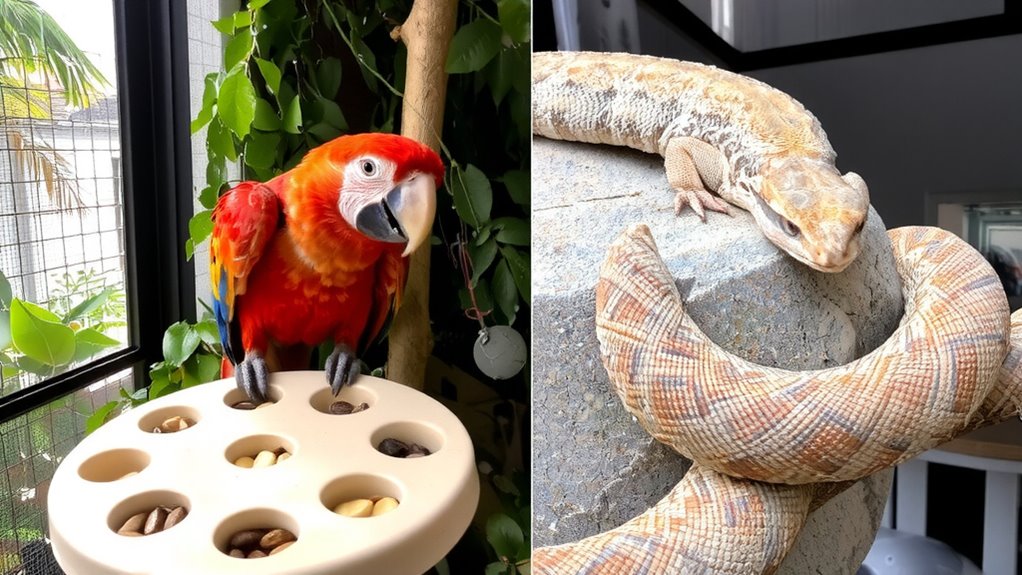
You’ve already set the stage by tapping into your exotic pet’s natural behaviors-now it’s time to reinforce those actions with rewards that align with their instincts. For birds, offer puzzle feeders that trigger instinctive foraging; these devices release food only after manipulation, mimicking wild feeding challenges. Parrots respond best to rewards requiring 5–15 seconds of problem-solving, increasing engagement. Reptiles prefer movement-triggered reinforcement-use robotic prey simulators with variable speeds (0.5–3 in/sec) to stimulate hunting. These devices enhance motivation by appealing to deeply rooted predatory drives. For species exhibiting natural mimicry, like mynas or lyrebirds, play recorded calls as auditory reinforcement. This strengthens learned behaviors by validating their vocal accuracy. Amphibians react to motion-based rewards: automated flickering LED cues (620–630 nm wavelength) simulate insects and prompt tongue-strike responses. Match reward delivery timing to species-specific response latency-birds average 1–2 seconds, reptiles 3–8. Precision in timing and stimulus type maximizes learning efficiency.
Earn Their Trust Before Asking for Tricks
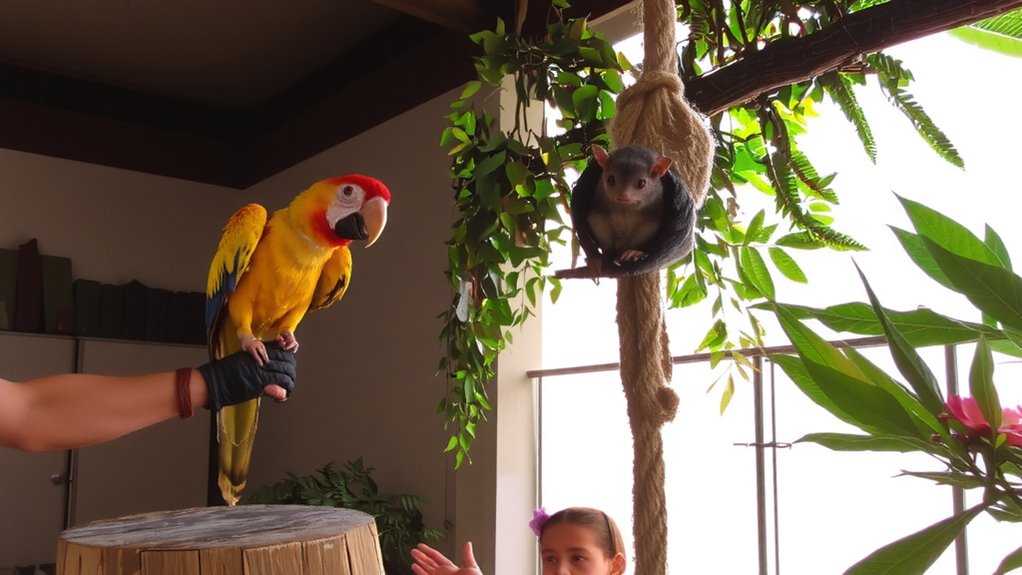
While training goals are important, they must follow a foundation of trust-especially with exotic species prone to stress-induced behaviors. You can’t expect a nervous skink or startled parrot to focus on cues if they don’t feel safe. First, build trust through consistent, non-threatening interactions. Spend time near the enclosure daily, offering food without reaching in. Gradually introduce hand-feeding using tongs or gloves to minimize perceived threat. Each session should last 5–10 minutes, aligning with species-specific attention spans. Over weeks, this repetition helps animals associate you with safety, not danger. That’s how you earn confidence. Reptiles show progress through reduced tongue-flicking or fleeing; birds may step up voluntarily. Trust isn’t assumed-it’s measured in decreasing stress markers and increasing proximity. Only then should you introduce target sticks or vocal commands. Training built on trust yields reliable, repeatable responses. Without it, motivation fails, regardless of reward quality.
Reward Good Behavior Every Time
Consistently rewarding the desired behavior strengthens learning more effectively than sporadic reinforcement. You must apply positive reinforcement immediately after the target action to create clear associations. Delayed rewards confuse exotic pets, weakening behavioral conditioning. Use consistent timing-deliver treats or praise within 1–2 seconds of the behavior for best learning. This precision aligns with neurological response windows in avian, reptilian, and mammalian species. For example, parrots retain behavior-reward links up to 2.4 seconds post-action, while hedgehogs require responses within 1.5 seconds. Use high-value rewards like mealworms or fruit bits, offering 0.1–0.3 grams per reinforcement to prevent satiation. Automatic treat dispensers with 0.8-second actuation delay improve accuracy. Each session should include 8–12 timed reinforcements to solidify behavior chains. Consistency guarantees repeatable results across multiple training events, enhancing long-term retention and response reliability. Choosing best dog training treats ensures optimal motivation and engagement during training sessions.
Keep Sessions Short and Species-Specific
Short training sessions tailored to your pet’s species yield stronger behavioral outcomes. You must align training frequency with natural behaviors and cognitive capacity. For example, reptiles benefit from 5- to 10-minute sessions twice weekly, while birds respond best to daily 3- to 5-minute drills. These intervals match attention spans and metabolic rates. Overextending reduces retention and increases stress. Pair each session with immediate play time to reinforce positive associations. Use species-specific stimuli-live insects for reptiles, vocal mimicry for parrots-to maintain relevance. Short, repeated exposure enhances neural conditioning without fatigue. You’ll improve compliance and reduce apathy. Training frequency should balance repetition and rest, guaranteeing maximum mental engagement. This precision maximizes learning while minimizing burnout. Matching duration and content to species norms guarantees maximum motivational transfer. Keep sessions brief, targeted, and biologically appropriate. Some snakes, such as the best pet snakes, are particularly responsive to consistent, short training due to their inquisitive yet low-energy nature.
Watch for Signs Your Pet Is Engaged (or Checked Out)
Attention is the cornerstone of effective training. You must recognize when your exotic pet is engaged or disengaged using observable body language cues. An alert posture, forward-facing ears or eyes, and oriented head positioning indicate focus. These signals reflect neural readiness to process commands. Attention shifts occur rapidly in exotic species, often within 30–60 seconds, especially in reptiles and birds. A turned head, closed eyes, or slow movement suggests waning interest. Some species, like hedgehogs, exhibit subtle signs-slight foot shifting or nose twitching-before full disengagement. Monitor these behaviors closely during sessions. Early detection of disengagement prevents wasted effort and reinforces positive associations. Use brief, consistent intervals to match natural attention spans. Accurate interpretation of body language cues guarantees timely reinforcement, aligning training with cognitive capacity. You can’t assume motivation; you must observe it in real time. Adjust immediately based on feedback.
Fix Low Motivation Fast: Before Training Fails
When motivation drops during training, your exotic pet’s behavior becomes less predictable and progress stalls. Address this immediately with targeted environmental enrichment. Introduce novel objects, varied textures, and rotating puzzle feeders to reignite engagement. These tools provide tactile and cognitive challenges proven to elevate participation in reptiles, birds, and small mammals. Pair enrichment with structured sensory stimulation-use controlled auditory cues, ultraviolet lighting cycles, and scent markers aligned with species-specific behaviors. For example, bearded dragons respond to 340–420 nm UVB exposure, enhancing alertness during sessions. Offer short, frequent training bouts (5–8 minutes) post-stimulation to capitalize on heightened arousal states. Monitor response latency and repetition accuracy to assess recovery in motivation. Adjust variables systematically: a 20% increase in stimulus variety every 72 hours prevents habituation. Rapid intervention with these evidence-based strategies prevents training failure and sustains behavioral momentum.
On a final note
You maximize motivation by aligning training with your exotic pet’s natural behaviors. Birds respond to food rewards like crushed pellets; reptiles prefer thermal gradients or hiding opportunities. Sessions last 5–10 minutes, matching attention spans. Use immediate, consistent reinforcement-delayed rewards reduce associative learning by up to 70%. Monitor pupil dilation, posture, and tongue flicks to assess engagement. Discontinue at first stress signals. Precision timing and species-specific stimuli guarantee reliable operant conditioning outcomes.