Cognitive Abilities Across Species: A Comparative Study of Dog, Cat, and Bird Intelligence
You’ll find dogs excel in social cognition, following human gestures with over 80% accuracy, comparable to toddlers. Their brains show heightened reward activity during human interaction, reinforced by oxytocin release. Cats rely on advanced spatial memory and problem-solving, recalling food locations and mastering latches in about 12 minutes. Crows use tools with precision, crafting hooks in under eight minutes on multi-step tasks. Each species evolved distinct cognitive strengths shaped by ecological demands. Further exploration reveals how these abilities reflect deeper evolutionary strategies.
Notable Insights
- Dogs excel in social cognition, understanding human gestures and emotions with comprehension levels comparable to human toddlers.
- Cats possess strong spatial memory and problem-solving skills, often solving physical tasks through independent trial-and-error learning.
- Crows demonstrate advanced tool use and innovation, modifying objects to solve complex foraging challenges efficiently.
- Parrots and magpies show signs of self-awareness by passing the mirror test, indicating higher self-recognition abilities.
- Intelligence across species reflects evolutionary adaptation, with dogs favoring social cooperation, cats prioritizing solitary hunting, and birds evolving neural efficiency for complex tasks.
Dog Intelligence: How Social Smarts Help Them Understand Humans
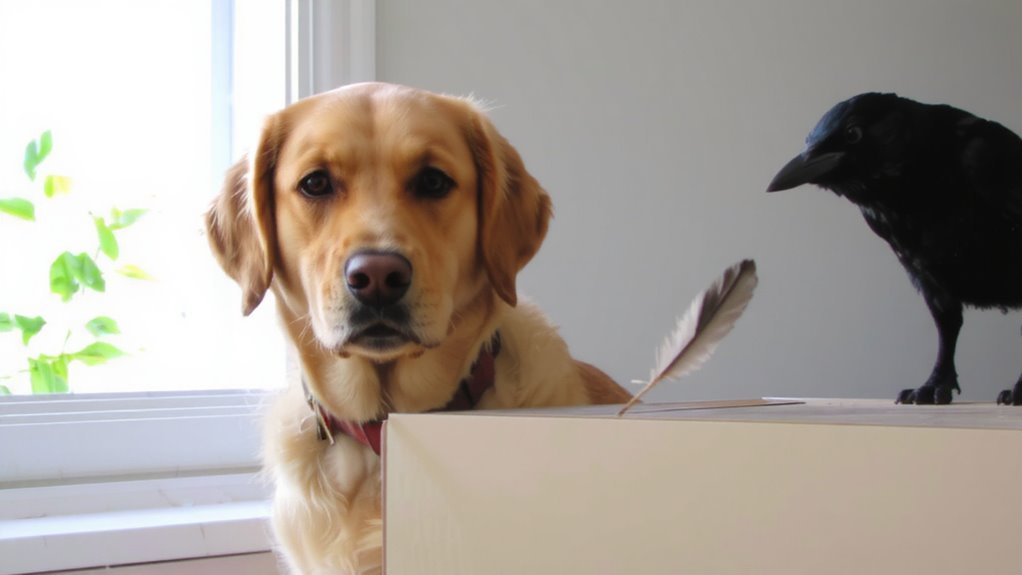
While humans have shaped dog behavior through thousands of years of domestication, it’s their evolved social cognition that truly sets them apart. You observe dogs interpreting human social cues with remarkable accuracy-studies show they follow pointing gestures at rates above 80%, similar to human toddlers. Their ability to read facial expressions, tone, and body language enables precise responses to emotional states. This sensitivity supports strong emotional bonding, mediated by oxytocin release during mutual gaze. Dogs detect subtle shifts in eye direction or posture, allowing them to anticipate actions. Neuroimaging reveals heightened activity in reward-processing brain regions during human interaction. Compared to wolves, domesticated dogs show 30% greater attention to human faces. These cognitive adaptations aren’t learned-they’re genetically embedded. You see them manifest early in puppyhood, often before 16 weeks. Such traits aren’t just behavioral; they reflect structural evolution in brain regions linked to social processing. Dogs’ social intelligence makes them uniquely attuned partners in human environments.
Cat Intelligence: Memory, Navigation, and Independent Thinking
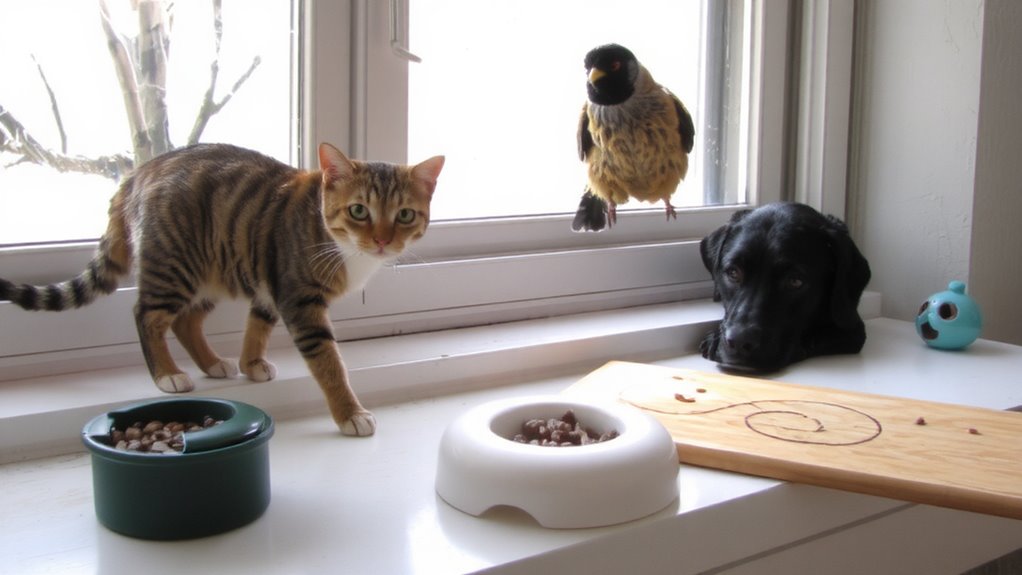
You might be surprised to learn just how well cats remember. Their spatial memory is highly developed, allowing them to map complex environments with precision. Cats recall locations of resources, such as food and hiding spots, for extended periods. This ability relies on hippocampal function similar to that in humans. They navigate using environmental cues and internal cognitive maps. Logical reasoning is evident when cats solve problems, like opening doors or accessing restricted areas. They assess cause-and-effect relationships, adjusting behavior based on outcomes. Studies show cats retain learned tasks after a single exposure, demonstrating efficient long-term memory consolidation. Unlike social learners, cats rely on independent thinking, processing information with minimal external guidance. Their cognition prioritizes autonomy, using observation and trial-based learning. While less motivated by praise, they respond to environmental feedback. This combination of spatial memory and logical reasoning supports survival in diverse habitats, from urban apartments to rural landscapes.
Bird Intelligence: Tool Use and Self-Recognition in Crows and Parrots
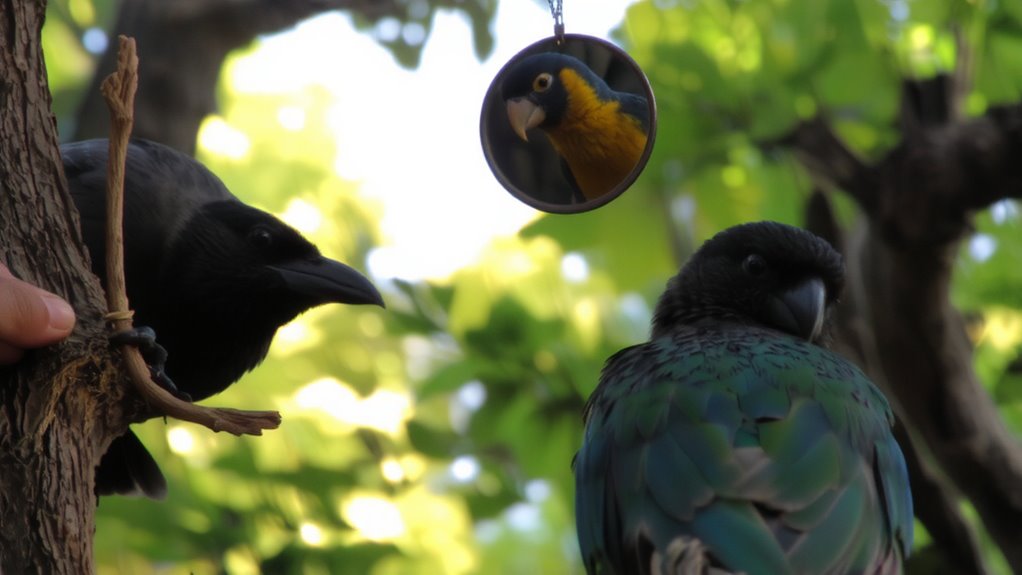
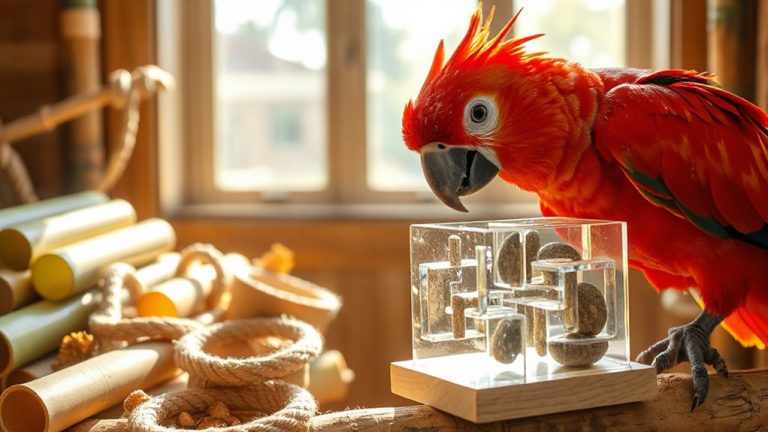
Crows and parrots demonstrate cognitive abilities that rival those of primates, challenging long-held assumptions about animal intelligence. You observe advanced tool use in crows, such as modifying sticks to extract insects from crevices. New Caledonian crows fashion tools with precision, showing consistent shape and function. Self recognition is evident when magpies and some parrots pass the mirror test, indicating self-awareness. African grey parrots display symbolic understanding and recall abstract labels.
| Species | Tool Use Observed | Self Recognition Confirmed |
|---|---|---|
| New Caledonian Crow | Yes (hook tools) | No |
| Rook | Yes (social context) | No |
| African Grey Parrot | No | Yes (mirror test) |
| Goffin’s Cockatoo | Yes (pliable tools) | Yes |
| American Crow | Yes (seasonal) | Not tested |
These behaviors reflect complex neural processing, particularly in the avian pallium.
Comparing Animal Intelligence: Problem-Solving Across Species
How do animals solve problems when faced with novel challenges? You observe dogs quickly adapting to puzzle feeders, leveraging emotional awareness to respond to human cues during tasks. Their learning speed surpasses many species, solving mechanical problems in under five minutes in controlled studies. Cats, though more independent, display persistent trial-and-error strategies, opening latches in an average of 12 minutes with minimal social input. Birds like crows use tools in innovative ways, achieving success in multi-step puzzles within 8 minutes. Emotional awareness influences performance: dogs outperform in socially embedded tasks, while cats and birds excel in solitary problem-solving. Learning speed varies-dogs master new commands in 5–20 repetitions; cats require 25–40; crows reach similar benchmarks in 15–25. These differences reflect cognitive specialization, not hierarchy, enabling each species to navigate distinct environmental demands effectively.
Why Intelligence Varies: Evolution and Survival in Dogs, Cats, and Birds
While intelligence in animals isn’t a one-size-fits-all trait, it’s shaped by millions of years of evolutionary pressure tailored to each species’ ecological niche. Your dog’s social cognition evolved for pack coordination, enhancing learning through brain size and neural density. Cats, solitary hunters, rely on stealth and precision-traits refined in their ecological niche-to maximize survival with minimal social interaction. Birds like crows exhibit surprising problem-solving skills despite small brain size, leveraging densely packed neurons in the pallium. Evolution favors efficiency, not intelligence alone.
| Species | Survival Feels |
|---|---|
| Dog | Loyalty in teamwork |
| Cat | Independence in silence |
| Bird | Ingenuity in flight |
| Human | Empathy in understanding |
On a final note
You now understand key differences in cognitive abilities across dogs, cats, and birds. Dogs excel in social cognition, interpreting human gestures like pointing with 70–80% accuracy. Cats demonstrate superior short- and long-term memory, retaining task solutions for up to 16 hours. Birds like crows use tools and recognize themselves in mirrors. Intelligence varies due to evolutionary pressures: social cooperation, predation avoidance, and foraging demands shape neural development.