Training Readiness by Age Assessment: Tailoring Programs According to Developmental Stages of Pets
Your pet’s training readiness depends on developmental stage, not just age. Puppies under 12 weeks focus for 2–5 minutes, learning best through play. By 6–12 months, attention spans reach 5–10 minutes, supporting simple commands. Adults (12+ months) sustain focus for 20–30 minutes and master complex tasks with 85–95% accuracy. Seniors need 5–10 minute sessions using simple cues. Cognitive and physical changes across life stages require tailored approaches for effective results-optimal timing and method selection guarantee long-term success.
Notable Insights
- Training readiness depends on cognitive and physical development, not just age, with key cues like attention span and response to stimuli.
- Puppies (8–12 weeks) learn best through play, with short 5-minute sessions aligned with their socialization window and neural development.
- Adolescent dogs (6–18 months) show improved focus and impulse control, requiring structured, frequent training to counter brain rewiring.
- Adult pets (1–7 years) have peak mental and physical capacity, supporting 15-minute sessions and complex tasks with consistent routines.
- Senior pets (7+ years) need simplified, low-impact training with short durations and food-based rewards due to cognitive and mobility decline.
What Is Training Readiness in Pets?
Training readiness refers to the stage at which a pet can effectively learn and respond to commands. You must assess training timing to maximize learning efficiency. Proper timing aligns with a pet’s cognitive and physical development, typically emerging after basic sensory and motor skills are established. Behavioral cues-such as sustained attention, consistent response to verbal stimuli, and reduced fear responses-indicate neurological preparedness. You’ll observe these cues during structured interactions, where the pet follows simple directives like “sit” or “stay” with minimal prompting. Readiness is not solely age-dependent; it includes environmental stability, health status, and prior exposure to stimuli. Early training attempts without these signals often produce inconsistent results. Successful programming requires accurate identification of these cues and precise training timing. Think of it like calibrating a sensor: input must match the system’s capacity. You’re optimizing for retention, speed of response, and accuracy under controlled conditions. A properly sized environment, such as the recommended best aquarium size, can support developmental stability for aquatic pets.
Age-Based Signs of Training Readiness
When can you expect your pet to start making reliable responses to commands? Training readiness varies by age and species, but certain developmental milestones signal it’s time. You’ll notice your pet begins to respond consistently to basic cues, especially when their play style shifts from random to goal-oriented. They start following social cues more accurately, like watching your face for direction. Attention span lengthens, often reaching 5–10 minutes by key developmental stages.
| Age Range | Observable Readiness Signs |
|---|---|
| 8–12 weeks | Short focus; learns through play style |
| 3–6 months | Responds to social cues; improves impulse control |
| 6–12 months | Sustained attention; masters simple commands |
| 12+ months | Reliable obedience; adapts to complex tasks |
Puppies: Early Signals and Starter Skills
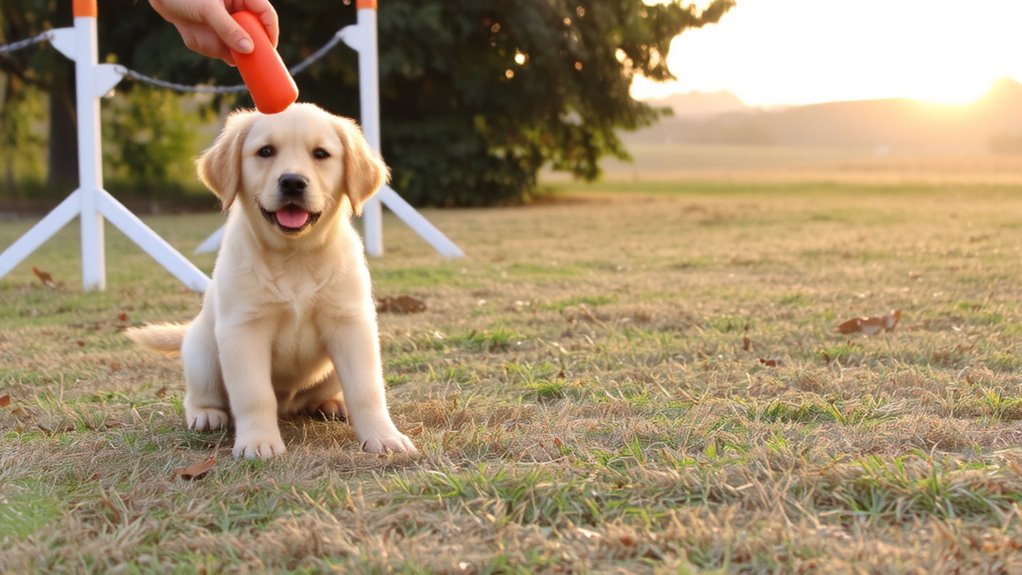
Your puppy’s first few months are packed with subtle behavioral cues that signal growing cognitive capacity. During this period, socialization windows are critical-typically open from 3 to 14 weeks-and enable robust neural development through controlled exposure to stimuli. You’ll notice your puppy begins testing boundaries, indicating readiness for early training. Start with bite inhibition exercises, which teach gentle mouthing by responding consistently when teeth contact skin. Puppies that learn bite inhibition before 16 weeks show 70% less aggressive mouthing in adulthood. Use short, five-minute training sessions two to three times daily to build focus. Reward correct behavior immediately with small, pea-sized treats (calorie count under 5 per treat). Prioritize positive reinforcement techniques-aversive methods reduce learning retention by up to 40%. Early skill acquisition directly correlates with long-term obedience, making precise timing and repetition essential during this foundational stage. A highly effective tool for ensuring accurate timing is a dog training clicker, which helps mark desired behaviors instantly and consistently.
Adolescents: Energy, Focus, and Readiness Gaps
Why do so many pet owners hit a wall with training around six to eighteen months? Because adolescent energy peaks during this phase, overwhelming focus challenges. Your pet’s brain is rewiring, reducing impulse control. Training doesn’t regress-it’s just outpaced by physiological changes. Consistency matters more now than ever.
| Stage | Energy Output (kcal/kg/day) | Attention Span (min) |
|---|---|---|
| Puppy | 100–130 | 3–5 |
| Adolescent | 140–170 | 1–3 |
| Adult | 90–110 | 5–8 |
Adolescent energy demands structured outlets like interval exercise. Focus challenges respond best to short, high-reward sessions every 12–24 hours. Use cue-specific markers to reinforce behavior. Avoid flooding-overexposure degrades retention. Instead, shape behaviors in incremental steps. Your pet isn’t resisting; their neurobiology is shifting. Adjust timing, not expectations. Incorporating proven pet training tools can significantly enhance consistency and effectiveness during this challenging phase.
Adult Dogs: Stability and Advanced Training Potential
Peak performance in dogs emerges during adulthood, typically starting around 18 to 24 months, depending on breed and individual development. You’ll notice improved behavioral consistency, making advanced training both efficient and effective. Adult dogs respond reliably to cues, with neural pathways solidified through prior learning. This stability supports sustained attention spans-often 20 to 30 minutes during structured sessions-ideal for skill refinement. You can now focus on precision, duration, distance, and distraction gradients in obedience tasks. Neurological maturity enhances impulse control, reducing reactivity by up to 60% compared to adolescence. Training modalities like shaping and chaining succeed with 85–95% accuracy in standard working breeds. Use variable reinforcement schedules to maintain learned behaviors. Cognitive capacity allows complex problem-solving, such as scent discrimination or sequential command execution. With physical growth complete, endurance and coordination support agility or service tasks. You’re working with a neurologically optimized learner, where consistency and repetition yield measurable performance gains.
Senior Pets: Adapting for Cognitive and Physical Changes
As pets enter their senior years, typically around 7 to 10 years for dogs and 10 to 12 for cats-depending on breed and size-physiological decline begins to influence learning capacity and physical responsiveness. Cognitive decline can impair memory, attention, and problem-solving abilities, reducing training receptivity. Neural processing slows, requiring repeated reinforcement for retention. Mobility limitations, such as osteoarthritis or muscle atrophy, restrict movement precision and endurance. Joints lose elasticity; stride length decreases by up to 30% in affected dogs. Training sessions must be brief-5 to 10 minutes-and conducted on non-slip surfaces to prevent injury. Use low-impact cues and reward-based motivation to maintain engagement. Elevated platforms can reduce joint stress during tasks. Adapt instructions to physical capacity; avoid jumps or rapid turns. Monitor fatigue closely. Environmental consistency aids cognitive function. Minimize distractions to support focus. Adjustments enhance comfort, preserve dignity, and sustain mental stimulation in aging companions.
Tailor Training to Your Pet’s Age and Stage
How do you adjust training to match your pet’s developmental phase? Start by aligning training frequency and reward types with age-specific needs. Young pets learn quickly but fatigue easily; short, frequent sessions yield best results. Adults benefit from consistent structure, while seniors need longer breaks and simpler tasks. Use primary rewards like food for puppies, social praise for adults, and low-effort incentives for older pets.
| Age Stage | Training Frequency | Reward Types |
|---|---|---|
| Puppy (0–6 mo) | 5–10 min, 3–5x/day | Treats, play, verbal |
| Adolescent (6–18 mo) | 10–15 min, 2–3x/day | Treats, toys, access |
| Adult (1–7 yr) | 15 min, 2x/day | Praise, play, routine |
| Senior (7+ yr) | 5–10 min, 1–2x/day | Rest, gentle touch, food |
Match methods precisely to cognitive and physical capacity.
On a final note
You must assess your pet’s training readiness by age to optimize outcomes. Young puppies respond best to short, repetitive sessions focusing on socialization and basic cues. Adolescents require structured routines to manage distractibility and impulse control. Adult dogs excel in advanced obedience with consistent reinforcement schedules. Seniors benefit from modified exercises accommodating cognitive and physical decline. Tailoring methods to developmental stage improves compliance, retention, and welfare.