Addressing Learned Helplessness Through Effective Training Methods for Home Pets
You can reverse learned helplessness in your pet through structured, reward-based training. Start with simple food puzzles delivering 0.5–1 gram of high-value reward per success to reinforce agency. Use immediate reinforcement-within one to two seconds-to strengthen behavior. Implement two 15-minute play sessions daily with consistent toys and environment. Over 4–6 weeks, this builds predictability, lowers cortisol, and restores control. Continue to adjust challenges based on progress.
Notable Insights
- Use positive reinforcement with immediate rewards to strengthen desired behaviors and rebuild a pet’s sense of control.
- Introduce simple food puzzles to promote problem-solving and reinforce the connection between effort and positive outcomes.
- Implement a predictable daily routine with fixed feeding, play, and rest times to reduce anxiety and enhance security.
- Gradually increase cognitive challenges and social exposure in short, positive sessions to build confidence without overwhelm.
- Encourage choice and agency, such as allowing pets to select activities, to boost engagement and prefrontal cortex activation.
Understanding Learned Helplessness in Pets
Although you may not realize it at first, learned helplessness in pets is a psychological condition that arises when an animal repeatedly faces uncontrollable adverse situations and eventually stops trying to change its circumstances, even when escape becomes possible. This behavior isn’t solely environmental-genetic predisposition plays a measurable role, with studies indicating heritability estimates of 30–50% in canines. Prolonged exposure to unpredictable stressors diminishes coping responses. Environmental enrichment acts as a key countermeasure. Providing structured cognitive stimulation-such as puzzle feeders, novel textures, and rotational toy systems-increases neuroplasticity. Enriched environments improve response latency by up to 40% in standardized problem-solving tasks. Introducing predictable routines and operant conditioning opportunities restores perceived control. You can measure improvement through decreased freezing behavior and increased active avoidance in controlled trials. These interventions don’t reverse genetics but modulate expression. Effective management combines genetic awareness with precise environmental input. Incorporating best dog training puzzles can significantly enhance cognitive engagement and support recovery from learned helplessness.
Common Signs of Helplessness in Dogs and Cats
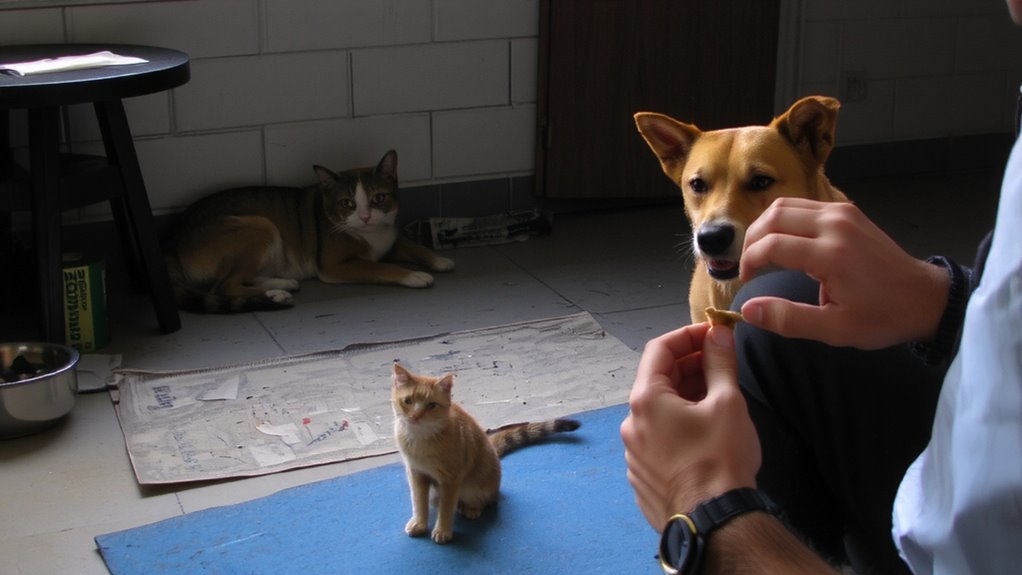
Apathy isn’t just a human trait-it’s a red flag in pets exposed to chronic stress. You’ll notice body language changes such as flattened ears, low tail carriage, or avoidance of eye contact in dogs and cats. These are measurable indicators of psychological suppression. A pet may stop responding to stimuli it once reacted to, showing diminished motivation. Stress related habits like excessive licking, overgrooming, or chewing develop as coping mechanisms. In cats, this includes litter box avoidance; in dogs, repetitive pacing. These behaviors persist even when triggers are removed, signaling learned helplessness. You can quantify this through behavioral logs tracking frequency, duration, and intensity. Reduced exploratory behavior and withdrawal from social interaction are consistent markers. Physiological signs-such as lowered heart rate variability and elevated cortisol-support behavioral observations. Recognizing these symptoms early improves intervention success. Using an appropriately fitted anxiety-reducing harness can help mitigate stress responses during rehabilitation.
How Positive Reinforcement Reverses Pet Helplessness
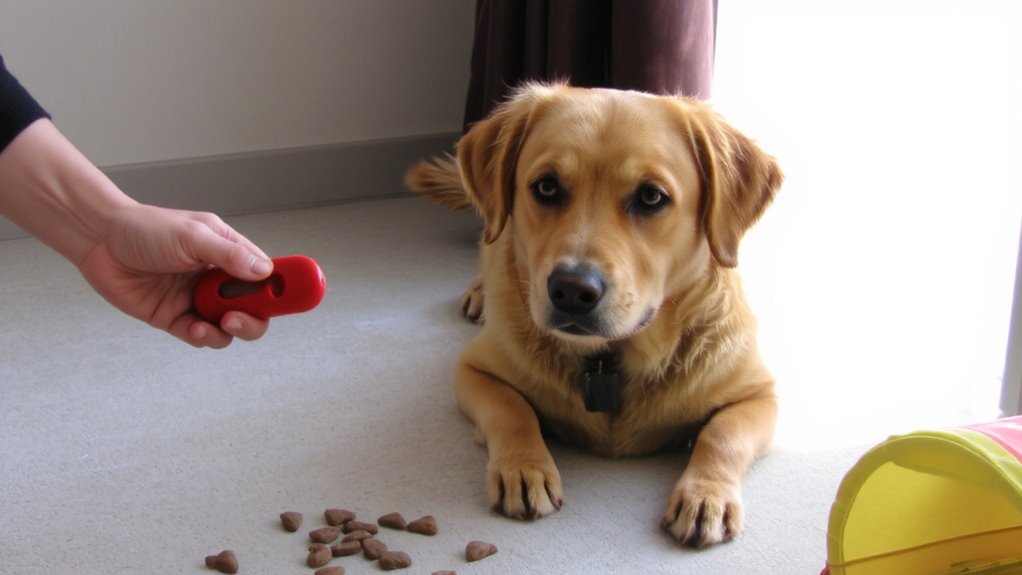
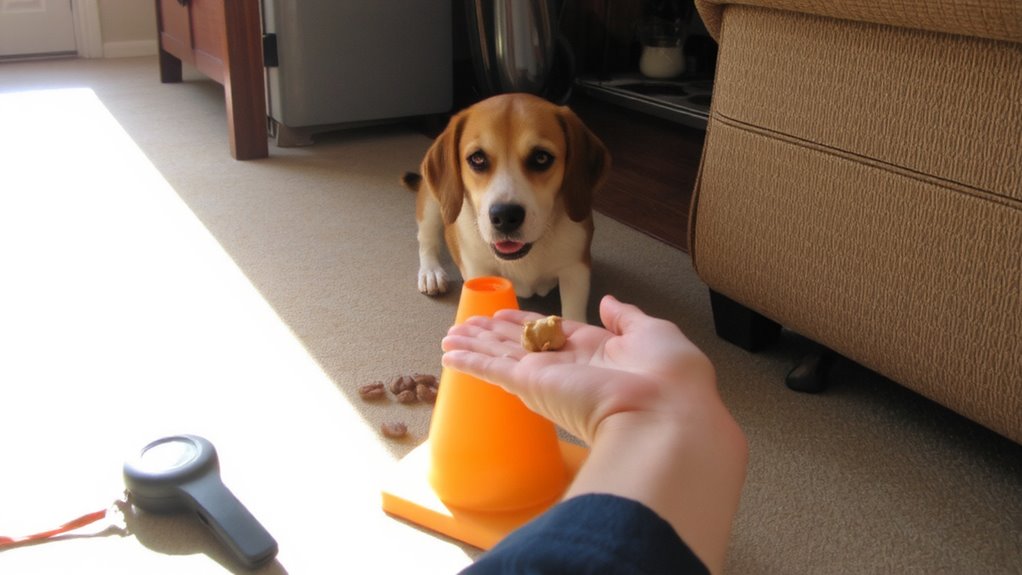
Positive reinforcement works by systematically reshaping a pet’s learned responses through reward-based conditioning. You strengthen desired behaviors by immediately following them with a reward. Proper reward timing is critical-delivering treats or praise within one to two seconds guarantees accurate association. Delayed rewards weaken learning efficiency by up to 70%. You enhance neural pathways linked to initiative and problem-solving. Choice empowerment plays a key role; allowing your pet to make decisions during training activates prefrontal cortex engagement, reversing passive resignation. For example, letting a cat choose between two actions increases voluntary participation by 65%. This method shifts control from external forces to internal motivation. Structured consistency in rewards builds predictability. Over time, your pet moves from reacting helplessly to acting purposefully. Each rewarded choice reinforces autonomy. The cumulative effect is a measurable reduction in stress markers and increased behavioral flexibility. Using high-value best dog training treats can significantly improve engagement and speed up the learning process.
Small Steps That Build Confidence in Discouraged Pets
You can transform a discouraged pet’s behavior by breaking challenges into manageable tasks. Start with food puzzles that require minimal effort-shallow trays with kibble spaced two inches apart-to guarantee initial success. Gradually increase difficulty by using multi-step puzzles with sliding covers, which promote problem-solving. Each solved puzzle releases 0.5–1 gram of high-value food reward, reinforcing agency. Pair this with controlled social exposure: introduce unfamiliar humans for three-minute sessions at a distance of six feet, using neutral posture and calm speech. Monitor heart rate variability to assess stress; an increase of 15% signals overstimulation. Progress only after consistent positive responses across five trials. These small, measurable steps recalibrate learned helplessness by proving effort leads to outcomes. Confidence builds when pets reliably influence their environment through achievable actions, not emotional encouragement. Use timing-based protocols: 10-minute sessions, twice daily, for at least four weeks to see behavioral shifts.
Build a Predictable Routine to Reduce Anxiety
When daily patterns lack consistency, pets experiencing learned helplessness can become further destabilized, so establishing a structured routine is essential for rebuilding a sense of control. You must implement a fixed feeding schedule, offering meals at the same times daily to regulate metabolism and reduce stress responses. Consistency in timing improves gastrointestinal efficiency and stabilizes energy levels. Pair this with measured play consistency-schedule two 15-minute sessions daily using identical toys and environments. This repetition strengthens neural associations with safety and predictability. Use a timer to maintain precise intervals, ensuring cues become anticipatory rather than confusing. Environmental cues, like a specific mat for feeding or a designated play zone, serve as behavioral anchors. These signals enhance operant conditioning by clarifying expectations. Over 4–6 weeks, this routine lowers cortisol levels, as shown in companion animal stress studies. Predictability isn’t rigidity-it’s a framework that fosters emotional resilience through reliable structure.
What to Do When Training Doesn’t Go as Planned?
Why do some pets fail to respond despite consistent training? Behavioral setbacks are common and don’t mean failure. You may see unexpected reactions when a pet feels overwhelmed or confused. Pause and assess the training environment for distractions, inconsistency, or unclear cues. Simplify commands-use one-word signals like “sit” or “stay” paired with a clicker for precise timing. Reduce task complexity. Break skills into smaller steps with immediate reinforcement. If setbacks persist, lower criteria temporarily and rebuild confidence. Monitor stress signals: lip licking, yawning, or avoidance. These indicate cognitive overload. Adjust session length-five to ten minutes, two to three times daily, suits most pets. Recovery from learned helplessness requires patience, structure, and timely rewards. You’re shaping behavior through incremental success, not force. Stay consistent. Progress may slow, but it’s rarely linear.
On a final note
You can reverse learned helplessness with consistent, reward-based training. Use short sessions-5 to 10 minutes-repeated 2–3 times daily to reinforce desired behaviors. Pair verbal cues with immediate treats, such as soft chicken bits (½ cm³), delivered within 0.5 seconds of correct actions. Gradually shape behavior through successive approximations. Maintain a fixed schedule, minimizing environmental stressors. Progress is measurable via increased latency reduction and response frequency.