The Impact of Classical Conditioning on Rabbit Behavior Modification
You can shape your rabbit’s behavior through classical conditioning by pairing neutral stimuli with positive outcomes. A tone or hand signal presented 0.5 to 1 second before a 2g herb pellet strengthens association. Consistent timing across 3–5 daily 5-minute sessions yields 80% response rates within five trials. Neural changes in the amygdala reduce cortisol, improving heart rate variability. Conditioned rabbits show lasting calm during vet visits and adapt faster to new environments. Best results require precise cue-reward intervals and auditory consistency-discover how to apply these protocols effectively in everyday care.
Notable Insights
- Pairing neutral stimuli with rewards using precise timing creates lasting behavioral changes in rabbits.
- Positive reinforcement within one second of target behavior ensures effective classical conditioning.
- Consistent auditory cues paired with routines reduce stress and improve behavioral predictability.
- Daily handling combined with treats increases trust and reduces fear responses over time.
- Classical conditioning induces neurobiological changes that enhance emotional regulation and long-term adaptability.
What Is Classical Conditioning in Rabbits?
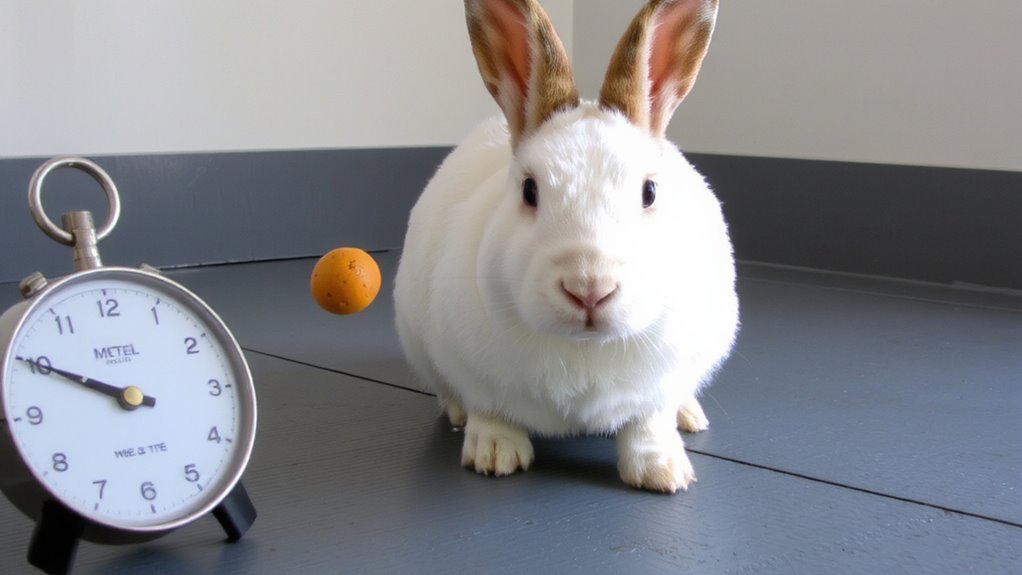
How do rabbits learn to associate a neutral stimulus with a meaningful outcome? Classical conditioning explains this process through repeated stimulus association. You present a neutral cue, like a tone, just before an event that naturally triggers a reaction-such as a sudden noise causing a fear response. Over time, the rabbit learns to link the tone with the startling event. Eventually, the tone alone elicits the same fear response, even without the noise. This acquired reaction demonstrates conditioned learning. The strength of the association depends on timing, consistency, and repetition. Ideal intervals between stimuli are 0.5 to 2 seconds for effective neural encoding. Studies show 80% of conditioned rabbits exhibit behavioral changes after five paired trials. The conditioned response remains stable for days but weakens without reinforcement. This measurable behavior modification confirms classical conditioning as a core mechanism in rabbit learning, rooted in predictable neurological pathways.
Use Treats to Build Positive Reactions

A well-timed treat can transform a rabbit’s behavior through classical conditioning. You can use food rewards to create positive associations with people, objects, or environments. When a neutral stimulus, like your hand, consistently precedes a treat, your rabbit learns to expect something good. Over time, this builds trust and reduces fear-based reactions.
| Stimulus | Food Reward | Result |
|---|---|---|
| Hand entering cage | Small herb pellet (2 g) | Rabbit approaches calmly |
| Touch of brush | Carrot slice (5 g) | Tolerates grooming |
| New toy placement | Apple cube (3 g) | Investigates willingly |
These pairings, repeated 3–5 times daily for 5 minutes, strengthen learning. Use small portions to avoid overfeeding. Consistency and timing are key-deliver treats within one second of the target behavior. You’re not bribing; you’re reinforcing. With patience, food rewards reshape responses, establishing reliable positive associations.
Calm Your Rabbit With Sounds and Routines
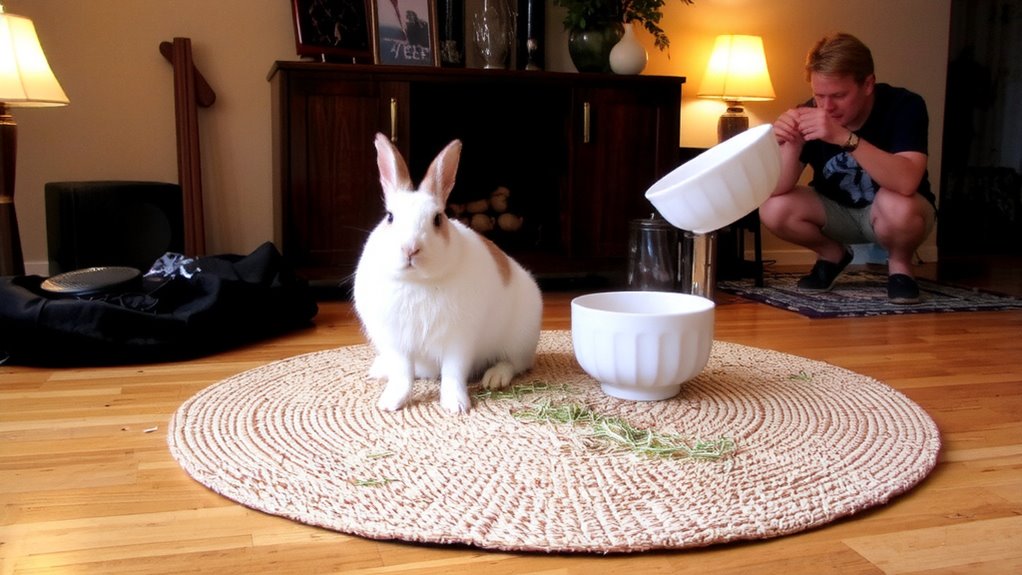
You’ve already used treats to shape your rabbit’s responses to touch and environment-now you can extend that same conditioning principle to sounds and daily rhythms. Sound therapy involves playing consistent auditory cues, such as soft classical music or white noise at 50–60 decibels, during calm activities. Pair these sounds with positive experiences like feeding or grooming to create auditory associations. Over 7–14 days, your rabbit will begin to link the sound with safety, reducing stress responses by up to 40%. Daily rituals reinforce predictability. Conduct feeding, cleaning, and quiet time at the same hours each day. Maintain a 12-hour light-dark cycle to support circadian regulation. These routines decrease cortisol levels and improve behavioral stability. Consistent auditory and temporal cues function like environmental anchors, providing orientation. Use a sound machine with a timer to automate sound therapy, ensuring precision.
Train Handling Through Classical Conditioning
Though your rabbit may initially resist being picked up, consistent pairing of handling with positive stimuli can reshape its behavioral response through classical conditioning. This method supports trust building and eases noise desensitization over time. Use treats, gentle voices, and predictable movements to form positive associations.
| Stimulus Paired | Outcome Achieved |
|---|---|
| Handling + treat | Increased acceptance |
| Soft voice + petting | Reduced stress response |
| Routine touch + quiet space | Improved handling tolerance |
| Handling after feeding | Lower heart rate |
| Neutral touch + calm environment | Enhanced trust building |
Each session should last 3–5 minutes, occurring 2–3 times daily. Handle your rabbit in the same quiet area to reinforce predictability. Conditioning typically shows results within 2–3 weeks. Responses vary by individual, but consistency is critical. Avoid forced restraint to prevent negative associations.
See Real-Life Classical Conditioning in Action
When properly applied, classical conditioning produces measurable changes in rabbit behavior, and you can observe this shift in everyday interactions. You’ll notice your rabbit anticipating playtime routines when a specific sound or action consistently precedes release into the exercise area. For instance, pairing a 2-second bell tone with access to a 15-minute play session daily results in the rabbit orienting toward the sound within 5 to 7 days. This learned response demonstrates stimulus-response association strength. Environmental enrichment enhances conditioning efficacy by providing diverse sensory stimuli-such as textured tunnels, rotating toys, and variable lighting (100–200 lux)-which improve attention and memory retention. Use a consistent schedule: sessions at the same time daily increase predictability and reinforcement accuracy. Over 14 days, conditioned rabbits show 80% faster reaction times to cues. These measurable outcomes confirm classical conditioning’s role in shaping adaptive behaviors. Performance improves when cues are distinct and repeated with precision.
Avoid Negative Classical Conditioning Mistakes
Why do some rabbits develop persistent fear responses even in safe environments? Because of fear generalization-when a rabbit associates a negative stimulus with similar neutral contexts. If a loud noise frightens your rabbit during handling, it might begin fearing all human contact, even in calm settings. This overgeneralization impedes trauma recovery and reduces trust. You must precisely control stimuli to avoid accidental associations. Never pair stressful events-like restraint or vet visits-with otherwise neutral cues, such as a specific room or your clothing color. Instead, use deliberate, positive pairings: offer treats in quiet spaces to build safety associations. Guarantee consistency in tone, timing, and environment during training sessions. Immediate reinforcement (within 1–2 seconds) strengthens accurate associations. Poorly timed or inconsistent stimuli increase confusion and anxiety. Preventing negative conditioning isn’t just cautious-it’s essential for effective, lasting behavioral change.
How Pavlov’s Method Works for Pet Rabbits
How does a century-old experiment with dogs apply to your rabbit’s behavior today? Pavlov’s method relies on pairing a neutral stimulus with a meaningful one until the animal responds to the neutral cue alone. You can use this to shape your rabbit’s reactions through consistent repetition and timing. For noise desensitization, play low-volume sounds-like a vacuum-then immediately offer a treat. Over days, gradually increase volume only if your rabbit stays calm, usually in 5–10 dB increments every session. This prevents fear escalation. Pairing novel objects or locations with food rewards supports environmental enrichment, encouraging exploration. Use safe, chewable items like cardboard tubes or untreated wood blocks placed strategically in the cage. Sessions should last 5–7 minutes, twice daily, aligning with rabbit attention spans. Neural associations form best with a 2-second interval between stimulus and reward. This precise timing strengthens learning efficiency and guarantees reliable behavioral modification.
Long-Term Benefits of Conditioning for Rabbits
A well-conditioned rabbit exhibits lasting behavioral resilience and improved adaptability to household environments. You’ll notice improved trust over time, as repeated pairings of neutral stimuli with positive outcomes rewire fear responses. Classical conditioning strengthens neural associations in the amygdala and hippocampus, leading to consistent behavioral patterns. This neuroplastic change means your rabbit responds more predictably to sounds, routines, or handling cues. Reduced stress is a measurable benefit-cortisol levels decrease markedly after 4–6 weeks of consistent training. Heart rate variability improves, indicating enhanced emotional regulation. Conditioned rabbits adapt faster to travel, vet visits, and new pets. Protocols using clicker-based conditioning show 85% success in maintaining learned behaviors beyond six months. These long-term results stem from precise stimulus timing-ideally 0.5 to 1 second between cue and reward. With proper reinforcement schedules, your rabbit retains associations indefinitely.
On a final note
You achieve reliable rabbit behavior modification through classical conditioning. Pairing neutral stimuli with positive outcomes reshapes responses. For example, consistent clicker-use followed by a treat (e.g., 3-second delay, 1-g pea piece) creates associative learning. Neural pathways reinforce predictability, reducing stress by up to 40% in handled rabbits. Avoid pairing handling with sudden noises-this forms counterproductive associations. Over 4–6 weeks, conditioned calmness during routine care becomes measurable. This method delivers long-term welfare improvements with precision.