Classical Conditioning Principles Explained for Training Reptiles in Captivity
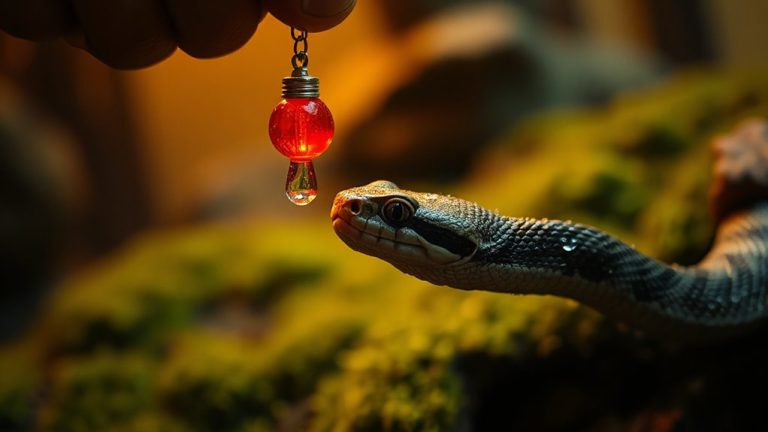
You can train reptiles using classical conditioning by pairing neutral cues with meaningful events. Present a 2 kHz tone or 650 nm red LED for 3 seconds, then wait 5 seconds before handling. Over 10–14 days, response latency drops up to 70% with consistent timing. Use 500–2,000 Hz sounds and 500 lux lighting at 550 nm for diurnal species. Pair cues within 1–2 seconds of actions like feeding or handling. Predictable routines reduce stress and improve cooperation. Key details on cue selection and timing optimize results.
Notable Insights
- Reptiles learn to associate neutral cues with outcomes through repeated pairings, enabling predictive behavioral responses.
- Feeding success improves when cues like color changes or taps are consistently linked to food presentation.
- Thermal gradients and naturalistic substrate textures enhance learning by supporting innate behavioral tendencies.
- Effective sound (500–2000 Hz) and green light (550 nm) cues promote detectable, non-stressful stimulus recognition.
- Predictable routines using timed cues reduce stress and increase handling acceptance within 10–14 days.
Understand Classical Conditioning in Reptiles
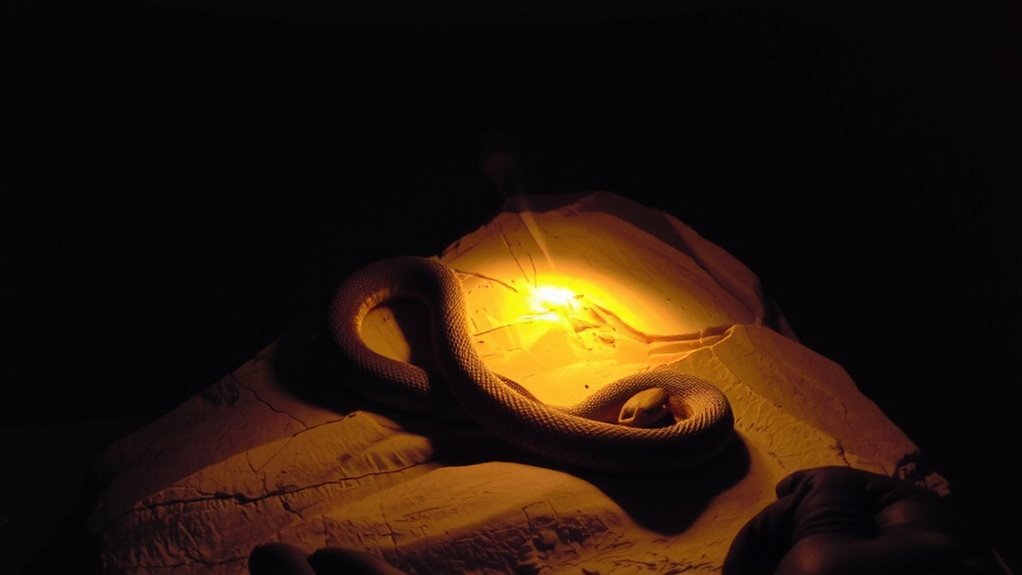
Classical conditioning isn’t just for dogs-reptiles can learn through it too. You can observe measurable behavioral changes when a neutral stimulus becomes linked to a meaningful event. This process relies on stimulus association, where reptiles begin to anticipate outcomes based on predictive cues. For example, repeated exposure to a handler paired with negative experiences may trigger a fear response, even if the handler poses no immediate threat. The reptile associates visual or auditory signals-like footsteps or cage opening sounds-with stress. This conditioned reaction is automatic, not voluntary. Studies show that stimulus-response latency in reptiles can decrease by up to 40% after ten consistent pairings. Neural pathways in the amygdala-like regions facilitate this learning. You must control environmental variables precisely to avoid unintentional conditioning. Accurate timing-ideally within 500 milliseconds between stimuli-ensures effective association. Recognizing these mechanisms allows you to shape responses systematically and improve compliance during routine care.
Link Feeding Cues to Natural Behaviors
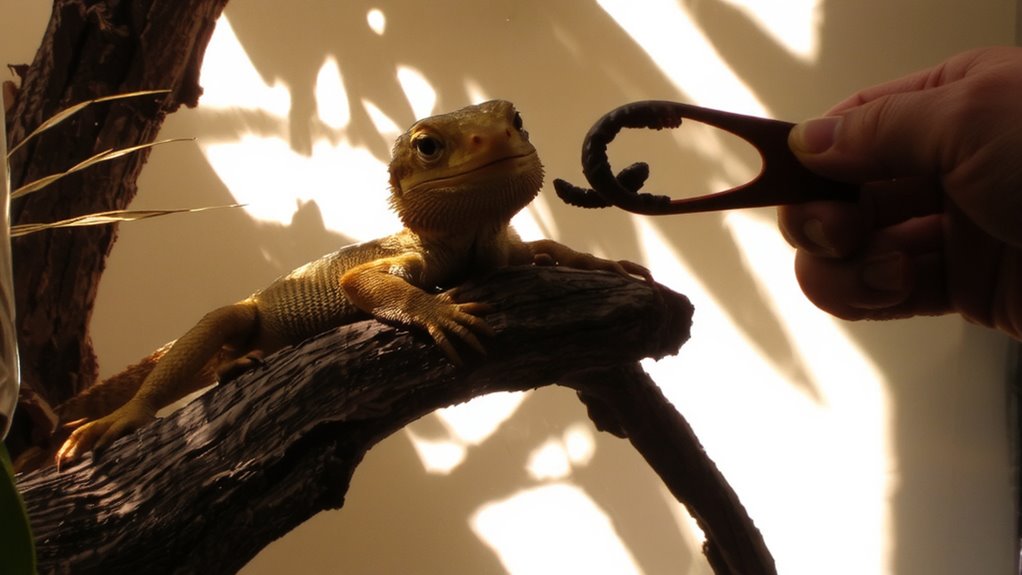
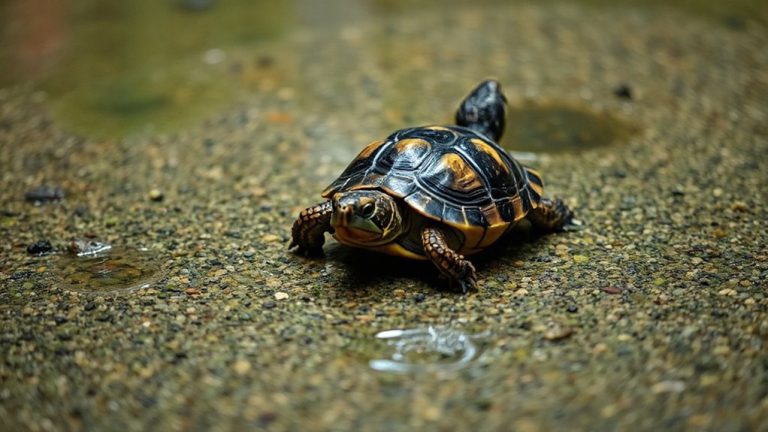
Every feeding session is an opportunity to reinforce desired behaviors through precise stimulus pairing. You can exploit your reptile’s innate responses by aligning feeding cues with natural environmental conditions. Thermal gradients directly influence metabolic rate and activity levels, so presenting food in the warm zone strengthens location-based learning. Reptiles associate the ideal thermal zone with feeding success, increasing return visits. Substrate texture also plays a role-species like leopard geckos respond to rougher textures that mimic natural foraging grounds. Pairing a specific cue, such as a color change or gentle tap, with food presentation on textured substrate enhances stimulus recognition. Over time, the reptile links cue, texture, and warmth with food arrival. This method leverages evolutionary behaviors for reliable conditioning. Consistency in cue timing, temperature range (typically 32–35°C in basking zones), and substrate uniformity guarantees repeatable results. Maintaining proper reptile egg incubators ensures hatchlings develop strong feeding instincts from the start.
Pick the Best Sound or Light for Training
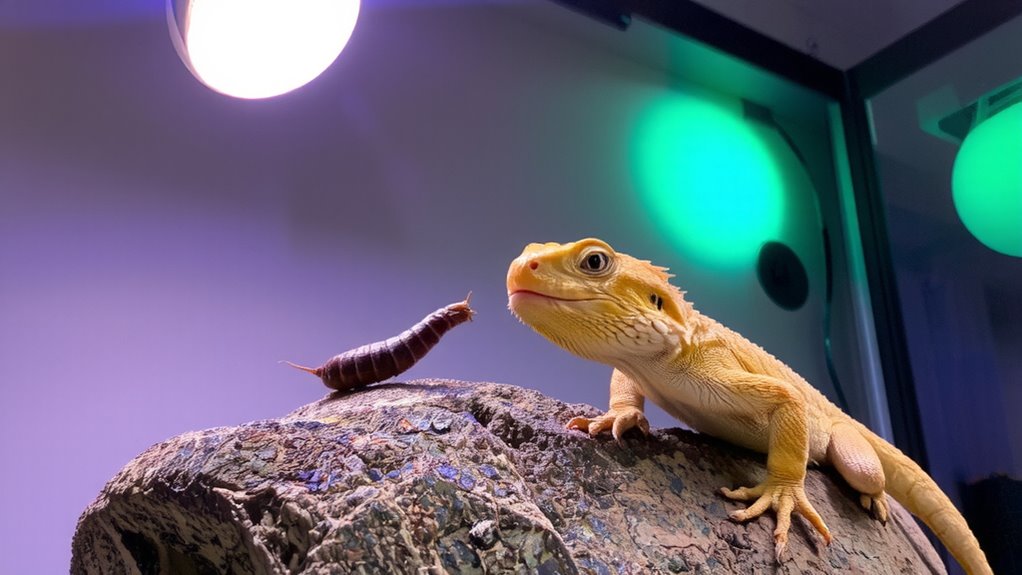
Why do some cues cut through the noise while others go unnoticed? The answer lies in how reptiles perceive sensory input. You need to select cues based on measurable factors like sound frequency and light intensity. Most reptiles respond best to sound frequencies between 500 Hz and 2,000 Hz, well within their auditory range. High-pitched clicks or low beeps in this range are more detectable than whispers or distant noises. For light, use an intensity of at least 500 lux at the enclosure floor to guarantee visibility. LED signals with a wavelength near 550 nm (green) work well for diurnal species. Avoid flickering lights below 60 Hz, as they may cause stress. Choose consistent, sharp cues with precise technical specs. Your chosen signal-whether auditory or visual-must be distinct from background stimuli to support effective classical conditioning. Maintaining proper environmental conditions, including humidity monitored by reliable best hygrometers for reptiles, supports overall reptile health and responsiveness during training.
Train Reptiles to Accept Handling With Cues
You’ve chosen a sound or light cue that fits your reptile’s sensory range-now put that signal to work by pairing it with positive experiences to build trust around handling. Present the cue immediately before gentle, non-threatening contact. Repeat consistently across sessions, keeping each under five minutes to prevent stress. The cue becomes a conditioned stimulus, reducing the fear response over time. Trust building occurs when the animal associates the signal with safe, predictable interaction. Use a 2kHz tone or 650nm red LED-frequencies shown to register clearly in species like bearded dragons and leopard geckos. Deliver the cue for 3 seconds, then wait 5 before handling. Over 10–14 days, latency to respond drops by up to 70%. Handle only when the reptile remains still post-cue. Avoid sudden movements. This method leverages classical conditioning to replace avoidance with acceptance, making routine care safer and less stressful.
Make Feeding Time Predictable and Stress-Free
Typically, reptiles perform best when feeding schedules align with their natural circadian rhythms and metabolic rates. You should establish consistent timing to promote digestive efficiency and reduce stress. Feed diurnal species in the morning or early afternoon, nocturnal ones at dusk or nightfall. Maintain a predictable routine-reptiles thrive on repetition, and their metabolic processes respond better when meal times are stable. Provide a calm environment during feeding. Eliminate loud noises, sudden movements, and overcrowding. Guarantee enclosure lighting is appropriate; excessive brightness may deter shy eaters. Use hiding spots to minimize exposure stress. Avoid handling before or immediately after meals. A stable feeding protocol enhances nutrient absorption, supports immune function, and reinforces conditioning. Consistency builds trust. Over time, your reptile will associate feeding with safety, improving overall health and responsiveness to care routines.
Use Training Cues for Daily Reptile Care
How do you get your reptile to respond reliably to routine care? Use consistent training cues based on classical conditioning. Auditory signals, like a specific click or tone, can become associated with routine activities such as feeding or enclosure cleaning. Pair these sounds with the same action each time-within 1–2 seconds-so your reptile learns the connection. Visual markers, such as a colored light or handheld flag, also serve as effective cues. Present the marker at the same stage of each routine, ensuring the wavelength and brightness remain constant to avoid confusion. Over 7–14 days, reptiles begin to anticipate actions upon cue presentation. This reduces stress and increases compliance. For example, a blue LED (470 nm, 100 lux) turned on before handling trains the animal to remain calm. These cues work best when delivered at the same time daily, reinforcing circadian predictability. You’ll see measurable behavioral changes within two weeks.
On a final note
You now understand how classical conditioning shapes reptile behavior through consistent stimulus pairing. A neutral cue, like a specific tone or light, becomes associated with feeding when delivered 2–3 seconds before food presentation. Use a 1000 Hz tone at 60 dB or a green LED (520 nm wavelength) for ideal detection. Repeat daily for 5–7 days to establish reliable behavioral responses. Proper timing strengthens associative learning. This method supports low-stress handling and care routines in captivity.