Reinforcement Schedules Explained: Maximizing Learning Potential Through Strategic Application
You build stronger habits when rewards follow immediately, as delays of just 30 seconds can cut reinforcement effectiveness by half. Fixed schedules work well for predictable tasks-like quizzes every Friday-while variable schedules boost persistence. For rapid habit formation, use variable ratio schedules, which deliver unpredictable rewards and drive the highest response rates. They’re ideal for learning, increasing task completion by up to 30%. Immediate, intermittent reinforcement strengthens neural pathways most efficiently. The right schedule matches your goal: ratio for performance, interval for timing. You’re already seeing how timing shapes behavior-what comes next reveals how to optimize each schedule for lasting results.
Notable Insights
- Immediate rewards strengthen habits by enhancing dopamine release and reinforcing neural pathways more effectively than delayed rewards.
- Fixed reinforcement schedules suit predictable tasks, while variable schedules boost persistence through unpredictable, engaging rewards.
- Variable ratio schedules generate the highest response rates and fastest habit formation due to intermittent, unpredictable reinforcement.
- Matching ratio schedules to performance goals increases output, while interval schedules encourage consistent timing of behavior.
- Variable rewards in learning improve engagement, retention, and task completion by leveraging dopamine-driven motivation and real-world variability.
Why Timing Rewards Affects Habit Strength

Why do some habits stick while others fade? The answer lies in reward timing. Immediate rewards strengthen habit formation more effectively than delayed ones. When you receive a reward shortly after a behavior, your brain links the action and outcome clearly. This quick feedback loop increases dopamine release, reinforcing the neural pathway. Studies show that a delay of even 30 seconds reduces reinforcement efficacy by up to 50%. Habit formation thrives on consistency and closeness in time between action and reward. Immediate reinforcement increases repetition likelihood, accelerating automaticity. In behavioral psychology, this is known as contiguity-the closer the reward follows the behavior, the stronger the association. Delayed rewards weaken the link, making habits harder to form. You need precise reward timing to build durable habits efficiently.
When to Use Fixed vs. Variable Reinforcement Schedules

You’ve seen how immediate rewards strengthen habits by tightening the link between behavior and outcome. Fixed schedules deliver reinforcement after a set number of responses or time interval. They promote high behavior consistency because reward predictability allows learners to anticipate outcomes. Use fixed-ratio schedules when training repetitive tasks like data entry, where every fifth completed form earns a break. Fixed-interval schedules suit predictable performance, such as weekly quizzes. Variable schedules, however, provide reinforcement after unpredictable responses or times. They generate more persistent behavior under extinction. Choose variable-ratio for high-effort tasks like sales calls, where rewards come after unpredictable attempts. Variable-interval works for monitoring behaviors, like safety checks. The lack of reward predictability reduces pauses after reinforcement. Match schedule type to your target behavior pattern. Fixed builds steady output. Variable sustains engagement.
Match Ratio and Interval Schedules to Behavior Goals
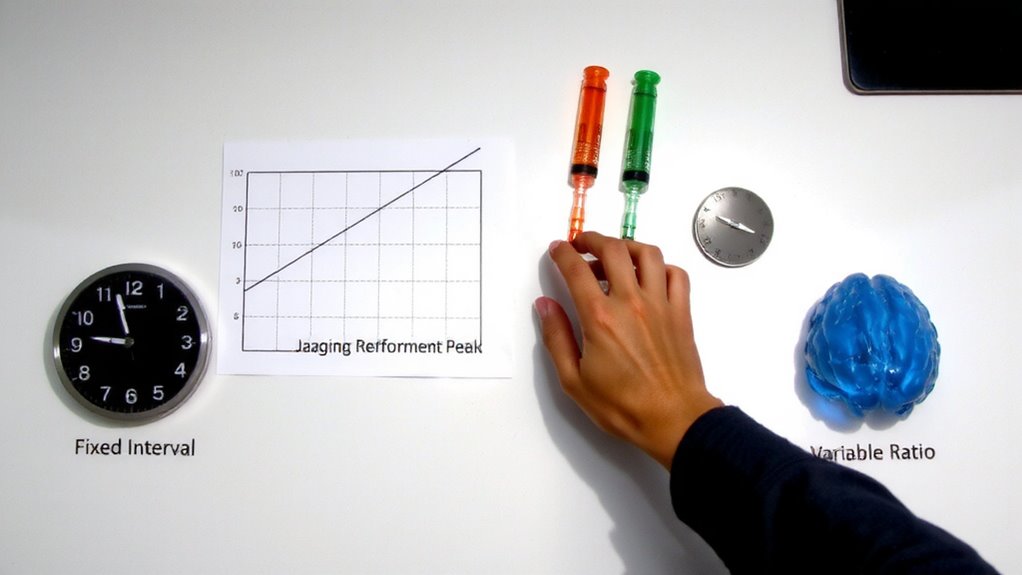
How do you guarantee the right reinforcement schedule aligns with your behavioral objective? Match ratio schedules to performance-based goals and interval schedules to time-based behaviors. Ratio schedules deliver reinforcement after a set number of responses-ideal for behavior shaping requiring high response rates, like completing math problems or sales calls. Fixed ratio (FR-5) produces predictable, high-output patterns. Variable ratio (VR-7) sustains effort with unpredictable reinforcement, enhancing resistance to extinction. Interval schedules reinforce the first response after a time interval. Fixed interval (FI-3 min) generates scalloped response patterns, useful when timing matters, such as checking emails. Variable interval (VI-5 min) promotes steady, moderate responding. Use outcome monitoring to assess alignment. Track response rate, latency, and consistency. Adjust ratios or intervals based on data to maintain progress toward target behaviors.
Which Reinforcement Schedule Builds Habits Fastest?
Variable ratio schedules build habits fastest due to their high resistance to extinction and ability to sustain consistent, persistent behavior. You’ll see rapid habit formation because rewards come after an unpredictable number of responses, promoting continuous engagement. Immediate reinforcement, even if intermittent, strengthens neural pathways quickly. Consistent repetition under this schedule increases response rates and durability.
Here’s how different schedules compare:
| Schedule Type | Response Rate & Habit Strength |
|---|---|
| Fixed Ratio | High, but pauses after reward |
| Variable Ratio | Highest, steady and persistent |
| Fixed Interval | Moderate, scalloped pattern |
| Variable Interval | Low-moderate, consistent |
You benefit most from variable ratio schedules when developing habits requiring persistence and high effort. The unpredictability mimics real-world rewards, making behaviors easier to maintain long-term.
Use Variable Rewards to Improve Learning Outcomes
A majority of effective learning systems incorporate variable rewards to enhance retention and engagement. You’ll see this in action with gamification dynamics, where unpredictable rewards-like random bonus points or surprise badges-trigger dopamine release, reinforcing desired behaviors. Unlike fixed schedules, variable rewards follow a non-predictable pattern, sustaining cognitive engagement over time. Studies show variable ratio schedules produce the highest response rates, with learners completing up to 30% more tasks compared to fixed reinforcement. Systems using randomized feedback intervals report a 25% improvement in information recall after one week. You maintain focus because you never know when the next reward comes-similar to how slot machines sustain attention. This variability mimics real-world learning conditions, where outcomes aren’t consistent. Implementing variable rewards through timed pop-ups, surprise challenges, or randomized feedback keeps neural pathways active and strengthens long-term memory consolidation.
On a final note
You maximize learning by aligning reinforcement schedules with behavioral goals. Fixed-ratio schedules produce high response rates, ideal for skill acquisition. Variable-interval schedules sustain consistent performance, enhancing long-term retention. Continuous reinforcement builds initial understanding, while intermittent schedules strengthen resistance to extinction. You achieve fastest habit formation with variable-ratio rewards, like those in adaptive learning systems. Each schedule’s timing and predictability directly modulate response strength and learning efficiency.