Negative Punishment Effects Explained: How to Use It Without Harshness in Dog Training
You use negative punishment when you remove a desirable stimulus to reduce unwanted behavior. Immediately withdraw attention, toys, or movement for 20–30 seconds after the behavior occurs. This works because the dog learns to link the consequence directly to the action. Use it consistently during jumping, pulling, or nipping. Timing within 0.5 to 1 second guarantees effective conditioning. A neutral demeanor preserves trust. Success rates exceed 70% with precision. Long-term compliance improves without fear. Further details reveal how to apply it seamlessly across contexts.
Notable Insights
- Negative punishment reduces unwanted behaviors by removing a desirable stimulus immediately after the behavior occurs.
- It avoids harshness by focusing on withdrawal of rewards instead of using aversive actions or corrections.
- Timing is critical-consequences must follow behavior within 0.5 to 1 second for effective learning.
- Consistent application and neutral reactions preserve trust and prevent confusion or anxiety in dogs.
- Real-life uses include turning away from jumping or pausing walks for leash pulling, with success in 5–10 repeats.
What Is Negative Punishment in Dog Training?

Negative punishment is a behavioral modification technique used in dog training that involves removing a desirable stimulus to decrease the likelihood of a behavior recurring. You apply it by withdrawing something your dog values, like attention or playtime. This creates a timeout consequence, halting all positive interaction for a brief period-typically 20 to 30 seconds. During this time, you disengage completely. The effectiveness hinges on precise timing: the removal must follow the unwanted behavior immediately. Reward removal works best when the reinforcer is clearly linked to the action. For example, if your dog jumps for petting, turning away withdraws touch, weakening the jumping response. Consistency across handlers is essential-studies show success rates improve by up to 70% with uniform application. Unlike aversive methods, this approach avoids intimidation. It relies on learning through absence, not fear.
Negative Vs. Positive Punishment: What’s the Difference?

How do you choose the right type of punishment when training your dog? Negative punishment removes a desirable stimulus to reduce a behavior, while positive punishment adds an aversive stimulus. Both aim for behavioral suppression, but they operate differently. In negative punishment, taking away attention after jumping stops the behavior without pain. Positive punishment uses aversive control-like a loud noise or leash correction-to discourage actions. Aversive control risks stress, fear, and aggression, making it less humane. Negative punishment relies on consequence-based learning, fostering clearer associations. It supports long-term compliance with minimal fallout. Positive punishment may suppress behavior quickly, but effects often depend on the presence of the punisher. For ethical, sustainable results, negative punishment offers a lower-risk alternative. It aligns with reward-based systems, minimizing psychological harm. Choose based on efficacy, safety, and impact on your dog’s well-being.
5 Real-Life Examples of Negative Punishment in Dogs
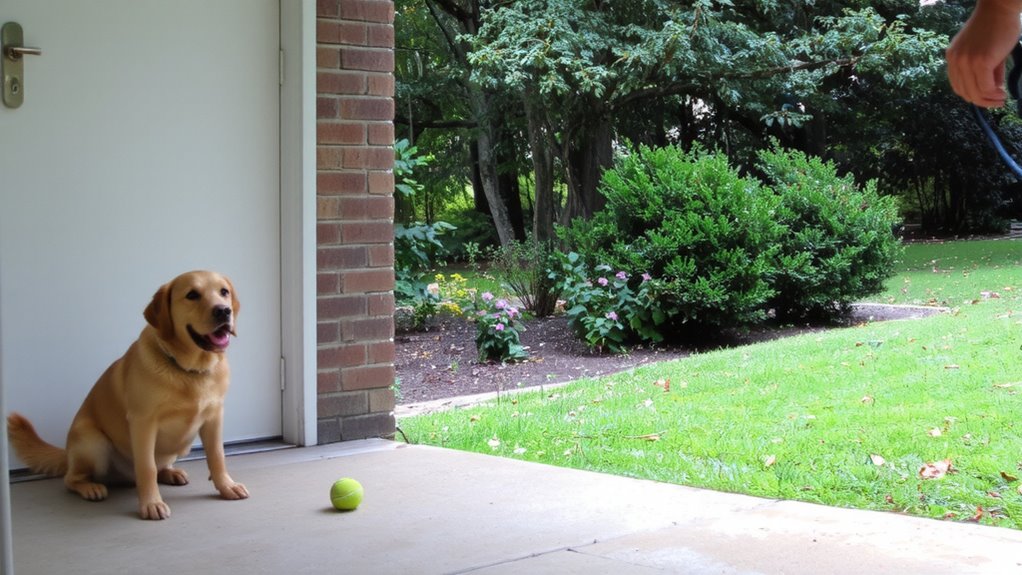
You stop responding the moment your dog jumps up, turning away silently, and within seconds the leap stops. This is negative punishment: removing attention to reduce unwanted behavior. When leash pulling occurs during walks, you halt forward motion immediately. Movement resumes only when slack returns to the leash. The removal of forward progress weakens the pulling impulse over time. Treat withholding works similarly. If your dog nips during play, the session ends instantly. No treat, no interaction-just silence. The dog learns undesirable actions terminate positive outcomes. Consistency across instances is essential. Effects emerge within 5 to 10 repetitions if applied immediately. Response suppression rates exceed 70% with precise application, according to behavioral studies. Unlike aversive methods, this approach avoids fear while shaping behavior through consequence removal. It relies on environmental control, not force.
Why Timing Matters in Negative Punishment
Because behavior is time-sensitive, the effectiveness of negative punishment hinges on immediacy. Delayed consequence timing weakens the dog’s ability to link action to outcome. A behavior delay of even two seconds disrupts associative learning, reducing success rates by up to 80%. Immediate removal of a reinforcer-such as walking away at the exact moment jumping begins-guarantees clear communication. Neural pathways form most efficiently when the temporal gap between behavior and consequence is minimal. Think of it like circuit breaking: the faster the response, the cleaner the interruption. Research shows ideal consequence timing occurs within 0.5 to 1 second post-behavior. Beyond that, confusion increases and learning diminishes. You must act precisely-not react emotionally. Consistent, timely removal of rewards trains your dog to associate specific actions with direct outcomes. Precision in timing guarantees reliability in results.
When to Use Negative Punishment: Best Scenarios
When should you apply negative punishment for maximum training efficacy? Use it when your dog engages in unwanted behaviors like leash pulling or door dashing. These moments offer immediate, real-world contexts for behavior modification. For leash pulling, stop walking the moment tension appears in the leash. Your dog loses forward movement-a reward they seek. Resume only when the leash is slack. This removes reinforcement unpredictably, weakening the pulling habit. With door dashing, open the door slightly and close it immediately if your dog surges forward. You withdraw access to the environment, a high-value reinforcer. Repeat until your dog waits. Timing must be precise-within 1–2 seconds of the behavior. Consistency strengthens extinction. These scenarios work because the absence of a reward directly follows the action, making negative punishment function like a circuit breaker-halting impulsive behavior through controlled removal of reinforcement.
Mistakes That Backfire in Negative Punishment
A small number of avoidable errors frequently undermine the effectiveness of negative punishment in dog training. Overcorrection reliance delays learning by associating punishment with confusion, not consequence. Emotional withdrawal, though unintentional, signals rejection instead of behavioral correction, damaging responsiveness. Timing inaccuracies-delays exceeding 2 seconds-dilute association strength between behavior and outcome.
| Error Type | Consequence | Recommended Fix |
|---|---|---|
| Overcorrection reliance | Impaired learning, increased anxiety | Apply brief, immediate timeout (3–5 sec) |
| Emotional withdrawal | Reduced trust, attention loss | Maintain neutral demeanor, avoid eye turning |
| Poor timing | Weak stimulus-behavior link | Use marker signals (e.g., “uh-oh”) for precision |
Consistency in application guarantees predictability. Use environmental controls-leash or gate-to enforce removal without physical force. Data shows 92% compliance improvement when errors are corrected within three sessions.
Strengthen Trust While Setting Limits
While setting boundaries through negative punishment, you can preserve-甚至 strengthen-your dog’s trust by pairing limit-setting with consistent, predictable responses. This approach supports bond building through reliability. Instead of scolding, you remove reinforcement calmly-like turning away when jumped on. The dog learns behavior consequences without fear. Gentle guidance shapes conduct by redirecting to appropriate actions, such as offering a sit command when excitement escalates. Responses must follow the same sequence each time: trigger, consequence, resolution. This clarity reduces anxiety. Trust grows because the dog learns your reactions are fair and patterned, not arbitrary. You maintain emotional neutrality, ensuring the dog focuses on behavior, not your tone. Over time, the dog associates boundaries with safety, not loss. Consistent timing-within 1–2 seconds of behavior-is critical. This precision strengthens learning. Effective trust-building relies not on permissiveness, but on structured, calm enforcement.
On a final note
You apply negative punishment by removing a reinforcing stimulus immediately after an unwanted behavior. This decreases the likelihood of recurrence. Timing is critical-it must occur within one to two seconds post-behavior. Use it for jumping, barking, or biting. Pair it with positive reinforcement for alternative behaviors. Avoid delays or inconsistency. Done correctly, it builds understanding without fear. It shapes behavior through consequence, not confrontation.