Marker Training: Enhancing Performance in Show Cats Through Precision Timing
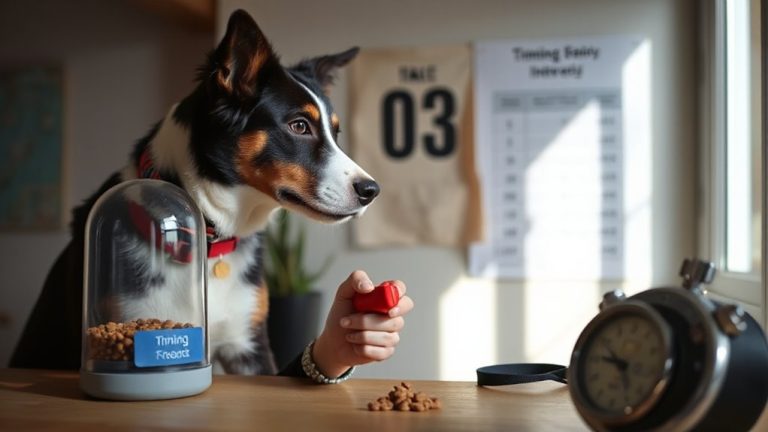
You train your show cat with a 2,800 Hz clicker to mark desired behaviors instantly, ensuring neural associations form accurately. Deliver high-value, bite-sized treats within one second of the click. Use a durable clicker with a 1.5-inch rigid body and millisecond response. Keep sessions to 3–5 minutes, twice daily. Precision timing strengthens learning up to 70%. Consistent pairing builds reliable performance-discover how elite trainers optimize every repetition.
Notable Insights
- A distinct click or verbal marker precisely signals desired behaviors in show cats, strengthening learning through immediate feedback.
- Marker timing must be accurate within 0.5 seconds to avoid reinforcing unwanted behaviors and ensure clarity.
- High-value, low-calorie treats delivered within one second of the marker solidify the cat’s association between action and reward.
- Short, frequent training sessions of 3–5 minutes maintain focus and prevent fatigue in show cats during skill development.
- Consistent use of a 2,800 Hz auditory marker enhances responsiveness, improving performance in complex show routines.
Defining Marker Training for Show Cats
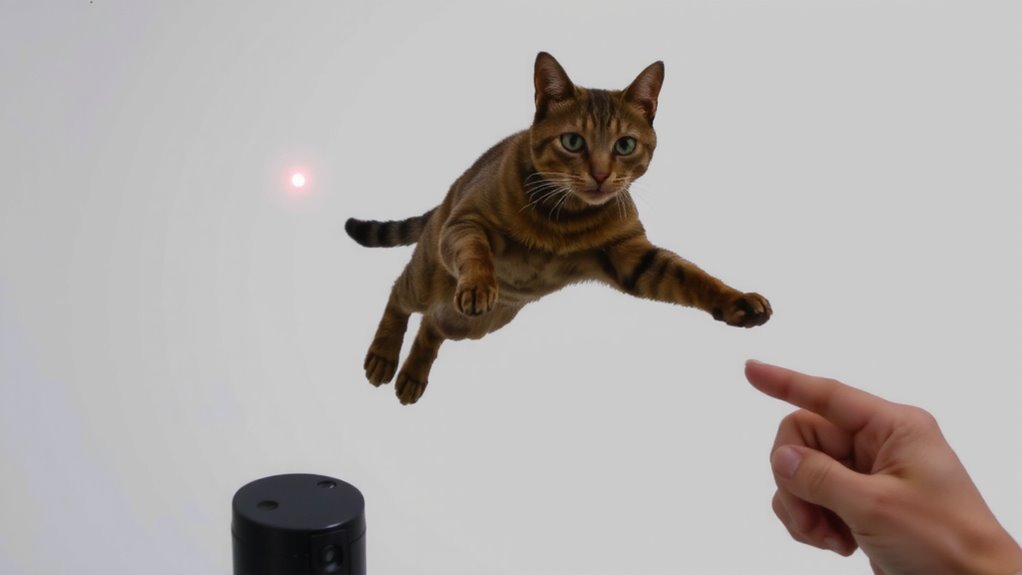
While you may be familiar with basic cat training, marker training is a specific operant conditioning technique that uses a distinct signal-usually a click or verbal cue-to precisely communicate the exact moment a desired behavior occurs. You establish clicker association by pairing the click sound with an immediate reward, typically a small treat. This creates a reliable neural link: the cat learns the click predicts a reward. Consistent repetition over 5–10 short sessions solidifies this connection. Reward consistency is critical-delivered within one second of the marker guarantees accurate behavioral reinforcement. Inconsistent timing or sporadic rewards weaken learning efficiency. Use high-value, easily consumable treats (approximately 1–2 calories each) to maintain focus during training. Sessions should last 3–5 minutes, conducted 2–3 times daily. Marker training enhances precision in shaping complex show behaviors like stance holding or directed gaze. It’s efficient, measurable, and scientifically grounded in behavioral psychology. For cat trainers seeking reliable tools, selecting the right dog training clickers can offer similar benefits when adapted for feline use.
Why Timing Matters in Marker Training
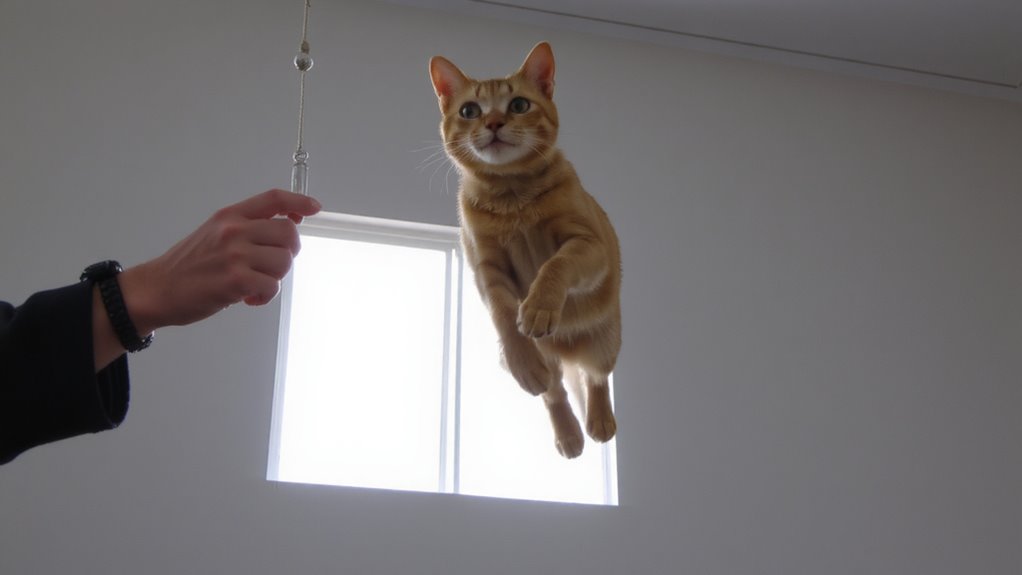
How do you make certain your cat associates the click with the exact behavior you want? Precision timing is critical. A delay of even 0.5 seconds can mark an incorrect action, leading to confusion. Marker training relies on immediate feedback to connect behavior with consequence. The click must occur at the exact moment the desired behavior happens-no earlier, no later. This accuracy strengthens learning through operant conditioning. Immediate feedback solidifies the link between action and reward, increasing repetition. Without precision timing, your cat may repeat unwanted behaviors, thinking they earned the click. Studies show correctly timed markers improve learning speed by up to 70%. Use consistent, split-second responses to maintain clarity. Your timing directly impacts training efficiency. Delayed clicks degrade performance, reduce accuracy, and prolong sessions. Master precision timing to guarantee your cat learns quickly and correctly. Effective marker use demands discipline and focus-your timing is the foundation.
Essential Tools for Marker Training Success
A reliable clicker is your foundation. Clicker devices produce a consistent, sharp auditory signal that marks desired behavior with millisecond precision. Opt for a durable metal or rigid plastic model, approximately 1.5 inches in diameter, with a responsive button mechanism to guarantee rapid activation. The sound frequency should be between 2,500 and 3,000 Hz-clear enough for acute feline hearing but not startling. Models with a wrist lanyard or keychain clip improve accessibility during extended sessions. Pair your clicker with strategic reward selection. Use high-value, bite-sized treats-approximately 5 to 8 calories each-such as freeze-dried chicken or commercial training morsels under 0.25 inches in size. Immediate delivery within 1–2 seconds post-click maintains associative strength. Store rewards in a sealable pouch to preserve freshness and minimize scent dispersion during training.
Step-by-Step Marker Training for Show Cats
What does it take to shape flawless show behaviors with precision? You start by pairing a distinct auditory marker-like a click-with immediate reinforcement. Begin in a quiet environment, using treats the cat consistently responds to, such as freeze-dried chicken pieces no larger than 0.5 cm³. Shape simple behaviors first: target touching or sitting on cue. Accurately time the marker to capture the exact moment of correct performance-ideally within 0.5 seconds. Gradually chain behaviors, increasing complexity. Integrate leash walking by marking steady, calm movement beside you, using a lightweight 1.2-meter nylon harness. Simultaneously implement grooming desensitization: mark calm reactions during brief brushing sessions, starting at 10-second intervals. Each session lasts 4–7 minutes to maintain focus. Repeat daily, tracking progress in a training log. Over 3–4 weeks, conditioned responses become reliable under low-distraction conditions.
Fixing Common Marker Training Problems
Consistent marker use builds reliable responses, but even well-structured training can hit snags. You must address timing errors immediately-marking even a half-second late degrades behavior consistency. Your marker should coincide precisely with the desired action; use a consistent auditory signal like a clicker with a frequency of 2,800 Hz for ideal cat responsiveness. Inconsistent rewards confuse cats, undermining reward clarity. Deliver the treat within one second of the marker to strengthen the association. If your cat hesitates or performs incorrectly, avoid repeating the marker-this dilutes its predictive value. Instead, reset with a neutral signal and restart the cue. Limit sessions to 3–5 minutes to maintain focus. Use high-value rewards, such as freeze-dried chicken pieces no larger than 0.25 inches, to sustain motivation. Troubleshoot poor response rates by auditing your timing and ensuring reward clarity aligns with behavior consistency.
How Top Show Cats Succeed With Marker Training
You’ll notice top show cats respond to markers with split-second precision, and that’s no accident. Their success stems from consistent marker timing paired with strategic breeding selection. Breeders prioritize cats with sharp focus, responsive temperaments, and physical symmetry-traits that enhance trainability. These innate qualities, refined over generations, create a foundation ideal for marker conditioning. During training, a click or sound immediately follows desired behavior, reinforcing correctness within 0.5 seconds for peak association. This precision builds reliable performance under show evaluation conditions. Judges assess poise, posture, and responsiveness-metrics directly influenced by training fidelity. Cats trained with exact timing exhibit steadier gait, controlled movement, and faster cue response. Marker training, as a result, doesn’t just shape behavior-it aligns genetic potential with technical execution. Breeding selection amplifies results, ensuring only the most trainable phenotypes advance.
On a final note
You now understand marker training’s role in sharpening show cat performance. Precise timing-within 0.5 seconds of desired behavior-ensures accurate associations. A 2,000 Hz audible clicker or consistent verbal marker works effectively. Reinforcement follows immediately, strengthening neural links. Consistency across 10–15 minute daily sessions yields measurable gains. Top performers achieve 90%+ accuracy in show routines through calibrated repetition and split-second feedback loops.