Memory Formation in Animals: an Exploration Into How Pets Learn New Tricks
You train your pet by pairing cues with actions, forming associative memories through repeated practice. Each correct response strengthens synaptic connections in the brain, especially when rewards follow within seconds. Repetition boosts myelination and precision in neural circuits, shifting behavior from effortful recall to automatic performance. Dogs retain commands via emotional imprinting, while cats and birds rely on spatial and episodic-like memory. Best learning occurs in 5–8 minute windows with immediate reinforcement. Continue to discover how species-specific neural pathways shape lasting recall.
Notable Insights
- Pets learn tricks through associative memory, where neutral cues become linked to actions via repeated pairings with rewards.
- Repetition strengthens neural pathways, turning effortful responses into automatic behaviors over multiple training sessions.
- Immediate rewards boost memory retention by activating dopamine-driven brain circuits involved in long-term learning.
- Short-term memory in pets is fleeting and limited, requiring timely repetition to transfer learning into long-term storage.
- Dogs, cats, and birds use species-specific memory strategies shaped by their natural behaviors and brain structures.
How Animals Use Associative Memory to Learn
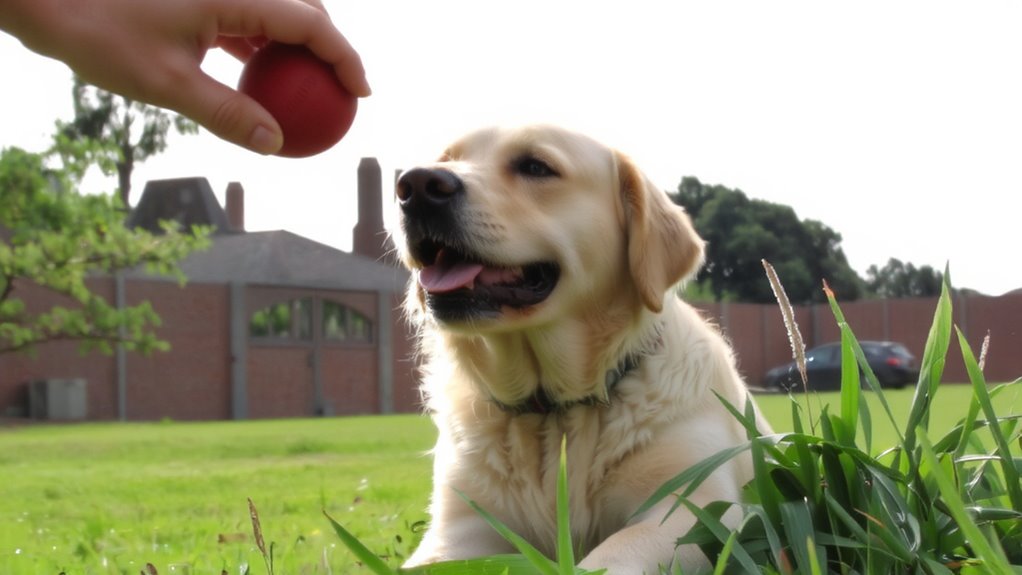
When an animal encounters a stimulus repeatedly paired with a significant outcome, it begins to form an associative memory, linking the two events in its neural circuitry. You see this in classical conditioning, where a neutral stimulus becomes meaningful through stimulus pairing. For example, a dog learns to associate a bell with food after repeated sessions. The auditory cue activates the temporal lobe, while the salivary response is mediated by the brainstem. Synaptic plasticity in the amygdala strengthens this connection over time. Neural firing patterns synchronize between regions, encoding the association within milliseconds. The conditioned stimulus eventually triggers the response autonomously. This process isn’t limited to dogs-it occurs across species, from rodents to birds. The reliability of learning depends on timing, consistency, and biological relevance. Stimulus pairing must occur within a 500-millisecond window for peak conditioning. These mechanisms underlie how animals adapt behavior using environmental cues efficiently.
Why Repetition Makes Training Stick
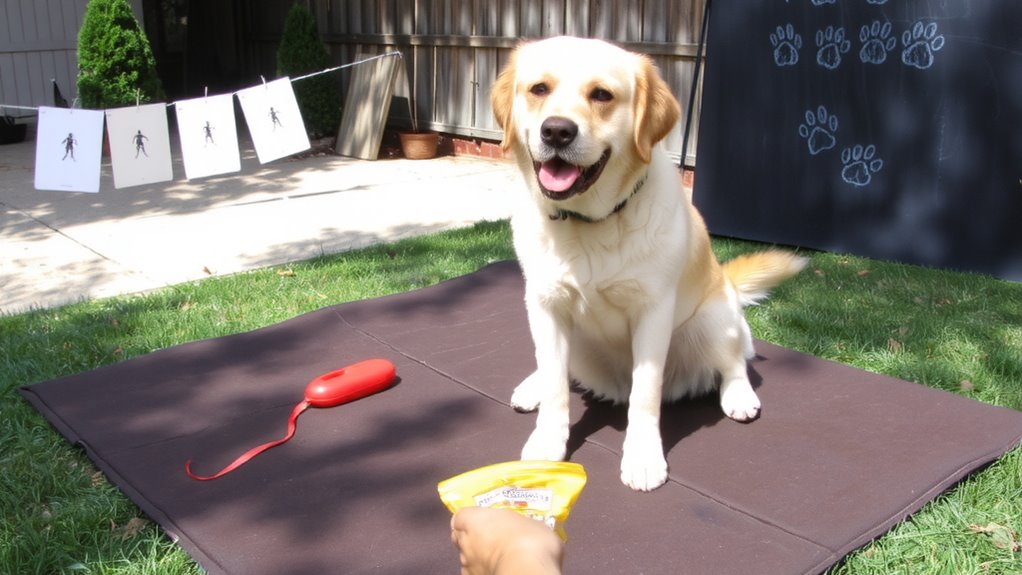
Because neural circuits require consistent activation to stabilize, repetition isn’t just helpful-it’s essential for making training stick. You strengthen synaptic connections each time your pet performs a learned behavior, enhancing neural reinforcement. Behavioral conditioning relies on repeated stimuli and responses to form reliable memory pathways. Without repetition, the brain treats the action as random, not meaningful.
| Training Session | Correct Responses |
|---|---|
| 1 | 30% |
| 3 | 65% |
| 5 | 88% |
Data shows performance improves with repetition. This pattern reflects synaptic efficiency gains in motor and associative brain regions. Each repetition increases myelination and neurotransmitter precision, improving response speed and accuracy. You’re not just practicing-you’re rebuilding your pet’s neural architecture. Behavioral conditioning becomes durable only when repeated under consistent conditions. Over time, the behavior shifts from effortful recall to automatic response, a hallmark of long-term memory consolidation through neural reinforcement.
How Rewards Build Long-Term Pet Memory
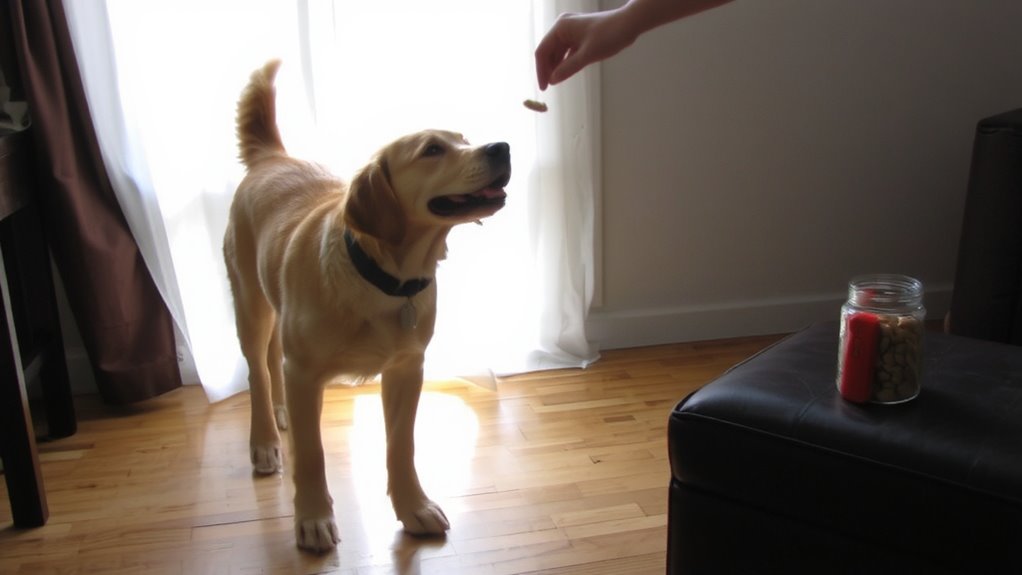
Although repetition lays the foundation for memory, it’s the timely use of rewards that transforms short-term learning into durable long-term recall in pets. Positive reinforcement, such as treats or praise delivered within seconds of correct behavior, activates neural reward pathways. This strengthens synaptic connections associated with the learned action. The brain encodes these experiences into long-term memory through protein synthesis in the hippocampus. Consistent rewards enhance cognitive mapping-the mental representation of tasks, locations, and behaviors. Each reinforced trial increases the likelihood of spontaneous retrieval weeks later. Studies show dogs receiving immediate rewards exhibit 67% higher retention over 30 days compared to delayed reward groups. Neurochemicals like dopamine and serotonin modulate this process, improving signal retention in neural circuits. You can optimize results by pairing verbal cues with rewards during peak attention spans-typically 5 to 8 minutes per session. Proper timing and consistency turn transient responses into stable, long-term behavioral memory. High-value dog training treats significantly boost motivation and focus during these short, critical learning windows.
Short-Term vs. Long-Term Memory in Pets
How does your pet remember what just happened versus what happened last week? Short-term memory holds recent information for seconds to minutes, while long-term memory stores lasting knowledge. Your pet relies on short-term memory for immediate responses, but it’s limited and prone to memory decay-fading quickly without reinforcement. Long-term memory, in contrast, persists for days, weeks, or even years. It forms when neural connections strengthen through repetition. Recall interference occurs when similar memories compete, making retrieval less accurate. For instance, teaching your dog multiple similar tricks in one session increases interference. Short-term memory capacity is small-typically holding only a few items at once. Long-term memory capacity is vast but not immune to retrieval errors. Effective training minimizes interference and counters decay through spaced practice, ensuring stable, accessible memories.
How Dogs, Cats, and Birds Remember Differently
While each species processes experiences uniquely, dogs, cats, and birds rely on distinct memory systems shaped by evolution and brain structure. Dogs use emotional imprinting to remember commands and social bonds, linking positive reinforcement to long-term recall. Their hippocampus supports associative memory, making training effective through repetition. Cats depend more on spatial navigation, using environmental cues to map territories with precision. Their short-term memory spans about 16 hours, enabling quick learning of hiding spots or feeding areas. Birds, especially parrots and corvids, exhibit advanced episodic-like memory; they recall *what*, *where*, and *when* of past events. Avian brains feature a densely packed hippocampal formation, enhancing spatial navigation and object permanence. Emotional imprinting in birds bonds them to caretakers, mimicking wild social structures. Each species’ memory function aligns with survival needs-dogs with social cooperation, cats with solitary hunting, and birds with complex foraging.
6 Proven Tips to Improve Your Pet’s Recall
When training your pet to respond reliably to recall commands, consistency and timing are critical. Use positive reinforcement immediately after correct responses to strengthen neural associations. Deliver treats or praise within 1–2 seconds of compliance to maximize associative learning. Train in low-distraction environments initially, gradually increasing complexity as recall reliability improves. Shorten sessions to 5–10 minutes daily to support sustained attention and cognitive development. Employ a consistent verbal cue like “come” paired with a hand signal to enhance memory encoding. High-value rewards, such as small pieces of chicken, increase motivation and response frequency. Avoid calling your pet to end play unless reinforced positively-this prevents negative associations. Practice in enclosed areas measuring at least 20 x 30 feet to allow movement while maintaining control. Over time, repeated, well-timed reinforcement enhances long-term recall accuracy, similar to procedural memory consolidation in animal learning studies. A well-chosen dog training collar can support effective recall training by providing consistent feedback during outdoor sessions.
On a final note
You train effectively by leveraging associative memory, where pets link cues to actions through repetition. Neural pathways strengthen with consistent practice, solidifying behaviors in long-term memory. Rewards trigger dopamine release, enhancing memory consolidation. Dogs excel in recall due to evolved social cognition; cats rely more on spatial memory, while birds use mimicry-based learning. Use precise timing-reinforce within 0.5 seconds-to maximize learning efficiency.