How to Prepare Your Rabbit for a Stress-Free Veterinary Wellness Visit
Choose a carrier with a rigid plastic base, secure latches, and minimum dimensions of 18 in × 12 in × 12 in for safe, well-ventilated transport. Use one with mesh panels on two sides for airflow. Place it in your rabbit’s space weekly, lined with scented bedding. Offer treats inside to build positive associations. Start short 5-minute car trips every few days. Support their body fully when handling. Normal heart rate ranges from 180–250 bpm; elevated rates signal stress. Carry a travel kit with water, hay cubes, waste pads, and a familiar blanket. Secure the carrier on the rear floor with a seatbelt. Maintain cabin temperatures between 68–72°F. Minimize noise using closed windows or white noise. Dual-access carriers allow easier exit at the clinic. Keep movements slow and predictable to preserve trust. Further steps guarantee long-term cooperation.
Notable Insights
- Choose a well-ventilated carrier with secure latches and interior dimensions of at least 18 in × 12 in × 12 in for safe, comfortable transport.
- Acclimate your rabbit to the carrier by placing it in their living area and encouraging voluntary entry with treats and familiar bedding.
- Conduct short practice trips using the carrier every 2–3 days to build positive associations and reduce travel anxiety.
- Handle your rabbit daily with gentle, supportive techniques to build trust and make veterinary exams less stressful.
- Pack a travel kit with spill-proof water, familiar hay, waste pads, and a comfort blanket to maintain stability during transit.
Choose the Right Carrier for Your Rabbit
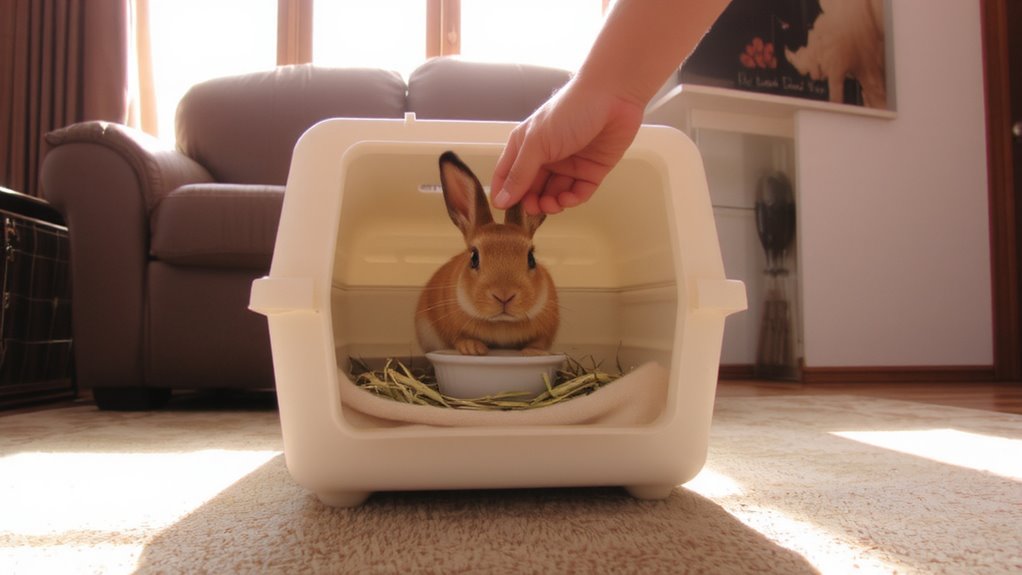
When selecting a carrier for your rabbit, start by prioritizing ventilation, security, and size. Proper ventilation design guarantees constant airflow, preventing heat buildup and respiratory stress. Opt for carriers with mesh panels on at least two sides; these offer superior air exchange compared to solid walls. Carrier size must allow your rabbit to sit, stand, and turn around comfortably. Aim for an interior minimum of 18 inches long by 12 inches wide by 12 inches high for small to medium breeds. A carrier that’s too large increases injury risk during transit due to uncontrolled movement. Choose rigid plastic or fiberglass bases with secure latches-these maintain structural integrity during impact. Non-slip flooring prevents foot injuries. Avoid top-loading-only designs; dual access (top and side) simplifies placement and removal. Secure fastenings and reinforced seams enhance safety. Providing a familiar hiding space inside the carrier, such as a best guinea pig hideout, can help reduce anxiety during travel.
Turn the Carrier Into a Safe Zone
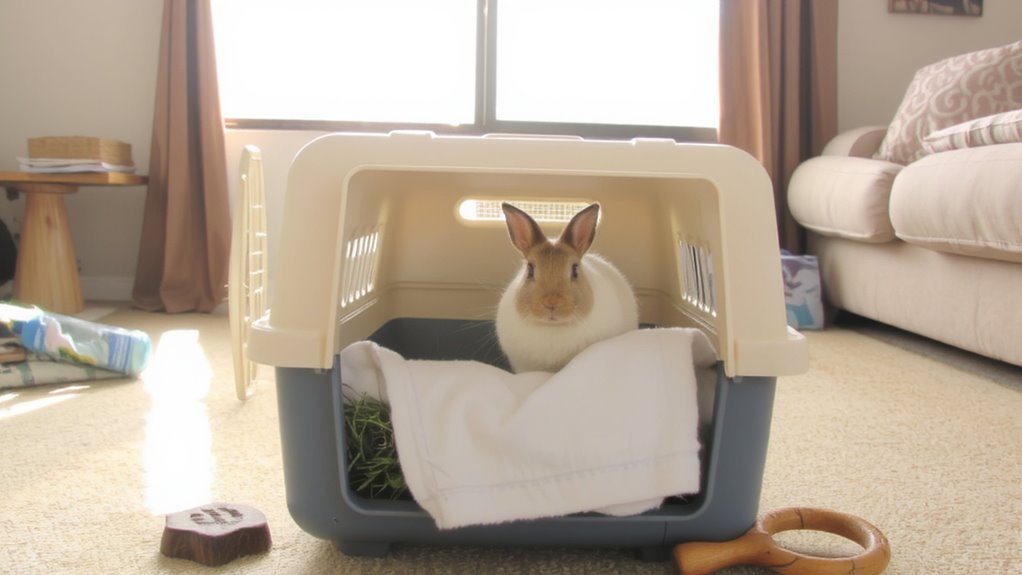
Make the carrier a familiar and secure space by introducing it well before the vet visit. Place it in your rabbit’s primary living area for at least one week prior. Line the interior with bedding that carries familiar scents, such as a used fleece blanket or hay from their home enclosure. These scent markers reduce anxiety by reinforcing environmental continuity. Offer treats and hay inside the carrier daily to establish positive reinforcement. This behavioral conditioning encourages voluntary entry and diminishes avoidance behaviors. Use a quiet, consistent tone when interacting near the carrier to avoid startling your rabbit. Avoid forcing entry, as this creates negative associations. Guarantee the carrier remains open during acclimation, allowing free access. A properly acclimated rabbit will enter without resistance, improving handling efficiency. Proper acclimation reduces stress-induced hyperthermia and tachycardia, critical for safe transport. Treat the carrier as a functional habitat extension, not just a transport tool.
Practice Short Trips for a Calm Vet Visit
Though your rabbit may not need immediate veterinary care, practicing short trips in the carrier prepares them for necessary travel with minimal stress. Short trips acclimate your rabbit to motion, sounds, and confinement similar to a vet visit. Begin with five-minute rides around the block, gradually increasing duration over several weeks. Use a secure, well-ventilated carrier measuring at least 24″ x 12″ x 12″ for average adult rabbits (e.g., 5–8 lbs). Place familiar bedding inside to reduce anxiety. Each time you return, offer a small treat as positive reinforcement. This pairs the experience with rewards, strengthening behavioral resilience. Avoid abrupt stops or loud noises during travel. Repeat sessions every 2–3 days to reinforce adaptability. Over time, your rabbit will associate the carrier and car motion with safety, not danger. Consistent short trips considerably lower cortisol levels during actual veterinary transport.
Build Trust With Gentle Handling
A majority of rabbits benefit greatly from consistent, gentle handling to build trust and reduce stress during veterinary care. Regular bonding sessions lasting 10–15 minutes daily improve socialization and decrease flight responses. During these periods, allow your rabbit to approach you first, then use slow, predictable movements to avoid triggering fear. Support their entire body-lift with one hand under the ribcage and the other under the hindquarters-to prevent injury and increase security. Incorporate grooming routines 2–3 times weekly using soft-bristle brushes designed for fine fur; this mimics natural allogrooming behaviors and strengthens rapport. Monitor heart rate during handling; normal resting rates range from 180–250 bpm, but spikes indicate distress. Consistent tactile exposure to paws, ears, and teeth aids veterinary assessments. Over weeks, this predictable interaction reduces cortisol levels, improving compliance during exams. Trust develops through repetition, timing, and respect for your rabbit’s behavioral thresholds.
Pack a Travel Kit to Reduce Stress
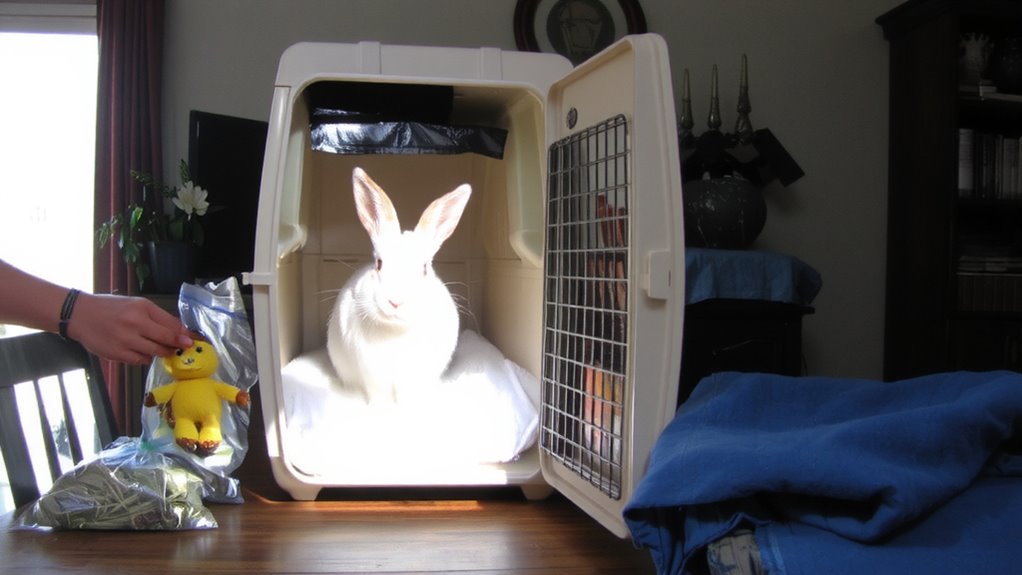
Your rabbit’s travel kit should include a well-ventilated, rigid carrier sized to allow for natural postural changes-minimum dimensions of 18 in × 12 in × 12 in for small breeds, with larger carriers for rabbits over 5 lbs. This prevents injury and reduces stress during transport. Line the carrier with a familiar favorite blanket to provide tactile comfort and thermal insulation. Avoid loose fabrics that could entangle limbs. Include a small supply of travel snacks-such as hay cubes or fresh parsley-in a sealed container to maintain gastrointestinal function. These should be low-moistage to prevent spoilage and offered sparingly. Pack a spill-proof water bottle designed for small animals, secured to the carrier. Bring waste-absorbing pads to manage soiling. Carry a flashlight, spare carrier latch, and emergency contact list. A complete travel kit guarantees preparedness, minimizes handling at the clinic, and supports physiological stability throughout transit. For convenient and safe transport, consider a mini rabbit travel cage that meets these size and ventilation requirements.
Keep Your Rabbit Calm in the Car
Once the travel kit is assembled and the carrier secured, focus shifts to the environment inside the vehicle. Car motion and noise control are critical to minimizing stress. Sudden movements and loud sounds can elevate your rabbit’s heart rate. Place the carrier on a flat, stable surface-ideally the rear seat floor-to reduce motion impact. Use a seatbelt to prevent shifting. Maintain a consistent cabin temperature between 68–72°F. Apply noise control by closing windows and setting the HVAC to recirculate. A high-quality collapsible kennel can further enhance stability and comfort during transit.
| Strategy | Effectiveness |
|---|---|
| Closed windows | High noise reduction |
| Soft carrier liner | Dampens vibrations |
| White noise audio | Masks engine sounds |
| Center vehicle position | Stabilizes car motion |
| Weighted carrier base | Limits lateral movement |
These steps mitigate sensory overload. Your rabbit remains calmer when motion and auditory input are predictable.
Know What Happens at the Vet Visit
The veterinary examination begins with a systematic assessment designed to detect subtle signs of illness. Your rabbit undergoes essential checks, including temperature, heart rate, and respiration rate. Normal rabbit temperature ranges from 101°F to 103°F; heart rate averages 180–250 bpm. The vet evaluates hydration via skin turgor and checks mucous membrane color for circulatory health. A thorough health screening follows, involving dental inspection for malocclusion and overgrowth, common in captive rabbits. The digestive system is assessed through abdominal palpation and fecal examination for parasites. Body condition scoring uses a 1–5 scale, with 3 ideal. The vet inspects eyes, ears, and skin for infections or mites. Weight is recorded accurately to the nearest 10 grams for future comparison. These procedures guarantee early disease detection. You’ll receive a summary outlining findings and recommendations. Understanding this process helps you support your rabbit’s long-term wellness through proactive care.
On a final note
You now control the key steps to a stress-free rabbit vet visit. Proper preparation reduces stress-related health risks like gastrointestinal stasis. Use a rigid carrier measuring at least 18″ L × 12″ W × 12″ H for medium breeds. Line it with a non-slip mat and your rabbit’s used bedding. Acclimate your rabbit over 7–14 days. At the clinic, minimal handling and consistent routines support physiological stability. You’ve optimized safety, comfort, and clinical efficiency.