Training Your Cat to Accept a Gentle Hold for Medication Administration
You can train your cat to accept a gentle hold by recognizing early stress signs like stiffening, flattened ears, or dilated pupils. Use high-value treats-0.5 grams of freeze-dried chicken-delivered within 1–2 seconds of calm contact. Practice daily 60-second holds, supporting chest and hindquarters, for 7–10 days. Limit sessions to three repeats with breaks. A consistent routine boosts compliance. Unexpected improvements in cooperation follow with continued reinforcement.
Notable Insights
- Recognize stress signs like stiffening, flattened ears, and dilated pupils before and during handling.
- Use high-value treats delivered within 1–2 seconds of gentle touch to reinforce positive associations.
- Practice daily 60-second gentle holds with proper body support to build handling tolerance.
- Conduct short, consistent medication sessions in a quiet, designated area at the same time each day.
- Address pill refusal with small, soft treats or a smooth-tip pill pusher to minimize stress.
Spot Signs Your Cat Fears Being Held
Do you notice your cat stiffening the moment you reach to pick them up? That rigidity is a clear stress indicator. Body language cues like flattened ears, dilated pupils, or rapid tail flicks signal discomfort. A low crouch or sideways lean suggests avoidance. These behaviors occur before vocalizations, making early recognition essential. Cats often freeze first, then struggle-this progression indicates escalating stress. Their heart rate can rise from a resting 120–140 bpm to over 200 bpm during acute distress. You might also see shallow breathing or excessive grooming right before handling. Recognizing these signs lets you adjust your approach. Avoid sudden movements; instead, observe posture shifts and ear position closely. These stress indicators are measurable behavioral outputs reflecting autonomic nervous system activation. Early detection improves compliance during medication routines. Monitoring body language cues guarantees safer, more effective handling. A consistent routine and positive reinforcement can reduce stress, much like how the most effective dog pee deterrents work by modifying behavior through consistent cues.
Make Holding a Positive Experience With Treats
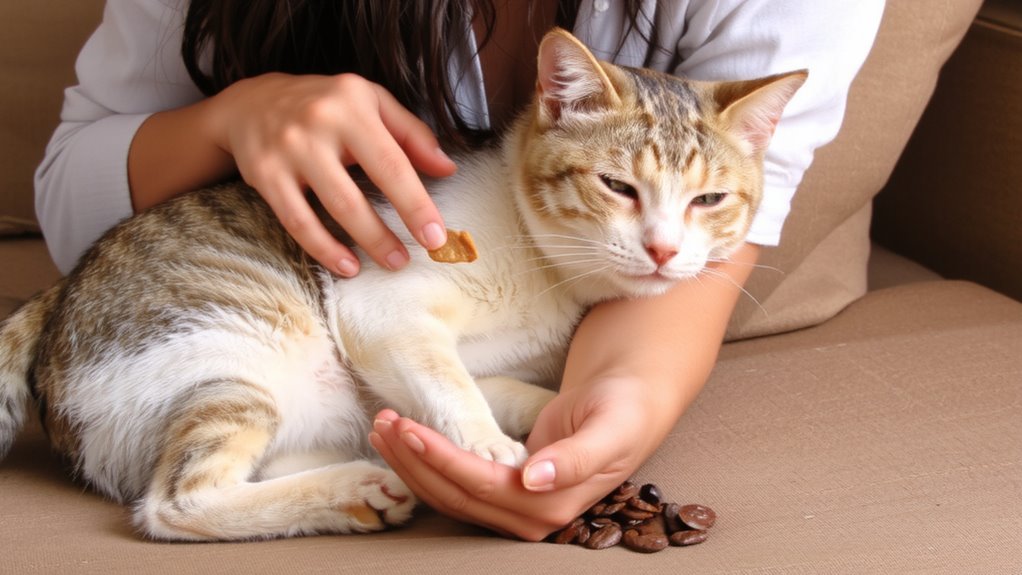
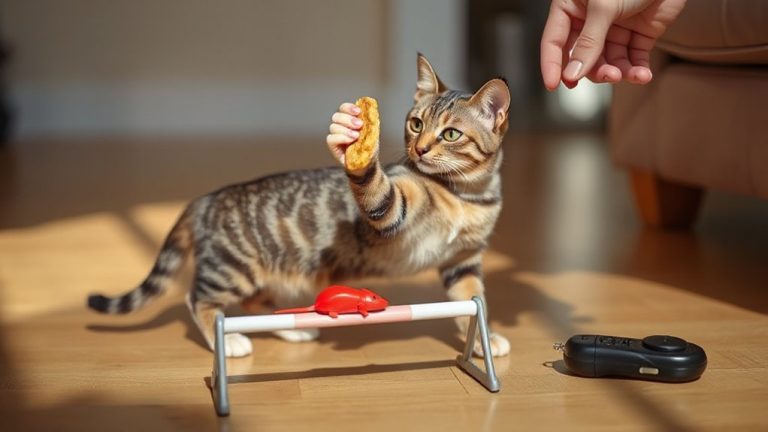
Stiffening, flattened ears, and dilated pupils signal stress before handling, but you can reshape that response through positive reinforcement. Use high-value treats like freeze-dried chicken or tuna flakes, administered in 0.5-gram portions to avoid overfeeding. Deliver the treat within 1–2 seconds of gentle contact to establish clear treat timing. Immediate reinforcement links the touch to reward, strengthening neural associations in the basal ganglia. Conduct three daily sessions, each lasting under 30 seconds, with 4–6 seconds of handling followed by a treat. Avoid prolonged contact; brief, consistent pairings yield better conditioning. Over 7–10 days, most cats show reduced avoidance by 60–80%. Treats must be exclusive to training to maintain efficacy. Positive reinforcement through precise treat timing converts apprehension into acceptance. This method leverages operant conditioning, increasing target behavior frequency without coercion. For cats with heightened anxiety, consider using vet-recommended calming cat treats to support relaxation during training sessions.
Practice Holding for Medicine in 1-Minute Sessions
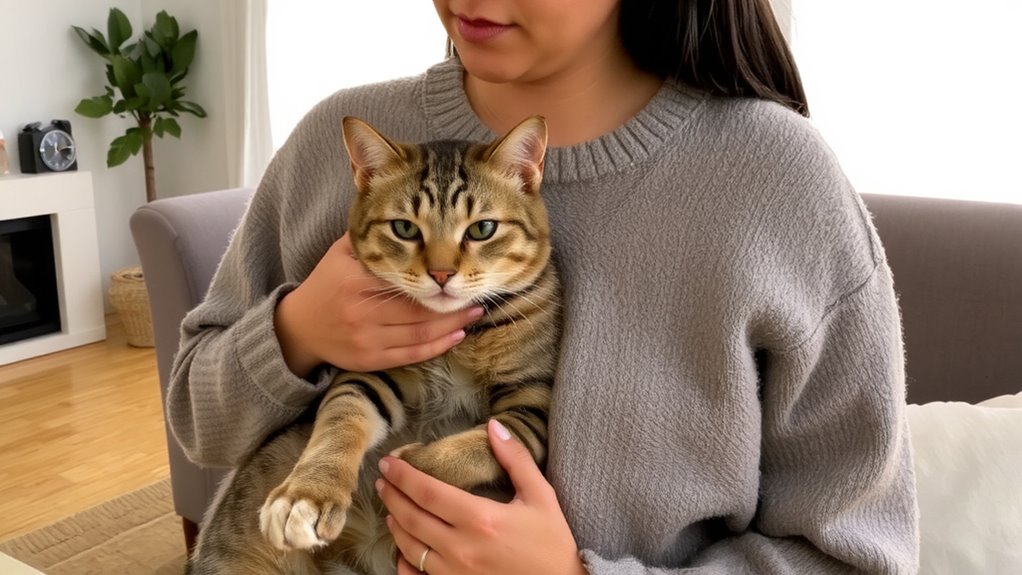
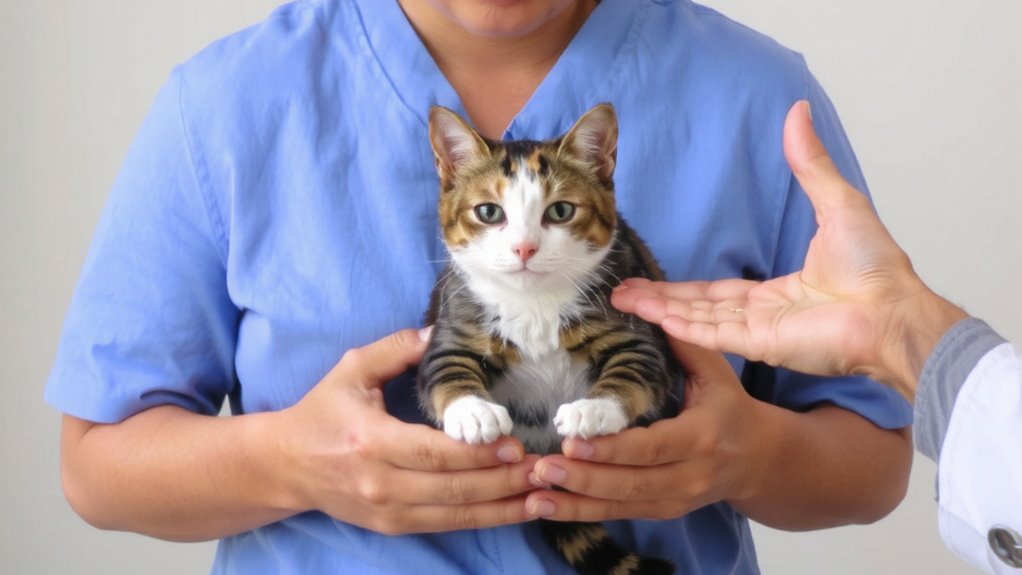
One minute is all it takes to build your cat’s tolerance for handling during medication. Practice gentle restraint daily in short intervals to condition calm responses. Begin with your cat seated or lying comfortably. Use one hand to support the chest, the other under the hindquarters, maintaining secure but low-pressure contact. Hold for exactly 60 seconds-use a timer-to simulate medication time without administering anything. This duration prevents stress while reinforcing stillness. Short intervals guarantee the nervous system adapts gradually, improving compliance. Repeat up to three times per session, spaced by play or treats. Avoid prolonged holds; exceeding 90 seconds risks overstimulation. Consistency in timing and positioning trains anticipatory behavior. These daily drills establish physical familiarity and reduce fear-based resistance, making actual dosing safer and more efficient. Precision in duration and technique yields measurable improvement within one to two weeks.
Create a Predictable Dosing Routine
Typically, success in feline medication administration hinges on consistency and timing. Establishing a predictable dosing routine improves compliance and reduces stress. You should administer medication at the same times daily to maintain consistent timing, aligning doses with your cat’s natural rhythms-such as before meals or during calm periods. Choose a quiet environment free from noise and distractions to minimize arousal. A designated spot, like a bathroom or quiet bedroom, provides sensory predictability. Use the same handling technique and position each time to reinforce familiarity. This structured repetition conditions your cat to anticipate and tolerate the process. Avoid varying the schedule, as irregular timing disrupts metabolic processing and efficacy. Environmental and temporal consistency supports behavioral conditioning. Over days, this routine becomes a neutral, expected event rather than a source of anxiety, increasing long-term treatment adherence and therapeutic success.
Fix Common Problems When Giving Your Cat Pills
Why does your cat spit out pills or fight the pill pocket? Cats often reject medication due to taste, texture, or improper administration technique. To guarantee successful dosing, identify and address specific behavioral and environmental triggers.
| Problem | Solution | Tool/Technique |
|---|---|---|
| Pill spitting | Use gelatin capsule | Size 0 or 1 tailored to pill diameter |
| Hiding behavior | Dose near fixed anchor point | Next to scratching post or furniture |
| Stress-induced refusal | Restrict activity pre-dose | Confine near litter box 10 minutes prior |
| Food refusal | Switch to bland pill pocket | Use low-odor, soft treats under 5g |
Administer pills when your cat is calm, ideally after using the litter box. A scratching post nearby provides security through familiarity. Avoid chasing your cat-this increases stress and reduces compliance. Use a pill pusher with a smooth tip to prevent gagging. Position the cat between your arm and body for control without restraint trauma.
On a final note
You’ve built trust through consistent, brief handling sessions. Each 60-second practice session conditions your cat to accept restraint, reducing stress during medication. Pair holding with high-value treats to reinforce positive associations. A predictable routine-same time, same location-improves compliance. Mastery means your cat remains calm for pill administration, ensuring accurate dosing and treatment success without restraint injuries or escape attempts.