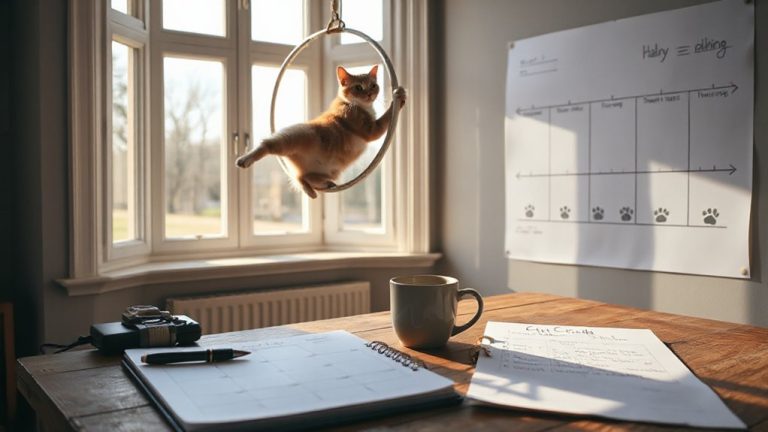
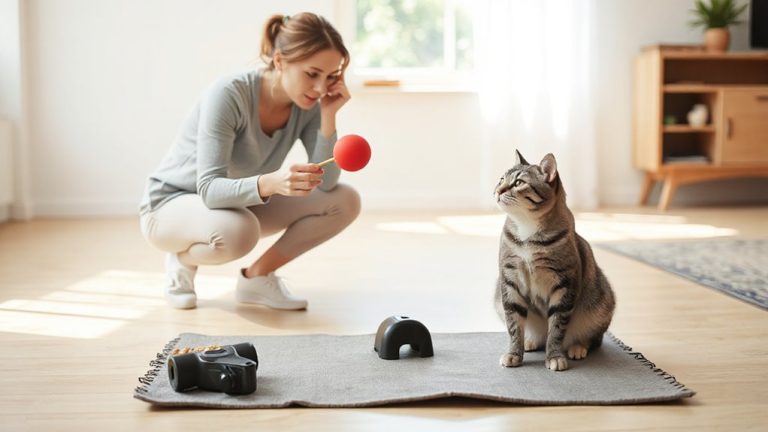
Using Clicker Training to Teach Cats to Spin in a Circle on Cue
You can teach your cat to spin on cue using a 2,800 Hz clicker to mark precise movements. Start with 3–5 minute sessions twice daily, using pea-sized treats (1–2 kcal each). Lure small head turns with a target stick, clicking and treating for every 45-degree increment. Shape the behavior gradually, advancing only after three consecutive successes. Add the verbal cue “spin” just before rotation begins. Keep sessions short, timing clicks within 0.5 seconds of the action. Consistency in setup and reinforcement guarantees reliable performance-further refinements improve accuracy and response speed.
Notable Insights
- Use a clicker to mark the exact moment of desired behavior, immediately followed by a small treat.
- Start with target training, guiding the cat’s nose in a circular motion using a wand or lure.
- Shape the spin gradually, clicking and reinforcing small head turns before progressing to full rotations.
- Introduce the verbal cue “spin” just before the cat begins turning, pairing it consistently with the action.
- Keep sessions short (3–5 minutes), practice 2–3 times daily, and use high-value, low-calorie treats.
What Is Clicker Training for Cats?
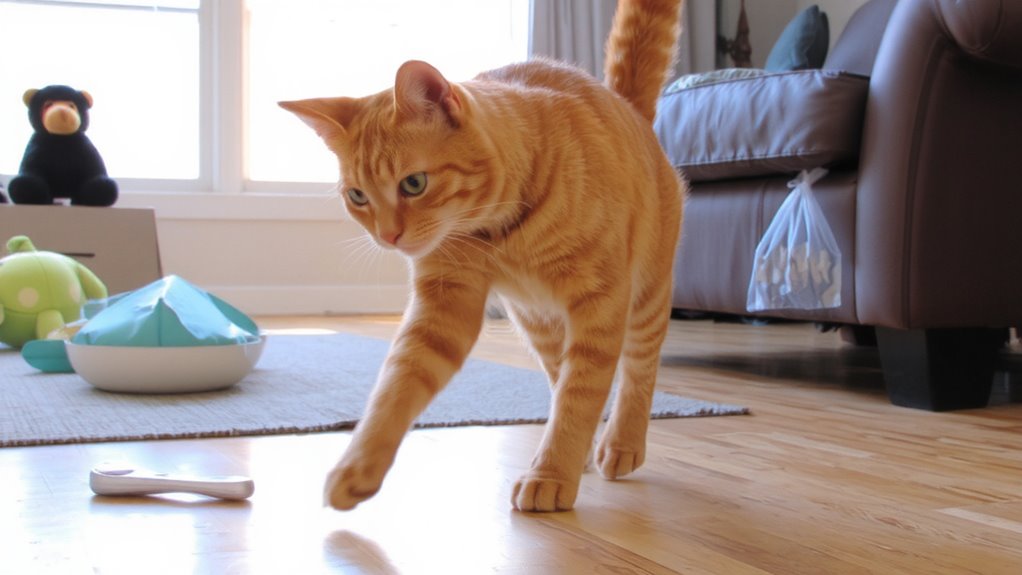
Clicker training is a method of positive reinforcement that uses a small handheld device to mark desired behaviors in real time. The clicker emits a consistent, high-pitched sound at 2,800 Hz, creating a precise auditory signal. This sound bridges the gap between behavior and reward, communicating exactly which action earned a treat. You use positive reinforcement by immediately following the click with a small, tasty food reward, typically 1–2 kcal per treat, to strengthen the association. Target training often begins the process-you present a wand or stick the cat touches with its nose, guiding movement. The mechanical consistency of the clicker eliminates vocal tone variability, ensuring clarity. Each session should last no more than 3–5 minutes to maintain focus. Over time, your cat learns to associate the click with reward, enabling accurate shaping of complex behaviors like spinning.
Set Up Your Training Session
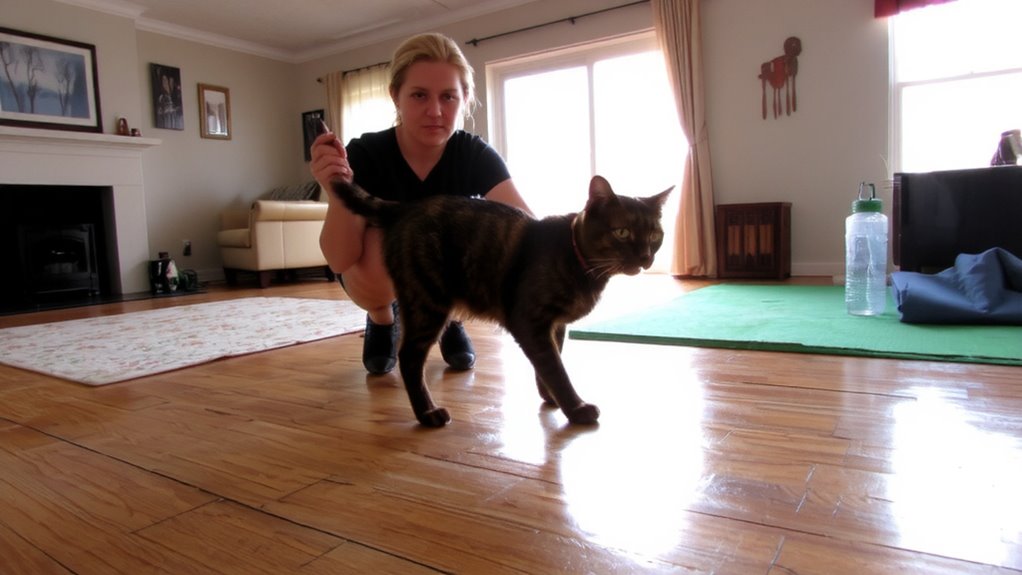
You’ve learned how the clicker marks behavior with precision, and now it’s time to prepare your environment for effective training. Optimize your training environment by minimizing distractions and guaranteeing a quiet, consistent space. Use a room with non-slip flooring to prevent falls during movement. Keep session timing brief-5 to 7 minutes twice daily-to maintain focus and prevent fatigue. Overlong sessions reduce retention and increase frustration.
| Factor | Specification | Purpose |
|---|---|---|
| Location | Quiet indoor area | Reduces distractions |
| Session Timing | 5–7 minutes, 2x/day | Matches cat attention span |
| Training Environment | Free of obstacles, consistent | Guarantees safety and predictability |
| Tools Ready | Clicker, 10–15 pea-sized treats | Enables rapid reinforcement |
Prepare all materials in advance. Efficiency improves learning.
Shape the Spin in Small Steps
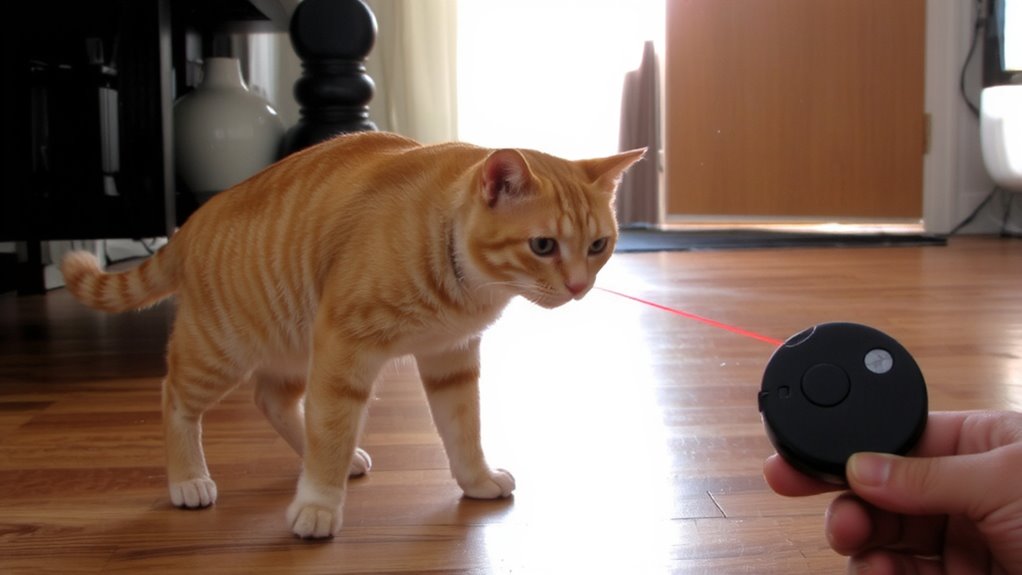
Most cats learn the full spin in 3 to 5 sessions when training progresses through precise behavioral increments. Begin by capturing small head turns toward a treat, clicking and rewarding immediately. Use lure progression: start with food held close to your cat’s nose, then slowly move it sideways in a circular motion. At first, click for a 45-degree turn, then gradually increase the angle. Each session should last 3–5 minutes to maintain focus. Minimize environmental distractions by training in a quiet, familiar space; a sudden sound or movement can disrupt shaping. Increase criteria only when your cat performs the current step reliably in three consecutive trials. Full rotation typically emerges by step six or seven of the lure progression. Consistency in hand signal and timing guarantees clean behavior acquisition. Avoid rushing-precise shaping reduces confusion and builds accuracy.
Add the “Spin” Command and Refine the Trick
Now that your cat consistently performs the full spin through shaping, how do you turn this learned behavior into a reliable, cue-controlled trick? Begin by adding the verbal cue “spin” just before your cat initiates the behavior. Precise cue timing is critical-say the word the instant before the first paw movement. This links the action to the command. Use target reinforcement by presenting the target stick immediately after the cue, guiding the full rotation. Click and treat only when the spin is completed following the verbal cue. Gradually phase out the target stick, relying solely on the verbal command and hand signal. Practice in short, focused sessions-three to five minutes, two to three times daily. Reinforce correct responses with high-value treats to maintain motivation. Over time, increase criteria by requiring cleaner spins before clicking. This sharpens accuracy and response consistency.
Fix Common Clicker Training Mistakes
Even with consistent practice, progress can stall if common clicker training errors go uncorrected. Timing errors are among the most frequent issues. You must click the instant your cat performs the desired behavior-delay by even half a second, and the association weakens. The click marks the exact action, so precision is critical. Misaligned timing leads to confusion and slows learning. Overfeeding treats is another pitfall. Each treat should be pea-sized, no larger than 1–2 calories, to prevent satiation and weight gain. Limit training sessions to five to ten treats per day. Use high-value rewards only during training; switch to lower-calorie options for maintenance. Track daily intake to guarantee treats don’t exceed 10% of your cat’s caloric needs. Correct timing and controlled reinforcement sustain motivation without compromising health or clarity.
Train Consistently to Master the Trick
Regularly practicing clicker training sessions helps your cat build reliable behavioral responses over time. Consistency strengthens neural associations, making the spin behavior more predictable. Training frequency is critical-aim for 5 to 10 daily sessions, each lasting 3–5 minutes, to maintain focus and prevent fatigue. Reinforcement timing must be precise: click within 0.5 seconds of the correct movement to guarantee accurate signal association.
| Session Duration | Frequency | Rest Period |
|---|---|---|
| 3 minutes | 5/day | 2 hours |
| 5 minutes | 8/day | 1.5 hours |
| 4 minutes | 10/day | 1 hour |
Short sessions with immediate reinforcement timing increase learning efficiency. Over time, consistent training frequency solidifies the behavior. Use the table to optimize your schedule based on your cat’s attention span.
On a final note
You’ve now mastered the fundamentals of teaching your cat to spin using clicker training. Each session should last 3–5 minutes, conducted 2–3 times daily, ensuring ideal focus. Accurate timing of the click-within 0.5 seconds of the desired behavior-is critical. Reinforce with a high-value treat, such as freeze-dried chicken (approximately 3–5 calories per piece), to maintain motivation. Consistency yields success.