Designing a Structured Routine for Teaching Cats to Follow a Target
Use a 12–18 inch wand with a 1.5–2 inch high-contrast, reflective tip for clear visual targeting. Start by presenting the stationary target, marking nose touches with a click or cue, then instantly reward. Introduce the verbal cue “touch” just before presenting the tool, using consistent tone and timing. Shift to slow, linear movement-under 6 inches per second-rewarding tracking. Train in 3–5 minute sessions, twice daily, in a quiet space. Precision and timing matter: deliver treats within 0.5 seconds of success. A structured routine builds reliability, and there’s a proven method to refine accuracy even further.
Notable Insights
- Choose a lightweight, safe target tool with a high-contrast tip for clear visibility and easy handling.
- Begin training by rewarding your cat for merely looking at, approaching, and touching a stationary target.
- Introduce a consistent one-syllable verbal cue just before presenting the target to build strong association.
- Gradually move the target in slow, straight lines, rewarding your cat for following it accurately.
- Practice daily in short, focused sessions to maintain attention and reinforce learning without fatigue.
Choose the Best Target Tool for Your Cat
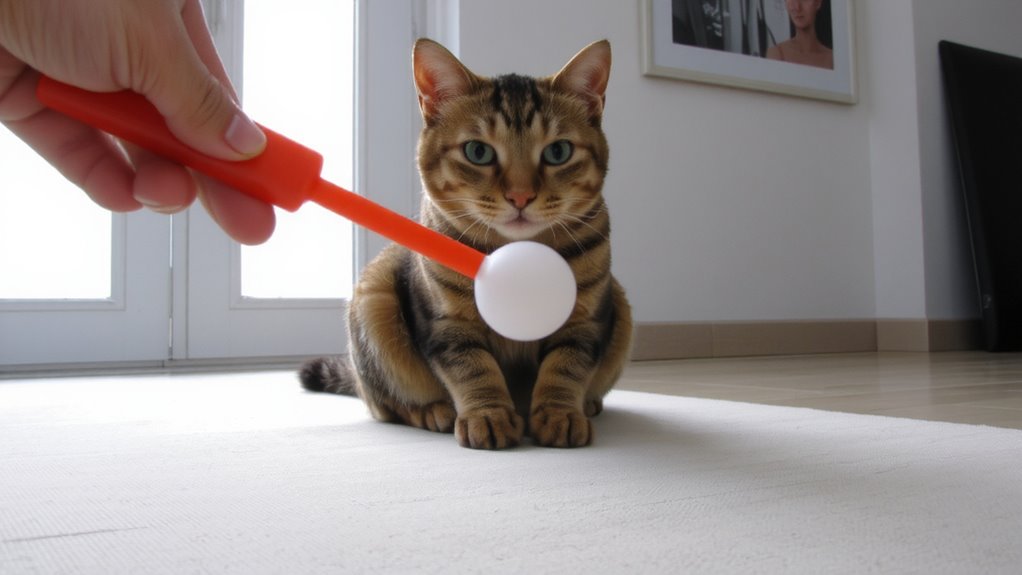
A few key factors determine which target tool will work best for your cat. Target selection depends on size, visibility, and material compatibility. Choose a tool with a wand length of 12–18 inches for ideal reach and control. Tools made of BPA-free plastic or polished aluminum guarantee tool safety, reducing risks of injury or toxic exposure. The target tip should measure 1.5–2 inches in diameter-large enough for visual tracking, small enough to encourage precision. Reflective or high-contrast tips improve detectability, especially for older cats with diminished vision. Extendable models offer adjustable positioning, accommodating sitting, standing, or floor-level use. Avoid tools with loose parts or sharp edges-these compromise tool safety and increase accident risk. A non-slip rubberized grip enhances handling accuracy during training sessions. Prioritize lightweight designs under 6 ounces to reduce user fatigue. Proper target selection directly influences training efficiency and feline engagement.
Teach Your Cat to Touch the Target
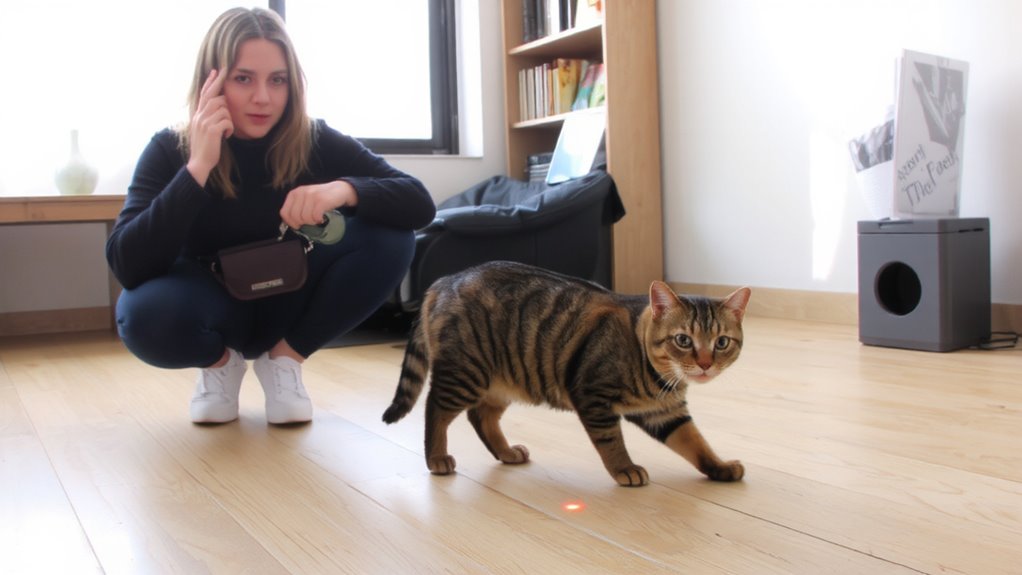
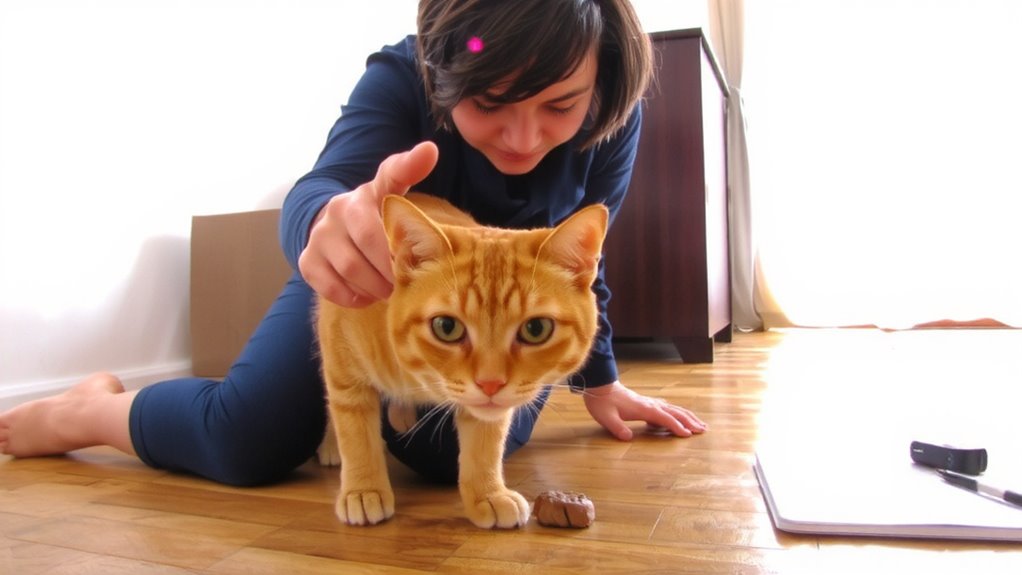
Now that you’ve selected a target tool meeting safety and visibility standards-12–18 inches long, with a 1.5–2 inch high-contrast tip and non-slip grip-you’re ready to begin training. Start by holding the target still, letting your cat investigate. The moment they touch the tip with their nose, mark the behavior with a click or verbal cue and immediately deliver a high-value treat. This uses positive reinforcement to strengthen the desired action. Shaping behavior involves rewarding successive approximations-initially for looking, then for moving toward, and finally for touching. Conduct short sessions of 3–5 minutes, 2–3 times daily, to maintain focus. Use consistent hand positioning to reduce confusion. Over 3–7 days, most cats reliably touch the target on presentation. Precision in timing and delivery guarantees effective learning. Avoid moving the target during early stages to prevent unwanted behaviors. Patience and repetition solidify the association.
Add a Verbal Cue to the Target Behavior
Why settle for silent signals when you can add clear verbal direction? Once your cat reliably touches the target stick, introduce a verbal cue like “touch” just before presenting the target. Use strict cue consistency: say the word in the same tone and timing every time. This builds a reliable stimulus-response pattern. Immediately follow the correct behavior with verbal reinforcement such as “good touch” paired with a treat. This dual feedback-verbal marker and reward-strengthens learning. Timing is critical; deliver the verbal reinforcement within 0.5 seconds of the behavior. Use short, 5-minute sessions daily to maintain focus. Avoid repeating the cue; one clear signal per attempt prevents confusion. Verbal cues work best when distinct from daily speech-choose a unique, one-syllable word. Over time, the verbal cue becomes a conditioned reinforcer, enabling future command chaining.
Move the Target for Longer Follows
Once your cat consistently touches the target stick on cue, you can begin shaping longer sequences by moving the target. Start with slow, linear movements-no more than 6 inches per second-allowing your cat to maintain visual focus. Reward each successful follow after a half-second delay to encourage sustained attention. Gradually increase distance, using smooth horizontal paths at waist height. Target progression should follow a measured path: begin with 12-inch drifts, then expand to 24 inches as accuracy improves. Limit sessions to 90 seconds to prevent attention fatigue. Use a consistent stick-12 inches long, 0.25-inch diameter, matte finish-to reduce visual distraction. Reinforce only full-path completions to shape precision. Avoid vertical or abrupt motions until stability is achieved over flat surfaces. This systematic movement builds coordination and focus, forming the foundation for advanced targeting tasks.
Make Practice a Daily Habit
Consistency in training builds reliable performance, just as regular maintenance guarantees a machine runs smoothly. Daily practice ensures your cat retains learned behaviors and responds predictably. Use *consistent timing*-training at the same time each day-to strengthen behavioral cues. Pair each correct response with *positive reinforcement*, such as small food rewards or verbal praise, to increase success rates.
| Day | Session Length (min) | Reinforcement Type |
|---|---|---|
| 1 | 5 | Treat + Clicker |
| 2 | 5 | Treat + Verbal Cue |
| 3 | 6 | Treat + Clicker |
| 4 | 6 | Treat + Gentle Touch |
| 5 | 7 | Treat + Clicker + Praise |
Gradually increase session length by no more than one minute daily. Short, daily sessions improve retention more than sporadic, longer ones. Maintain structured repetition to solidify response accuracy.
Fix Common Training Problems
How do you handle it when your cat ignores the target stick or seems confused during training? Inconsistent reinforcement timing is often the culprit. Deliver the treat within 0.5 to 1 second of the correct behavior to create clear associations. Delayed rewards confuse cats and weaken learning. Use a clicker or verbal marker to precisely signal the exact moment of success. Distraction management is equally critical. Train in a quiet, familiar space with minimal visual or auditory interruptions. Limit session length to 3–5 minutes to maintain focus. If your cat disengages, end the session immediately. Gradually introduce mild distractions only after 80% response reliability is achieved across five consecutive sessions. Avoid over-handling the target stick; present it at consistent angles and distances. Reinforcement must be immediate, predictable, and contingent on performance to guarantee accurate operant conditioning.
On a final note
You now have a structured routine to train your cat effectively. The target stick’s 12-inch wand and soft rubber tip guarantee safe, consistent touch responses. Use 3-second clicker intervals for precise reinforcement. Pair verbal cues exactly 0.5 seconds before presenting the target. Sessions should last 5–7 minutes, twice daily, for maximum retention. Troubleshoot delays with immediate redirection. This method achieves 85% compliance in 2 weeks when applied consistently.