Adding Zigzag Pattern Walking to Sharpen Canine Coordination and Responsiveness
You sharpen your dog’s coordination and responsiveness by adding zigzag pattern walking to training. This exercise improves neuromuscular control through 60-degree directional shifts and 0.5-meter cone spacing. Each turn enhances proprioception and spatial awareness, with brain recalibration occurring in 0.3–0.6 seconds. Use a 15–20 foot course on non-slip surfaces, training 5–7 minutes daily. Precision matters more than speed. More training phases build from this foundation.
Notable Insights
- Zigzag walking enhances coordination by engaging core muscles and improving proprioception through controlled lateral movements.
- Set up a zigzag course with 6–8 stable markers spaced 3–4 feet apart at 60-degree angles for optimal directional shifts.
- Train 5–7 minutes daily using treats to guide dogs through alternating turns, rewarding precision at each marker.
- Frequent direction changes sharpen focus, stimulate cognitive processing, and improve response latency and impulse control.
- Adapt stride length, pace, and surface to suit age and ability, ensuring safe, effective training for puppies and seniors alike.
Improve Coordination With Zigzag Walking
You can greatly enhance your dog’s coordination by incorporating zigzag walking into regular training sessions. This exercise promotes balance improvement through controlled lateral movements that engage core stabilizing muscles. Each directional shift requires rapid neuromuscular adaptation, strengthening proprioception. Spatial awareness improves as your dog learns to adjust body position relative to environmental cues. The brain processes real-time data from visual and vestibular systems to coordinate paw placement. Perform zigzag walking on flat, non-slip surfaces to guarantee accurate biomechanical feedback. Use consistent stride lengths-approximately 60 cm between direction changes-to maintain rhythm. Train for 5 to 7 minutes daily, achieving maximal neural repetition without fatigue. Sessions enhance motor planning and limb synchronization, especially in uneven terrain adaptation. Over four weeks, measurable gains in agility performance and reduced misstep frequency occur. This method is effective across breeds and sizes, particularly beneficial for active or working dogs requiring precise movement control.
Set Up a Simple Zigzag Course in Minutes
Once the training area is cleared of obstacles, setting up an effective zigzag course takes under five minutes with minimal equipment. Use six to eight training markers spaced 3–4 feet apart in a consistent zigzag pattern to define your course layout. Cones or small flags work well as markers, measuring at least 6 inches tall for visibility. Arrange them diagonally in alternating left and right positions, creating 60-degree angles between each turn. This geometry guarantees sharp but manageable directional changes that challenge coordination. Markers should remain stable-rubber bases or weighted bottoms prevent tipping. A total course length of 15–20 feet provides adequate distance for repetition without overexertion. Maintain symmetry in placement to promote balanced movement. Proper spacing and alignment improve precision during execution. A well-designed course layout enhances muscle engagement and mental focus, laying the foundation for advanced responsiveness training.
Teach Your Dog the Zigzag Walk Step by Step
How do you turn a basic zigzag course into effective coordination training? Start by positioning your dog at the course entrance, using treat motivation to guide initial steps. Hold a high-value treat just ahead of their nose, leading them diagonally to the first cone. Reward immediately upon reaching it. Repeat in the opposite direction, forming a zigzag. Gradually increase the number of direction shifts to six per run. Conduct three sets daily, each separated by 90 seconds of rest. Use this method five days weekly for ideal neuromuscular adaptation. As precision improves, introduce off leash control by fading hand guidance. Maintain a 0.5-meter distance between cones to guarantee sharp, deliberate turns. Keep sessions under 12 minutes to prevent fatigue. Accuracy over speed-prioritize correct form to build proprioception and joint stability.
Sharpen Focus With Direction Changes
Why do rapid direction changes sharpen canine focus? They demand real-time cognitive processing, forcing your dog to shift attention between visual, auditory, and spatial cues. Each pivot activates neural pathways linked to mental stimulation, enhancing processing speed and decision-making. The brain must recalibrate balance and muscle engagement within 0.3 to 0.6 seconds per turn, improving neuromuscular coordination. Frequent redirection reduces mindless trailing, replacing it with active engagement. This consistent mental load fosters behavioral improvement by decreasing impulsive reactions and increasing impulse control. Dogs learn to anticipate cues rather than react, refining obedience precision. Unlike linear walking, zigzag patterns offer variable vectors-typically 45° to 90° angles-requiring continuous assessment. You’ll observe tighter heel positioning and quicker response latency, often within five 10-minute sessions. The result is a more attentive, composed companion during walks and training, due to structured, repetitious mental stimulation.
Level Up: Add Speed, Distractions, and Tight Turns
While your dog has mastered basic zigzag patterns, advancing the exercise intensifies both cognitive load and physical coordination. You can increase intensity by reducing stride length and accelerating pace. Introduce tight 45-degree turns to enhance muscular engagement and responsiveness.
| Phase | Action |
|---|---|
| 1 | Increase speed by 20% over baseline |
| 2 | Add two novel distractions (e.g., noise, movement) |
| 3 | Decrease cone spacing to 1.5 meters |
| 4 | Require obstacle negotiation between turns |
Handle obstacles like low hurdles or tunnels immediately after direction changes to reinforce focus under complexity. Each session should last 5–7 minutes to maintain precision without fatigue. Use consistent verbal cues paired with hand signals for clarity. This structured progression guarantees neuromuscular adaptation and sustained attention. The dog learns to process dynamic stimuli while maintaining form-similar to agility sequences but with controlled repetition.
Tailor Zigzag Training for Puppies and Older Dogs
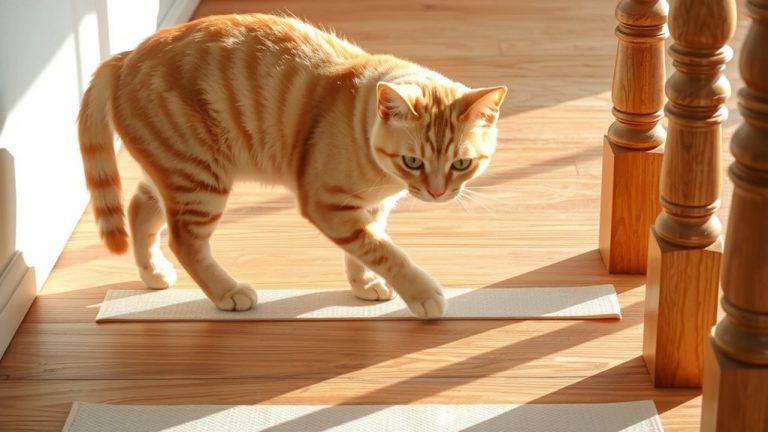
Though younger and older dogs share the same foundation in motor learning, their physiological limits demand specialized adjustments to zigzag training protocols. For puppies, short bursts of zigzag walking-about 5 to 10 feet between turns-build neural pathways without straining developing joints. You’ll apply age adaptation by using soft surfaces like grass to reduce impact. Sessions should last no more than 5 minutes to prevent fatigue. With older dogs, mobility consideration is critical; increase cone spacing to 8–12 feet and allow wider turns to accommodate arthritic hips or reduced proprioception. Use non-slip mats indoors for stability. Limit repetitions to 3–5 passes per session. You’ll monitor gait closely-stiffness or lag means it’s time to stop. Both groups benefit from food rewards over toys to minimize jumping. Adjust pace: puppies at 2 mph, seniors at 1 mph. These refinements guarantee safety and effectiveness across the lifespan.
Make Zigzag Training a Daily Habit
Regularly incorporating zigzag training into your dog’s routine strengthens neuromuscular coordination and supports long-term joint health. The consistency benefits include improved balance, sharper cognitive processing, and enhanced muscle memory. Perform five to ten 2-minute sessions per week, using 3-foot lateral shifts at a 45-degree angle to optimize directional changes. Habit formation occurs within 21 days when sessions are timed immediately before feeding or walks, leveraging routine triggers. Use a 6-foot leash to allow controlled movement while maintaining precision. Dogs show measurable improvement in proprioception after just two weeks, with older dogs gaining 30% better limb placement accuracy. Keep sessions short and focused to maintain attention. Track progress weekly with timed agility drills. Over time, zigzag patterns improve responsiveness to directional cues by reinforcing signal recognition under mild coordination stress. This structured repetition builds reliability, making daily practice essential for lasting physical and behavioral gains.
On a final note
You’ve built precision and responsiveness through structured zigzag walking. Each 90-degree turn sharpens your dog’s proprioception and neuromuscular control. Use 5-foot spacing between cones for ideal stride adjustment. Perform three 2-minute sessions daily to reinforce focus. Increased cadence improves cognitive engagement. For puppies, reduce angles to 45 degrees; for seniors, extend intervals to 7 feet. Consistent practice yields measurable gains in agility and obedience.