Mastering Negative Punishment Strategies for Managing Aggressive Dog Behavior
You stop aggression by removing something your dog values the instant it misbehaves. This is negative punishment-removing a positive stimulus like attention or toys within one to two seconds. Use a 30–60 second timeout in a quiet zone to reduce arousal. Avoid scolding; timing and consistency are critical. Pair it with cues like “sit” to redirect behavior. Poor timing cuts effectiveness by over 70%. Misuse fuels fear. True mastery requires precise application and understanding of canine learning theory.
Notable Insights
- Apply negative punishment by immediately removing attention or access to rewards when aggression occurs.
- Use 30–60 second timeouts in a quiet area to reduce arousal and reinforce consequence.
- Time the intervention within one second of the behavior to maintain clear association.
- Redirect to incompatible behaviors like “sit” or “look” after punishment to encourage compliance.
- Seek a veterinary behaviorist if aggression persists despite consistent, proper application.
What Is Negative Punishment in Dog Training?
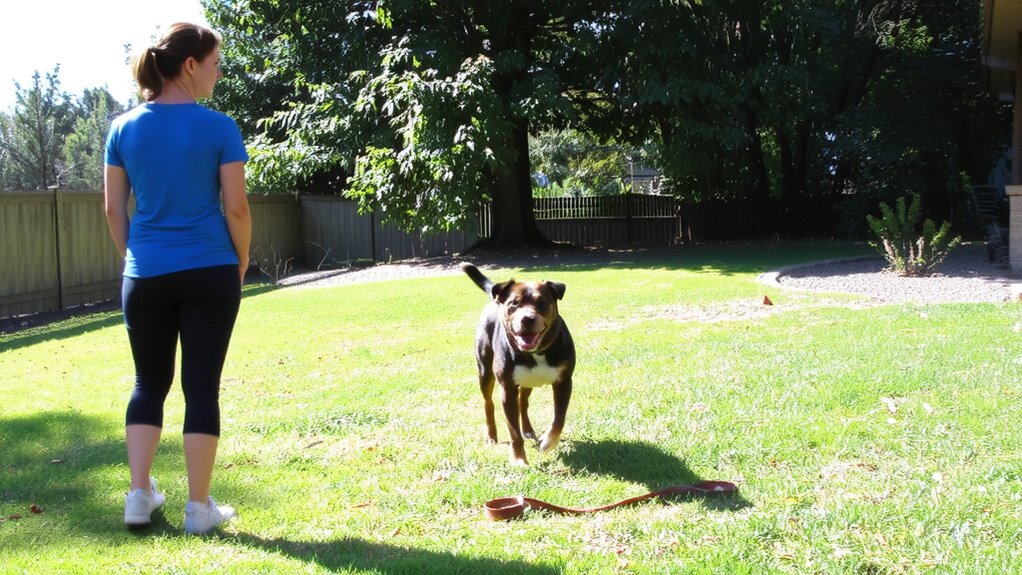
A concept often misunderstood in dog training, negative punishment involves removing a stimulus to decrease an undesired behavior. You apply it by withdrawing something your dog values, like attention or a toy, immediately after unwanted conduct. This technique aligns with dog psychology by targeting motivation through consequence, not force. In behavior modification, it complements positive reinforcement by clarifying boundaries. For example, if your dog jumps, you turn away-removing social contact-until they calm down. The timing must be precise: the removal should occur within one to two seconds post-behavior for effective association. Unlike aversive methods, negative punishment reduces aggression risks. It operates on operant conditioning principles, specifically Type II punishment. Consistency across handlers and environments guarantees reliability. Applied correctly, it shapes long-term behavioral change without compromising trust.
What Triggers Your Dog’s Aggressive Behavior?

What makes your dog react with aggression? Identifying triggers is essential for effective behavior management. Territorial guarding occurs when your dog perceives a threat to a specific area, like your home or yard. This behavior often includes barking, lunging, or snapping at unfamiliar people or animals near perceived boundaries. Resource guarding, on the other hand, happens when your dog protects valued items such as food, toys, or beds. Signs include stiff posture, growling, or biting when approached. Both behaviors are motivated by fear or anxiety, not dominance. Triggers can be subtle-like someone reaching toward a toy or stepping near a favored couch. Accurately diagnosing the trigger type allows for precise intervention. Environmental context, body language, and situational patterns provide critical data. Mislabeling the behavior leads to ineffective treatment. Record specific details: time, location, people present, and your dog’s actions. This information guides accurate assessment and prepares you for structured, science-based solutions.
How to Apply Negative Punishment Correctly
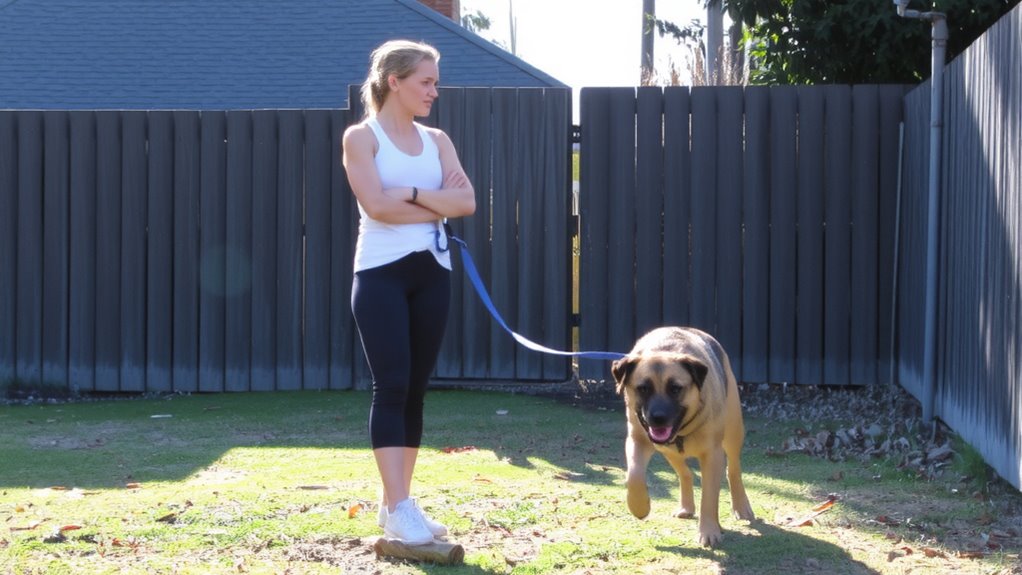
Once you’ve mapped the triggers behind your dog’s aggression, you can shape a response strategy that removes reinforcement without escalating fear. Apply negative punishment by withdrawing attention or access to rewards immediately after unwanted behavior. Use timeout techniques: remove your dog from the stimulating environment for 30 to 60 seconds, placing them in a quiet, distraction-free zone. This pause interrupts the behavior cycle and reduces arousal. Pair timeouts with behavior redirection-immediately cue a compatible action, like “sit” or “look,” when the trigger reappears. Reinforce the desired response with praise or treats. Timeouts must be consistent, brief, and applied within one second of the infraction. Delayed application reduces effectiveness by over 70% in canine learning models. Avoid physical force or scolding. Redirecting focus breaks the link between trigger and aggression, reshaping your dog’s automatic response over time through consequence-based learning.
How Negative Punishment Differs From Positive Punishment
Clarity in terminology shapes effective behavior modification. You must distinguish negative punishment from positive punishment to apply strategies safely and accurately. Negative punishment removes a desirable stimulus to reduce behavior, like walking away when your dog lunges. Positive punishment adds an aversive stimulus, such as a leash correction, to suppress actions. This distinction drives an aversive contrast: one subtracts value, the other imposes discomfort. Ethical concerns arise with positive punishment, as it may increase fear or aggression. Below summarizes key differences:
| Type | Stimulus Change | Example |
|---|---|---|
| Negative Punishment | Removal | Taking away attention |
| Positive Punishment | Addition | Using a loud noise |
| Goal | Behavior reduction | Applied consequence |
Use negative punishment to avoid ethical concerns and enhance learning. It’s more humane and aligns with evidence-based training.
Common Mistakes to Avoid With Negative Punishment
Why do some dog owners fail to see results when applying negative punishment? Inconsistent timing undermines its effectiveness. You must remove the reinforcer immediately after the unwanted behavior-any delay weakens the association. Dogs link consequences to actions within seconds; a 5-second lapse can render the correction meaningless. Emotional reactions also interfere. Reacting with anger or frustration introduces unpredictability, confusing your dog. This isn’t discipline-it’s chaos. Negative punishment relies on predictability and neutrality. Withdrawing attention should be mechanical, not emotional. For example, turning your back within one second of lunging removes social reinforcement efficiently. If you hesitate or yell, you create mixed signals. The behavior persists because the dog doesn’t clearly connect action to consequence. Precision matters. Stick to immediate, calm, consistent responses. That’s how learning accelerates. Avoid these errors, and your dog will understand faster.
Pair Negative Punishment With Positive Reinforcement
You can’t rely on removing reinforcers alone-pairing negative punishment with positive reinforcement creates a complete learning framework. Negative punishment reduces unwanted behavior by withdrawing a reinforcing stimulus, such as walking away when your dog lunges. But without behavior redirection, your dog won’t know what to do instead. Immediately after applying negative punishment, use positive reinforcement to reward calm, alternate behaviors like sitting or making eye contact. Consequence timing is critical: both punishment and reinforcement must occur within 1–2 seconds of the behavior. Delayed responses confuse the dog and weaken learning. Behavior redirection bridges the gap between stopping aggression and teaching acceptable actions. Use high-value treats initially, then fade to intermittent rewards. This dual approach increases predictability, enhances learning speed, and guarantees long-term reliability-much like pairing a circuit breaker with a surge protector in electrical systems. A well-organized training session can benefit from a reliable dog training pouch to keep treats and tools easily accessible.
When to Call a Pro for Aggressive Behavior
Even with consistent use of negative punishment and positive reinforcement, some aggressive behaviors persist or escalate due to underlying causes like fear, territoriality, or neurochemical imbalances. When this happens, professional intervention is necessary. A certified veterinary behaviorist or a credentialed dog behavior consultant uses functional assessment methods to identify triggers and diagnose root causes. They develop individualized treatment plans using scientifically validated protocols. Safety concerns must be prioritized-unpredictable aggression can result in injury. Immediately seek help if your dog displays escalating threats, bite inhibition loss, or aggression in multiple contexts. Early intervention improves prognosis. Professionals may recommend environmental modifications, medication, or behavior modification programs like desensitization and counterconditioning. Do not delay. Your dog’s behavior impacts household safety and welfare. Timely professional intervention guarantees effective, humane resolution.
On a final note
You now understand negative punishment’s role in managing canine aggression. It removes desired stimuli to reduce unwanted behaviors. Timing must be immediate-within 1–2 seconds of the behavior-to guarantee correct association. Unlike aversive-based methods, it avoids fear escalation. Pair it with positive reinforcement for best results. Misuse leads to confusion or increased anxiety. For severe aggression, consult a certified veterinary behaviorist. Precision and consistency guarantee effectiveness.