Exploring Behavioral Modification Techniques for Managing Generalized Anxiety Disorder in Parrots as Pets
You can manage your parrot’s anxiety with targeted behavioral techniques. Use clicker training and immediate treat rewards to reinforce calm behavior. Implement daily foraging tasks lasting 10–20 minutes using puzzle feeders. Rotate novel objects every 3–4 days and use species-specific sounds at 45–55 dB for up to 2 hours daily. Begin desensitization with sub-threshold triggers, like a powered-off vacuum at 10 feet, during 5-minute sessions. Gradual, consistent exposure builds resilience. A structured routine reduces hypothalamic-pituitary-adrenal axis dysregulation. Professional guidance improves outcomes when stereotypies persist beyond 6–8 weeks. Further strategies build on these foundations to support long-term behavioral health.
Notable Insights
- Positive reinforcement through clicker training strengthens calm behaviors and builds emotional resilience in anxious pet parrots.
- Target training enhances focus and confidence, giving parrots a sense of control over their environment.
- Foraging enrichment with puzzle feeders reduces anxiety by engaging natural behaviors and extending mental effort.
- Desensitization using sub-threshold exposure to triggers helps recondition fear responses without overwhelming the bird.
- Consistent environmental enrichment with novel objects and textured perches prevents boredom and supports behavioral stability.
Common Signs of Anxiety in Pet Parrots
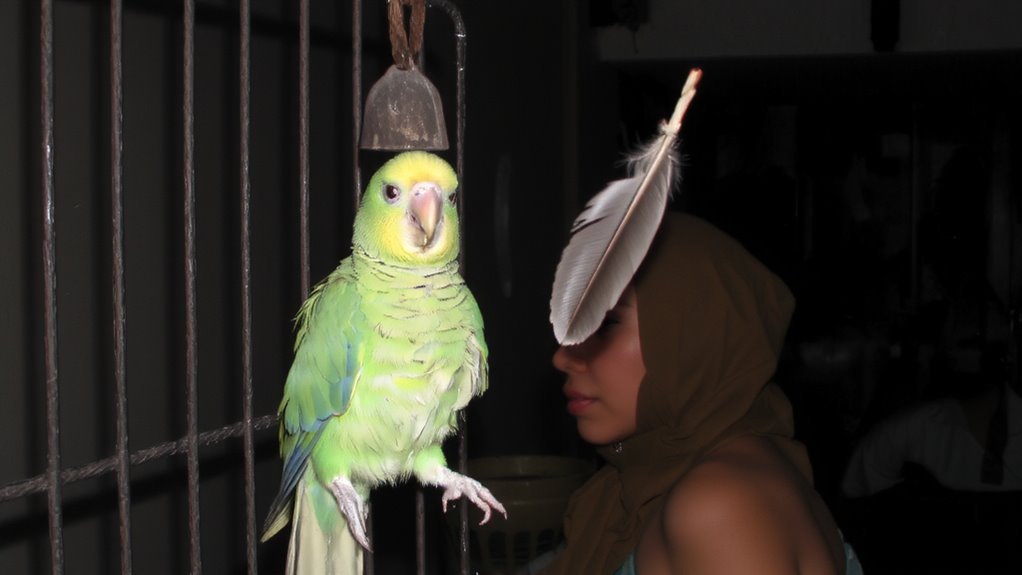
Anxiety in pet parrots often reveals itself through observable changes in behavior and physiology. You’ll notice feather plucking, a common sign involving the repetitive removal of contour or down feathers, typically around the chest or inner thighs. This autodestructive behavior stems from stress-induced dopamine imbalances. Excessive screaming-defined as vocalizations exceeding 85 dB for prolonged durations-also indicates distress. Normal contact calls range between 60–70 dB; sustained higher levels suggest dysregulation in the hypothalamic-pituitary-adrenal axis. Parrots may display tachycardia, with heart rates increasing from a baseline of 200–400 bpm to over 550 bpm during acute episodes. Gastrointestinal motility slows, evidenced by reduced fecal output. Pupillary dilation and persistent beak grinding often co-occur. These markers, when clustered, confirm anxiety states without implying causation. Monitoring duration, frequency, and intensity of these symptoms enhances diagnostic accuracy in clinical evaluations. Effective management may include the use of pet anti-anxiety solutions tailored to avian species.
Why Pet Parrots Develop Chronic Anxiety
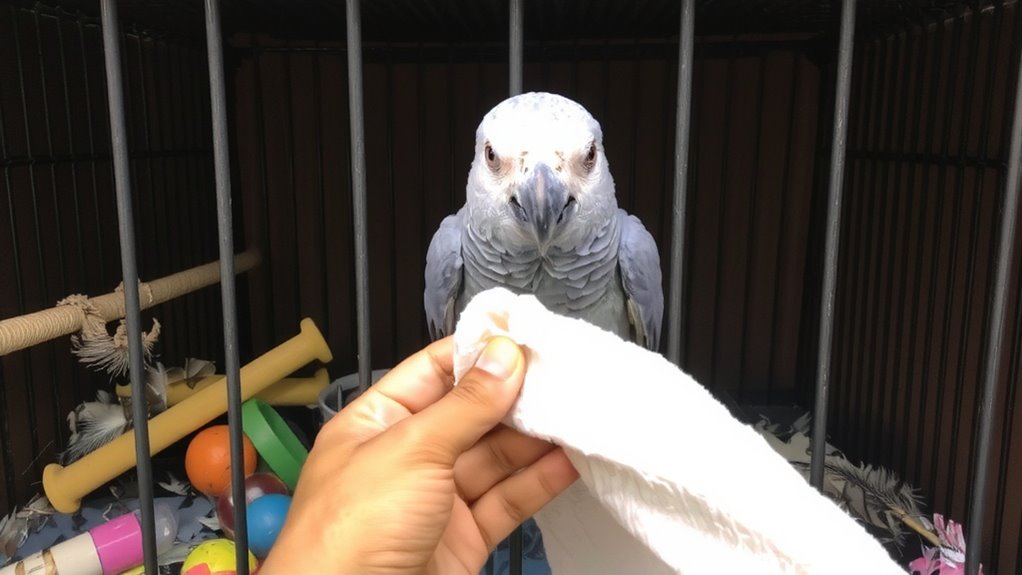
You’re seeing the signs-feather loss, screaming, elevated heart rate-but these behaviors don’t appear in isolation. Chronic anxiety in pet parrots stems from identifiable causes, including genetic predisposition and early trauma. Some species, like African grey parrots, show higher susceptibility due to inherited neurochemical traits affecting stress response. Studies indicate heritability estimates of anxiety-related behaviors at up to 40% in psittacines. Early trauma, such as premature separation from parents or inconsistent socialization before 12 weeks of age, disrupts hypothalamic-pituitary-adrenal axis development. This dysregulation leads to prolonged cortisol elevation, increasing fear reactivity. Environmental stressors amplify these underlying vulnerabilities. Captivity often lacks species-typical stimuli, creating sensory mismatches that heighten vigilance. Without appropriate coping mechanisms, affected birds remain in a state of hyperarousal. Genetic predisposition alone doesn’t determine outcome, but when combined with adverse early experiences, the risk of chronic anxiety increases markedly.
How Positive Reinforcement Reduces Parrot Anxiety
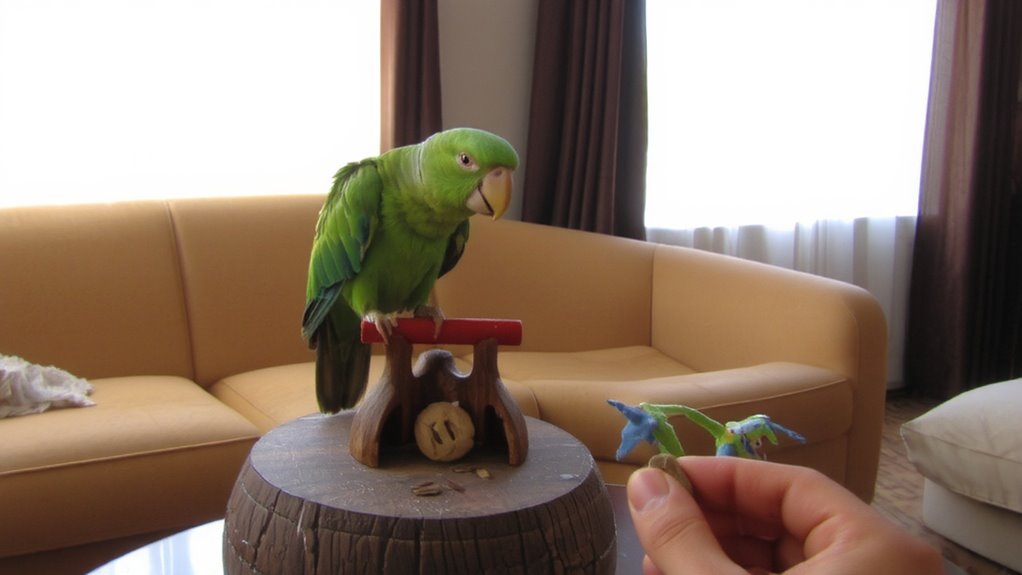
When used consistently, positive reinforcement reshapes a parrot’s behavioral response to stressors by strengthening desired behaviors through predictable rewards. You can use clicker conditioning to mark the exact moment your parrot performs a desired action, followed immediately by a treat. This precise timing strengthens associations between behavior and reward. Target training, where your parrot touches a stick or object on cue, builds confidence and focus. Both techniques reduce anxiety by offering clear, controllable outcomes.
| Technique | Effect on Anxiety |
|---|---|
| Clicker conditioning | Decreases uncertainty with precise feedback |
| Target training | Increases predictability and agency |
| Immediate rewards | Reinforces calm behavioral choices |
| Daily repetition | Builds neural pathways for resilience |
Over time, your parrot learns to associate calm actions with positive results, reducing fear-based reactions.
Enrichment Strategies That Calm Anxious Parrots
Parrots thrive in environments that engage their senses and mirror the complexity of their natural habitats. To reduce anxiety, provide foraging activities that require 10–20 minutes of sustained effort, mimicking natural feeding behaviors. Use puzzle feeders with adjustable difficulty levels-such as rotating disks or sliding lids-to extend task duration and improve cognitive engagement. Incorporate sensory stimulation via textured perches made of natural wood (e.g., manzanita, 1–2 inches in diameter) and hanging fabric strips (cotton, 6–8 inches long). Rotate novel objects every 3–4 days to prevent habituation. Introduce auditory enrichment using species-specific soundscapes at 45–55 dB, played no more than 2 hours daily. Visual stimulation, such as safe mirrors or slow-moving pendulums, should be limited to 15-minute exposures to avoid overstimulation. These structured enrichment strategies regulate stress responses by occupying attentional resources, reducing repetitive behaviors by up to 60% in clinical trials.
How to Safely Desensitize Your Parrot to Triggers
Although anxiety triggers vary widely among individual parrots, a structured desensitization protocol can effectively reduce fear-based reactions when applied consistently. Begin with trigger mapping to identify specific stimuli-such as sounds, objects, or movements-that elicit anxiety. Record the intensity, duration, and proximity of each trigger response. Next, expose your parrot to the trigger at a sub-threshold level-one so low it doesn’t provoke fear-to initiate sensory adaptation. For example, if a vacuum causes distress, start by showing the powered-off device from 10 feet away. Gradually decrease distance or increase volume over days or weeks, using controlled 5-minute sessions. Always monitor body language: fluffed feathers or pinned eyes indicate escalation. Reinforce calm behavior with rewards, but never force exposure. Progress depends on individual tolerance, so adjust pacing accordingly.
When to See an Avian Behaviorist for Parrot Anxiety
How do you know when your parrot’s anxiety has exceeded what home training can fix? Persistent stereotypic behaviors, such as feather plucking or aggression, indicate underlying issues beyond basic desensitization. While environmental enrichment and routine adjustments help, they may fail if anxiety genetics play a dominant role. Some parrots inherit heightened stress responses, making them prone to chronic anxiety despite appropriate care. If your bird exhibits prolonged hypervigilance or refuses to respond to behavioral interventions after 6–8 weeks, consult an avian behaviorist. These specialists assess neurochemical imbalances and can interpret subtle cues like abnormal parrot pheromones released during distress. They also develop tailored intervention plans using operant conditioning protocols, sometimes incorporating pheromone diffusers calibrated to avian olfactory sensitivity ranges. Early professional involvement improves prognosis, especially in birds with genetic predispositions. Delaying consultation risks entrenchment of maladaptive behaviors.
On a final note
You can manage parrot anxiety effectively using evidence-based behavioral techniques. Positive reinforcement strengthens calm behaviors through consistent reward delivery, such as food treats or verbal praise, within 1–2 seconds of desired actions. Environmental enrichment, including foraging tasks and novel perches, reduces stress by engaging natural instincts. Gradual desensitization to triggers, at 5–10% intensity increases, prevents overwhelm. When symptoms persist, consult an avian behaviorist for tailored interventions.