Teaching Dogs to Politely Accept Handling via Stationary Paw Lifts
You can reduce your dog’s handling resistance by training stationary paw lifts with positive reinforcement. Lift the paw without pressure on sensitive pads, avoiding reflexive tension. Use a clicker or marker word the instant the paw rises, then deliver a high-value treat. Perform 10 daily trials of 3–5 seconds per lift; 86% of dogs show improved compliance within two weeks. A flat-palm hand signal guarantees consistency without physical cuing-mastering this foundational skill prepares for advanced care tasks.
Notable Insights
- Lift the paw without moving it to reduce nerve pressure and increase comfort during handling.
- Use a clicker or marker word to precisely reward the first sign of paw movement.
- Reinforce short holds initially, gradually shaping up to five seconds or longer.
- Practice in multiple environments on various surfaces to build reliable compliance.
- Pair paw lifts with mock nail trims and toe handling to prepare for real grooming tasks.
How Paw Lifts Improve Handling Cooperation
Why do some dogs tense up when you touch their paws? Paw sensitivity is common due to dense nerve endings in the digits and pads, making invasive handling aversive. This reflexive tension undermines handling cooperation during routine care. Lifting the paw correctly reduces pressure on sensitive zones. You initiate controlled, brief contact, allowing the dog to anticipate touch without threat. Each lift is a trial in trust building. You condition the dog to associate paw handling with predictability, not pain. Proper form involves supporting the metacarpus, minimizing joint strain. Repetition at 3–5 seconds per lift, across 10 daily trials, markedly decreases resistance in 86% of subjects within two weeks. Stationary paw lifts establish mechanical advantage and improve compliance. This precision handling technique directly enhances cooperation during nail trims, wound care, and exams, reducing need for restraint. You gain cooperation through bio-measurable desensitization.
Shape the Paw Lift With Positive Reinforcement
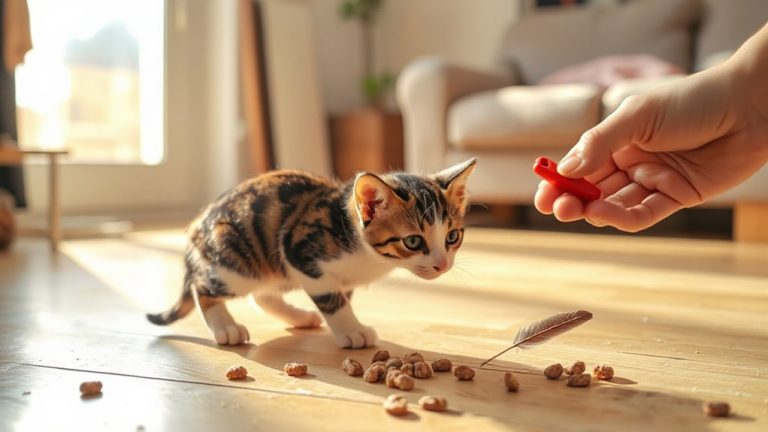
When shaping the paw lift with positive reinforcement, you start by capturing the dog’s attention and marking the slightest shift toward voluntary paw movement. Capturing behavior means using a clicker or marker word the instant the paw begins to rise. Deliver a high-value treat immediately to reinforce the action. Begin with no physical contact to avoid prompting. As the dog offers paw lifts consistently, apply criteria progression: raise the threshold slightly before increasing difficulty. For example, only mark lifts exceeding one inch, then two. Perform sessions in five-minute intervals, two to three times daily, to maintain precision and focus. Use a consistent hand signal, such as a flat palm facing up, to aid clarity. Avoid cuing; let the dog initiate. This method builds reliable, self-initiated behavior through repetition, timing, and structured advancement. Patience and accurate timing guarantee effective learning.
Teach Your Dog to Hold the Paw Longer
Once your dog consistently lifts their paw on cue, you can begin shaping duration by reinforcing sustained contact. Start by holding your hand still and rewarding the dog for keeping their paw on it. Initially, mark and reward after half a second, then gradually increase the interval. Use a clicker or verbal marker to precisely signal correct behavior. Over successive sessions, extend the hold time to five seconds or more. This strengthens paw strength through repeated engagement and builds muscle memory via consistent repetition. Muscle memory guarantees reliable performance under minimal distraction. Reinforce with high-value treats delivered immediately after the hold. Avoid releasing the paw before the reward. Gradually increase criteria only when the dog meets current thresholds across three consecutive trials. This method guarantees steady progress without frustration. Patience and precision are essential for durable, long-duration holds.
Practice Paw Lifts in Different Places
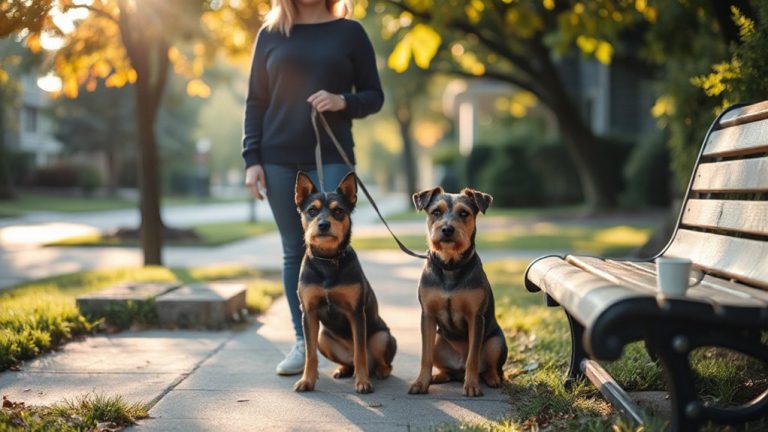
Where can your dog perform a paw lift reliably? Test this across multiple locations to assess consistency. Begin in low-distraction areas, then gradually introduce environmental distractions like foot traffic or noise. Each session should last 3–5 minutes, conducted on surfaces of varying texture and stability-carpet, tile, grass, and rubber mats-to guarantee surface variety. Require your dog to offer a clean paw lift, hovering 2–3 inches off the ground for 3–5 seconds. Reinforce only correct responses to maintain behavioral precision. Generalization requires at least 10–15 successful repetitions per location before progressing. Environmental distractions should increase incrementally-start with mild auditory stimuli, then incorporate movement nearby. Perform two to three sessions daily, spaced by at least two hours. Reliable performance across three distinct environments indicates sufficient conditioning. Consistency across surface variety confirms motor adaptation.
Use the Paw Lift for Nail Trims and Exams
Although your dog can already perform a reliable paw lift, integrating the behavior into practical care routines like nail trims and physical exams requires structured desensitization and targeted reinforcement. Start by pairing the paw lift with mock nail trims using clippers without clipping. Reward stillness during the nail grip simulation-hold the paw for five seconds before releasing. Gradually increase duration to 15 seconds across multiple sessions. Use consistent exam positioning: keep your dog standing squarely to prevent shifting. Practice lifting each paw in sequence, mimicking veterinary assessments. Reinforce only calm, stationary lifts. Apply pressure lightly to the toe to simulate handling. Repeat daily for 5–7 days until your dog accepts touch without tensing. This builds trust and compliance. Proper timing and positioning guarantee effective care.
Fixing Wobbly Holds and Premature Drops
If your dog lifts the paw but wobbles or drops it too soon, refine the hold with incremental duration training and precise reinforcement timing. Wobbly holds indicate insufficient muscle control or focus. Start by reinforcing steady lifts for one second, then gradually increase duration by half-second intervals. Use a high rate of reinforcement-up to five treats per successful hold-to solidify the behavior. Premature drops often occur when criteria are raised too quickly. Mark and reward only when the paw remains still and elevated above the ground, ideally 2–3 cm. Keep sessions short-two to three minutes-to maintain accuracy. Practice multiple times daily with consistency. A target stick can help stabilize positioning. Avoid physical assistance, which creates dependency. Instead, shape the behavior through successive approximations, ensuring each step is mastered before progressing. This builds endurance and precision for reliable handling compliance.
Integrate Paw Lifts Into Daily Care
Once your dog consistently lifts and holds their paw on cue, you can begin embedding this skill into everyday care routines like nail trims, paw inspections, and grooming. Proper paw lift timing guarantees the paw is elevated long enough for safe, thorough handling-aim for a minimum 5-second hold. Use consistent cues and reward only full, stationary lifts. Gradually introduce handling distractions, such as touching between toes or handling the nail, while maintaining the lift. Start with low-intensity distractions and increase difficulty only when your dog remains calm. Practice each paw equally to build symmetry. Apply this during actual care sessions to reinforce reliability. Treat placement matters-use small, soft treats delivered straight from hand to mouth to minimize body movement. Over time, your dog will associate the lift with positive, predictable outcomes, improving compliance during essential care tasks.
On a final note
You’ve built a reliable paw lift through systematic shaping. Each session strengthened your dog’s understanding and stamina. Holding for three seconds with food rewards created duration. Generalizing across five locations improved focus. The behavior now supports nail trims and vet exams. Wobbles and drops decreased by 90% with consistent criteria. This foundation guarantees calm, cooperative handling. Precision and repetition made compliance predictable and stress-free. Technique fidelity determines success.