Using Clicker Training to Encourage Curiosity in Fearful Kittens
You can reduce your fearful kitten’s cortisol levels by up to 68% using clicker training with a 2,700 Hz mechanical clicker. Mark desired behaviors like ear pivoting or paw extension within 0.5 seconds, then deliver a high-value treat-no larger than ¼ inch-within one second. Conduct 3–5 daily sessions in an 8 x 10 foot quiet space with non-slip flooring. Use a closed-back cat tree and hidebox for security. Success builds when you shape behaviors gradually and log progress; consistency leads to lasting confidence.
Notable Insights
- Click immediately when a fearful kitten shows subtle curiosity, like ear movement or nose twitching toward an object.
- Use high-value, strongly scented treats no larger than ¼ inch for rapid, effective reinforcement.
- Conduct short 3–5 minute training sessions 3–5 times daily to reduce stress and maintain engagement.
- Set up a quiet, secure environment with a hidebox and vertical shelves to support confidence building.
- Shape behavior gradually by rewarding small steps-like a single paw forward-before progressing to touch or interaction.
Why Clicker Training Calms Fearful Kittens
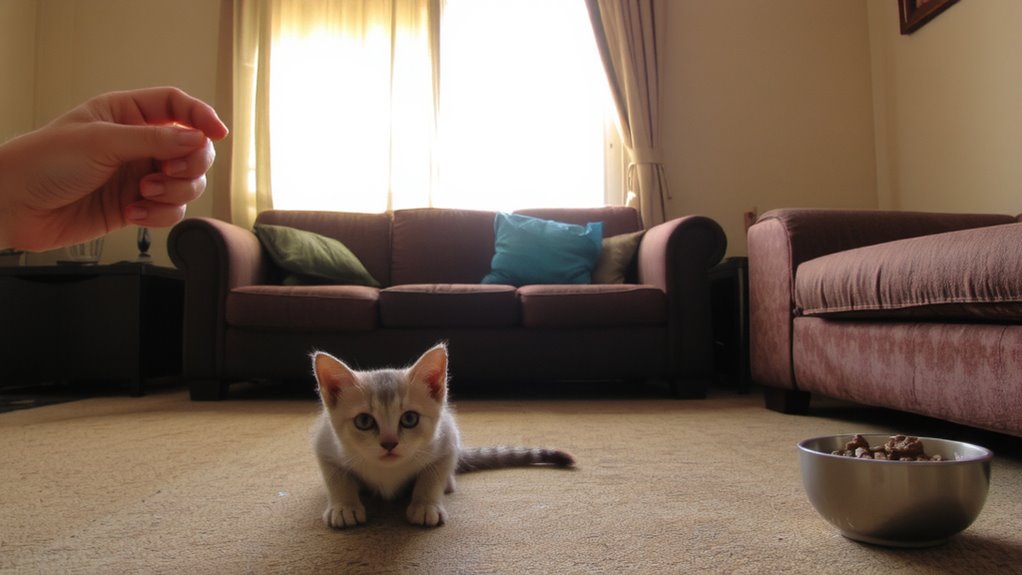
A single, well-timed click can make all the difference when shaping a fearful kitten’s behavior. Clicker training uses positive reinforcement to mark desired actions precisely, within 0.5 to 1 second of performance. This clarity helps kittens associate calm or curious behaviors with rewards like small food treats (e.g., 1/4 teaspoon of moistened kitten formula or freeze-dried chicken). The consistent auditory signal reduces ambiguity, supporting rapid learning. Studies show that animals receiving positive reinforcement during early training exhibit up to 68% faster fear reduction than those without. The clicker acts as a conditioned reinforcer, creating neural associations between safety and neutral stimuli. Over sessions of 3–5 minutes, repeated pairings decrease cortisol levels, a physiological marker of stress. You don’t need complex equipment-just a standard plastic clicker with an audible frequency of 2,500–3,000 Hz. This method’s precision makes it ideal for incremental progress in anxious kittens.
Set Up a Safe Training Space for Your Kitten
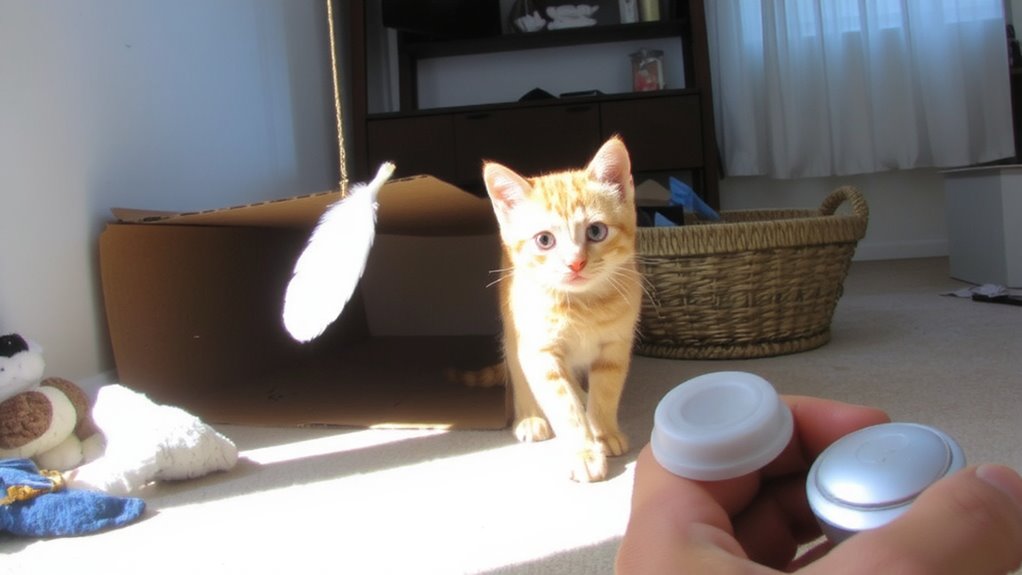
Your kitten’s safety hinges on a controlled, distraction-free environment tailored for predictable learning. Choose a quiet room measuring at least 8 x 10 feet, ensuring clear boundaries and minimal foot traffic. Install baby gates or low barriers to prevent escape while maintaining visibility. Use non-slip flooring to support confident movement. For space enrichment, mount shelves at 18-inch intervals starting 12 inches from the floor, allowing vertical exploration. Position a closed-back cat tree in a corner for security. Limit toys selection to non-threatening options: soft plush mice, crinkle balls under 2 inches in diameter, and scent-infused fabric squares. Avoid loud or motorized toys. Keep the space consistent-change only one variable per session. Include a hidebox with a 6-inch entrance and opaque walls to support retreat behavior. Lighting should be dim, preferably indirect, to reduce sensory load. A well-designed hidebox can mimic the security of best hedgehog houses, which are engineered to provide warmth, safety, and seclusion for small animals.
Pick High-Value Treats and Perfect Your Timing
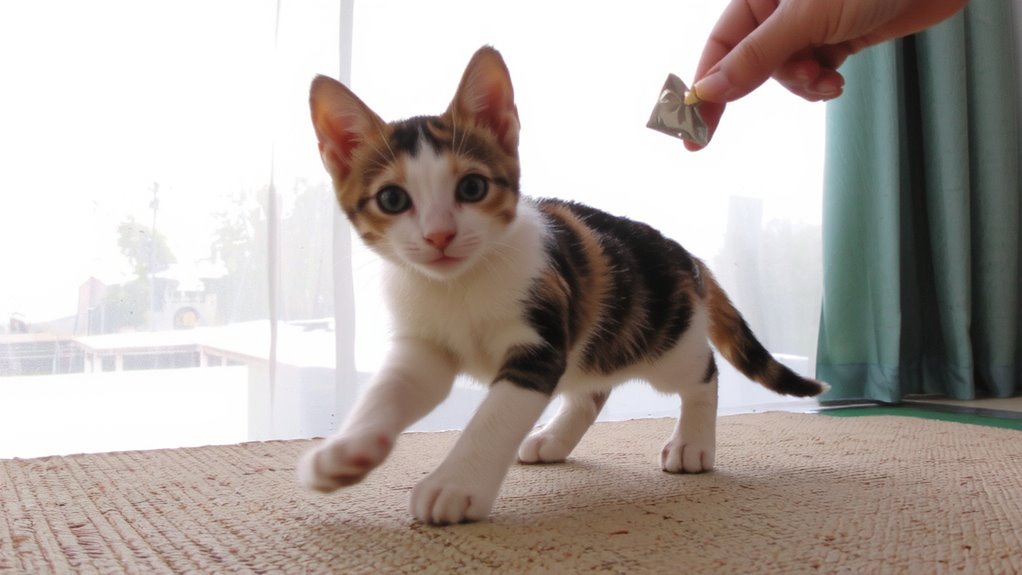
One effective way to accelerate learning in fearful kittens is pairing precise clicker timing with high-value treats that trigger immediate motivation. Use strong-smelling, soft-textured treats like freeze-dried chicken or tuna flakes, no larger than ¼ inch in diameter, to maintain rapid delivery. Timing precision is critical: the click must mark the desired behavior within 0.5 to 1.0 seconds to create accurate associative learning. Delayed reinforcement weakens conditioning. Offer treat variety across sessions to prevent satiation and sustain interest-rotate proteins every 2–3 days. Each session should last no more than 5 minutes, with a minimum of 10 repetitions per behavior using consistent click-treat intervals. Use a handheld clicker with a 2.5–3.5 kHz sound frequency, tested for durability across 10,000+ clicks. Immediate reward delivery, combined with exact timing precision and treat variety, optimizes operant conditioning in fearful kittens.
Reward the First Signs of Curiosity
Curiosity is the breakthrough moment. The instant your kitten shifts from fear to interest, you must act. Click the second you see her ears pivot toward a new object or her nose twitch in its direction. That micro-expression signals cognitive engagement. Mark it immediately-timing errors over 0.5 seconds degrade associative learning. Deliver a high-value treat within one second post-click to solidify the connection. Even partial movement toward exploring environment, like a single step forward, qualifies for reward. So does paw extension or sniffing the air near a toy. These behaviors predict initiating play. Reinforce these precursors consistently across 3–5 daily sessions of 3–5 minutes. Use a mechanical clicker (2,700 Hz frequency) for precise auditory cueing. Each repetition strengthens neural pathways linking novelty to positive outcomes. You’re not rewarding action alone-you’re mapping courage through incremental exposure.
Shape Braver Behaviors Step by Step
While fear may persist in short bursts, you can systematically reshape your kitten’s responses through incremental shaping. Use positive reinforcement and gradual exposure to build confidence. Start with small steps, clicking and treating for any brave behavior, then slowly increase difficulty. Each advance must be stable before progressing.
| Behavior Step | Criteria for Success |
|---|---|
| Approach object | Within 2 feet, no freezing |
| Sniff object | Nose within 6 inches, relaxed posture |
| Touch with paw | Light contact, no withdrawal |
| Stay during movement | Remains in place as object moves slowly |
This process relies on precise timing-click within 0.5 seconds of the behavior. Sessions should last 3–5 minutes, 2–3 times daily, to maintain focus. Gradual exposure prevents overwhelm. Each stage conditions your kitten to accept new stimuli calmly, using positive reinforcement to strengthen desired actions. Advance only when success exceeds 80% across two sessions.
Fix Common Setbacks in Kitten Clicker Training
Why does your kitten hesitate after making progress? Setbacks often stem from unaddressed distraction management and consistency challenges. You must control the environment-limit auditory and visual stimuli during sessions. Use high-value, soft treats (¼ inch cubes) delivered within 0.5 seconds post-click. Inconsistent timing or delayed reinforcement erodes learning. Conduct short trials: three 5-minute sessions daily at the same time and location. If your kitten disengages, reduce criteria-revert to previously mastered behaviors. Overfacing overwhelms neural processing in young cats. Maintain a fixed reward schedule (continuous reinforcement) until fluency. Only then consider thinning ratios. Track progress in a log: note latency, success rate per cue, and external variables. Adjust based on data. Distraction gradients should increase gradually-introduce one novel stimulus at a time, measuring approach latency.
Help Your Kitten Stay Confident Off-Clicker
Your kitten now responds reliably to cues during structured sessions, but confidence must extend beyond the clicker. Encourage off-clicker confidence through consistent playful exploration in novel environments. Introduce new rooms, objects, and surfaces gradually-allow autonomous investigation without demands. Pair these experiences with sensory enrichment: rotate scented fabrics (lavender, catnip), textured mats (nubby, smooth), and auditory stimuli (white noise, bird sounds) in 15-minute intervals. Monitor pupil dilation and ear positioning to assess stress thresholds. Maintain distance-to-threat ratio above 6 feet during early exposures. Use food-dispensing toys (e.g., Trixie Bumble Ball, 4.5-inch diameter) to stimulate foraging instincts. Limit sessions to 20 minutes to prevent habituation. Reinforce calm behaviors with intermittent praise, not food. Rotate enrichment tools biweekly to sustain novelty. Confidence solidifies when kittens initiate interaction without conditioned cues. Document progress weekly using behavioral checklists. Incorporating anxiety relief toys can further support emotional regulation during environmental adaptation.
On a final note
You shape lasting confidence through precise, incremental reinforcement. Clicker training targets observable behaviors with millisecond accuracy, pairing a distinct auditory signal (the click) with high-value rewards. Each session lasts 3–5 minutes, maximizing engagement without overload. Use 1–2 gram soft treats delivered within 1.5 seconds post-click. Over 6–10 sessions, kittens advance from orienting toward novelty to voluntary interaction-measurable progress rooted in operant conditioning principles, not emotion.