Building a Socialization Plan Using Calm, Leashed Dog Walks
Start your socialization plan by identifying triggers like bikes or squirrels that cause leash tension. Use a 6-foot polyester leash to deliver immediate feedback when tension occurs, preventing arousal. Train in low-distraction areas-early morning parking lots or quiet sidewalks-where you can maintain 15–20 feet from triggers. Reward calmness within 1–2 seconds using treats. Only decrease distance by 5-foot increments after consistent success, tracking reaction thresholds and latency. Progress indicates inhibitory conditioning is forming.
Notable Insights
- Start training in low-distraction environments like empty parking lots or quiet sidewalks to build focus.
- Use a 6-foot polyester leash to detect and respond to tension immediately when triggers appear.
- Reward calm behavior within 1–2 seconds of passing a trigger to reinforce positive associations.
- Maintain a 10- to 20-foot distance from triggers, adjusting based on your dog’s reaction threshold.
- Gradually decrease distance in 5-foot increments only after consistent calmness and slack leash.
Start With the Trigger, Not the Theory
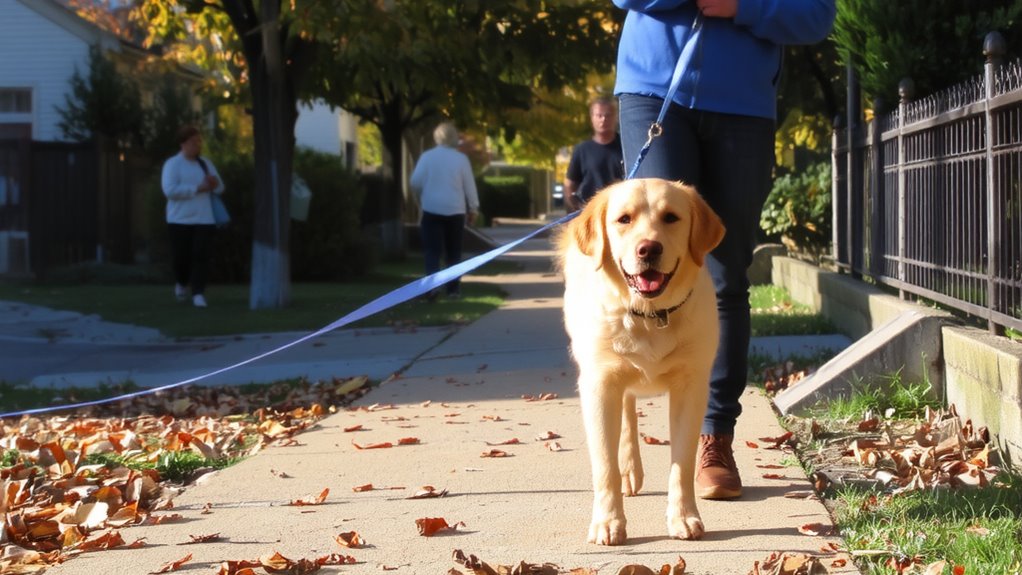
The trigger starts it all-your dog’s reaction to a specific stimulus is the key to shaping effective training. You observe dog behavior closely to identify what prompts arousal or stress. A sudden lunge at squirrels, barking at bikes-these responses reveal the real-world triggers affecting your control. Leash tension spikes the moment the trigger appears; measuring this force helps calibrate intervention timing. High tension correlates with reduced cognitive function in dogs, delaying learning. Immediate, consistent feedback at the onset of leash tension resets the behavioral response loop. Use a standard 6-foot polyester leash-its minimal stretch transmits precise pressure cues. React *before* the threshold where dog behavior becomes reactive. Training begins not with abstract theory, but with measurable, repeatable responses to tangible triggers. Data-driven observation guarantees accurate trigger mapping. Success hinges on timing, tool consistency, and environmental specificity.
Pick Low-Distraction Walks for Training
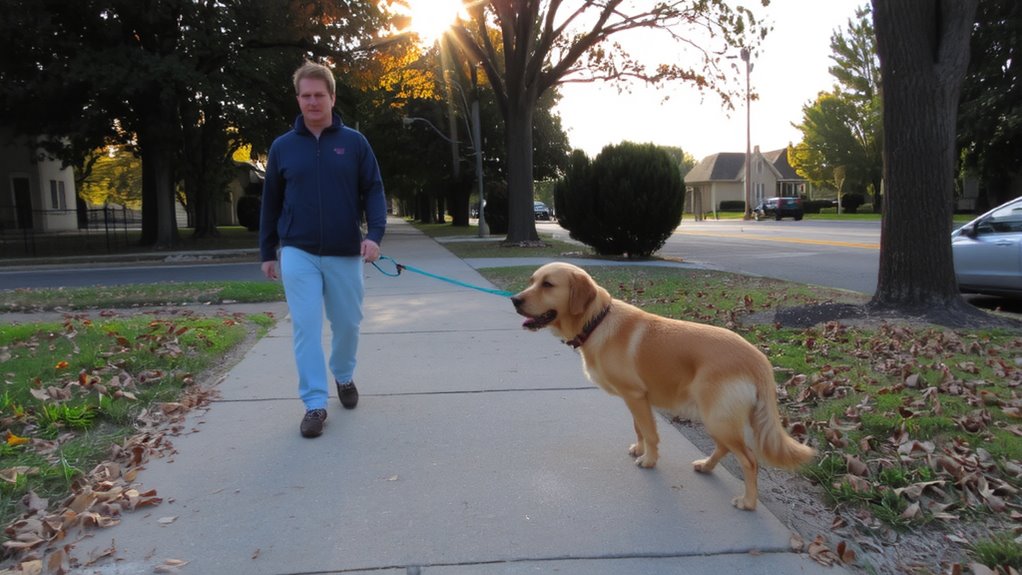
While you’re building reliable leash manners, choose training environments with minimal stimuli to maximize focus and consistency. Quiet environments reduce arousal levels, allowing your dog to process cues effectively. Follow consistent routines to reinforce learning and prevent setbacks.
| Time of Day | Recommended Location |
|---|---|
| Early morning | Empty parking lots |
| Mid-morning | Residential sidewalks |
| Late afternoon | Tree-lined bike paths |
| Early evening | School grounds (closed) |
| Weekend dawn | Parks (unoccupied) |
These locations offer controlled, low-traffic scenarios ideal for skill acquisition. Exposure to predictable stimuli strengthens neural pathways associated with obedience. Practice during the same time daily to align with circadian behavior patterns. Each session should last 10–15 minutes to maintain cognitive engagement without fatigue. Use a 4–6 foot nylon leash for ideal control. Quiet environments paired with consistent routines create repeatable training conditions essential for long-term behavioral change.
Reward Calmness When Dogs Pass By
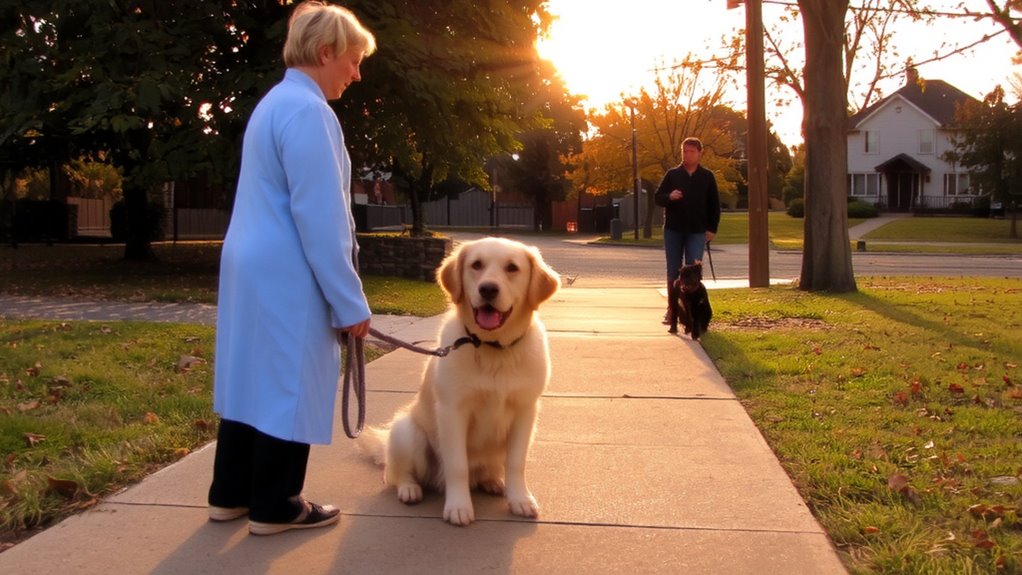
You’ve set up quiet environments to build focus, now shift to reinforcing calm behavior when distractions appear. When a dog passes by, reward your dog immediately upon remaining relaxed and composed. Use positive reinforcement-offer treats, praise, or toys-to strengthen this desired behavior. Accurate, consistent timing is essential: deliver the reward within 1–2 seconds of calm conduct to clearly link the action with the reward. Delayed responses weaken association and reduce learning efficiency. Begin at a distance where your dog notices but does not react-typically 15–20 feet. Deliver high-value rewards intermittently to maintain engagement. Gradually decrease distance as your dog consistently demonstrates calmness. Each repetition strengthens neural pathways associated with self-control. Track progress by recording reaction thresholds and latency to respond. Adjust variables like speed, angle, and spacing to improve generalization. Practice multiple times per session for ideal skill retention.
Keep a Safe Gap From Triggers
Start with a 10- to 15-foot buffer between your dog and any trigger-this safe gap gives your dog enough space to stay below threshold and remain mentally engaged. Maintain consistent leash tension: slack indicates calmness; tightness signals stress. Adjust trigger distance based on your dog’s temperament and past reactivity. A wider gap reduces arousal, allowing your dog to process stimuli without escalating into fight-or-flight responses. For reactive dogs, begin at 20 feet, then gradually refine as behavior improves. Use a 6-foot standard leash for control, or a 15-foot training lead in open spaces for flexibility. Keep movements smooth-abrupt pulls increase leash tension and anxiety. Monitor body language closely: a stiff posture or focused stare means the current trigger distance is too narrow. Prioritize consistency to build reliable responses. This methodical spacing establishes predictability, essential for long-term behavioral change.
Move Closer Only When Your Dog Stays Calm
Only after your dog consistently remains relaxed at a safe distance should you begin closing the gap to the trigger. Approach slowly, reducing distance in 5-foot increments only when your dog shows zero signs of tension. Use positive reinforcement immediately upon calm behavior-offer high-value treats within 1–2 seconds of exposure. This consistent timing strengthens associative learning, linking the trigger’s presence with rewards. If your dog tenses, freeze-do not retreat-then resume once relaxation returns. Each session should last 10–15 minutes, occurring 3–5 times weekly under controlled conditions. Maintain a loose leash; tension signals overload. The goal is inhibitory conditioning: your dog learns the trigger predicts good outcomes. Progress is measurable in decreased latency to accept treats and lower heart rate near stimuli. Always prioritize calm over proximity.
Monitor Signs of Progress (and Setbacks)
Progress isn’t always measured by how close your dog gets to the trigger, but by how consistently they stay relaxed in its presence. You should track baseline behaviors-like loose leash posture, steady breathing, and lack of tension-to identify improvement. Use a journal to record distance to triggers, duration of calm behavior, and responses to cues. Positive reinforcement strengthens desired actions; offer treats within 0.5 seconds of calm behavior for ideal conditioning. Setbacks may include sudden lunging or freezing-note environmental variables like noise levels or proximity changes. Reactivity doesn’t mean failure; it signals the need to reset to a safer distance. Reassess your dog’s thresholds every session. Progress is linear only in controlled settings. In real-world conditions, expect plateaus. Adjust criteria gradually-only decrease distance or increase stimuli when your dog maintains relaxation for three consecutive trials.
On a final note
You control the environment to shape your dog’s responses. Begin with walks in low-traffic areas, maintaining a 10–15 foot buffer from triggers. Use high-value treats (e.g., boiled chicken, cheese) the moment a dog appears, reinforcing calm behavior. Only decrease distance when your dog remains relaxed-no pulling, barking, or tense muscles. Track progress weekly: note reduced latency in calmness and increased focus. Consistency yields measurable behavioral change.