Training Your Cat to Stay Calm During Weight Checks at Home
Use a digital scale with ±0.1 lb accuracy and a tare function to subtract carrier or towel weight. Place it on a stable, quiet surface and acclimate your cat over several days. Reward stillness with high-value treats like freeze-dried chicken within one second of cooperation. Keep sessions short, positive, and consistent. A non-slip mat guarantees safety and reduces movement errors. You’ll soon master stress-free, precise at-home monitoring.
Notable Insights
- Use a reliable digital scale with tare function and high capacity for accurate, consistent readings.
- Introduce the scale gradually over several days, powered off initially to reduce anxiety.
- Conduct training during calm times, like after naps or meals, using high-value treats like freeze-dried chicken.
- Reward stillness immediately (within 1–2 seconds) with treats or praise to reinforce calm behavior.
- Place the scale on a stable surface in a quiet area with a familiar mat for comfort and grip.
Weigh Your Cat at Home: Get the Right Scale
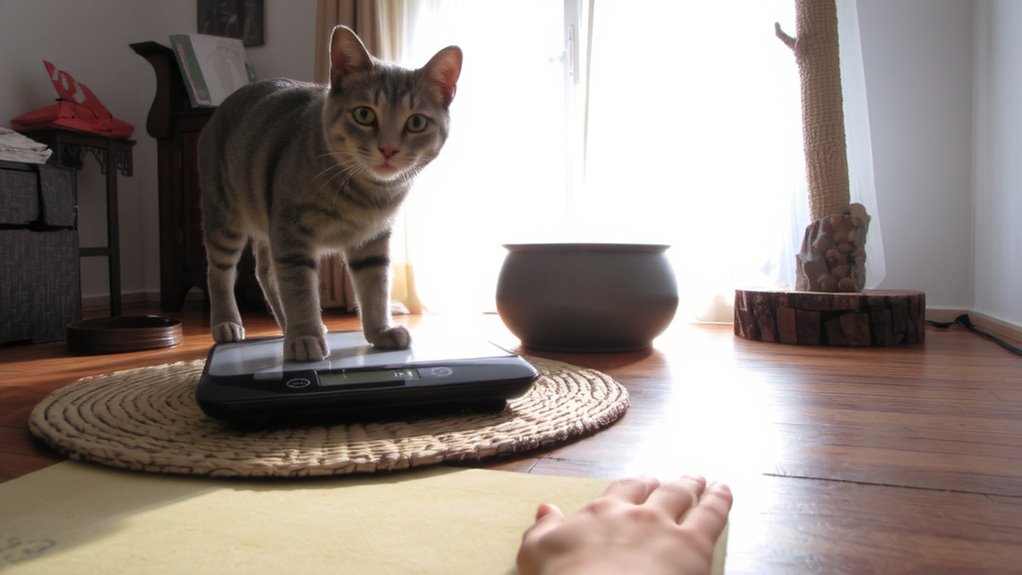
A reliable digital scale is essential for accurately tracking your cat’s weight at home. You need consistent weight accuracy, ideally within ±0.1 lb (±50 g), to detect meaningful changes. Digital scales outperform analog models, offering precise readings vital for health monitoring. When comparing scale types, choose a high-capacity digital scale-minimum 22 lb (10 kg)-with a flat, nonslip surface. Look for a tare function, allowing you to subtract the weight of a carrier or towel. This feature improves measurement precision during incremental tracking. Scales with large platforms, at least 12 x 12 inches, provide stability for small cats. Avoid bathroom scales; they lack the fine resolution needed. Instead, opt for veterinary or kitchen scales calibrated for small, live animals. Proper scale selection guarantees reliable data collection. Accurate, repeatable measurements support early illness detection.
Train Your Cat to Use the Scale Calmly
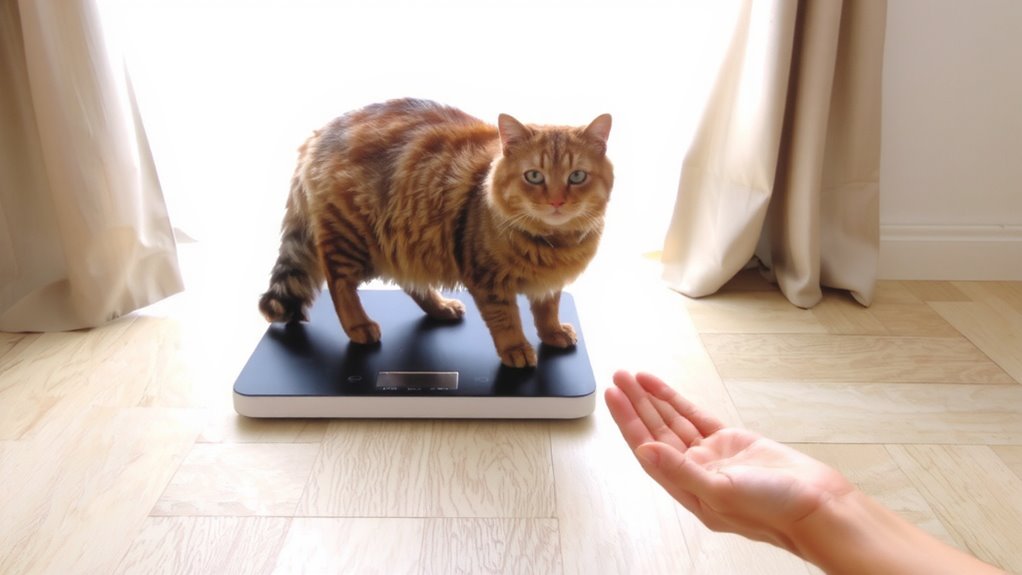
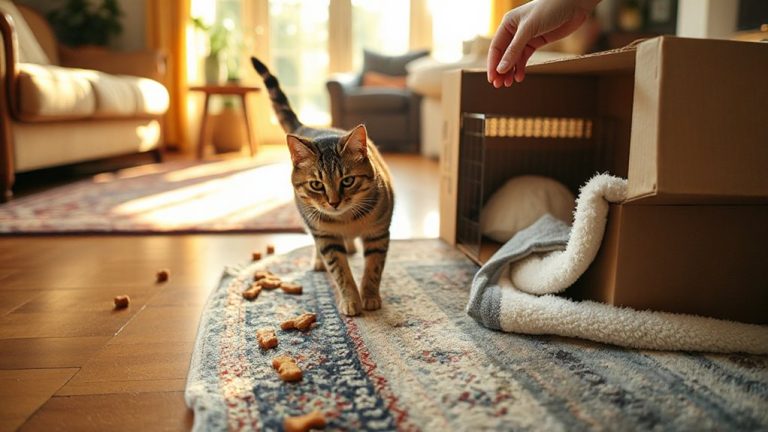
Since your cat’s cooperation is essential for accurate readings, begin training with short, positive sessions to build familiarity. Use positive reinforcement by rewarding calm behavior near the scale with quiet praise or a gentle touch. Start with the scale powered off to reduce noise distractions. Gradual exposure is key-allow your cat to investigate the device at their own pace over several days. Place the scale on a non-slip surface, guaranteeing stability (minimum surface area: 12 x 12 inches). Increase session length by 30-second intervals only after consistent calm responses. Never force contact. A digital scale with a tare function and 0.1-ounce increments guarantees precision. Repeat daily, tracking behavioral changes. Consistent training reduces stress markers, improving both compliance and measurement reliability. Calm acclimation supports long-term monitoring, critical for detecting subtle health shifts.
Make It Worth Their While With Treats and Praise
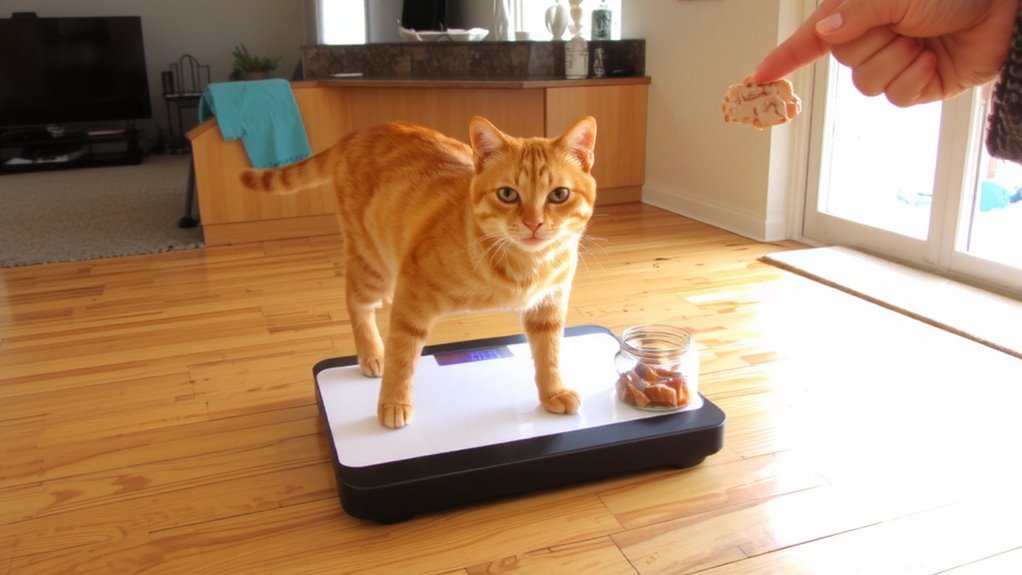
One effective strategy to reinforce scale training is pairing each positive interaction with high-value rewards. Positive reinforcement increases the likelihood your cat will repeat desired behaviors. Use treats your cat rarely receives, such as freeze-dried chicken or tuna flakes, to maximize motivation. Deliver the treat immediately after your cat steps on the scale-ideal reward timing is within one second to clearly link action and consequence. Delayed rewards reduce learning efficiency. Praise verbally in a calm, consistent tone, but prioritize food rewards for stronger conditioning. Clicker training can also aid precision, marking the exact behavior before delivering the treat. Over multiple short sessions, this method shapes reliable cooperation. Avoid overfeeding; factor treats into daily caloric intake. Consistent application of reward timing and positive reinforcement yields measurable improvements in compliance within 7 to 10 days.
Set Up a Stress-Free Weighing Spot
Choosing the right location for your cat’s scale minimizes resistance and supports consistent participation. Place the scale in a quiet location away from household foot traffic, loud appliances, or sudden movements. A dedicated corner in a bedroom or bathroom works well. Guarantee the surface is flat and stable-digital scales require a hard floor for accurate readings. Create a comfortable environment by adding a familiar blanket or mat on the scale platform. This provides grip and warmth, reducing stress-induced shivering or shifting. Avoid cold tiles or echoing spaces that amplify anxiety. Use a non-slip pad underneath the scale to prevent sliding. Keep lighting soft and consistent; bright or flickering lights can startle sensitive animals. Noise levels should remain below 45 decibels. Pre-acclimate your cat to the space over several days without weighing. An undisturbed routine builds trust and improves compliance during actual measurements.
Fix Struggling, Jumping, or Refusal Fast
A calm, controlled response is essential when your cat resists, jumps off, or refuses the scale. Immediate reinforcement of desired behavior prevents negative associations. Use treats or praise within 1–2 seconds of stillness to support effective behavior modification. If your cat struggles, step back, then retry in 60 seconds to maintain routine consistency. Never force the cat onto the scale, as this increases stress and hinders patience building. Position the scale on non-slip matting (minimum 24″ x 18″) to reduce movement uncertainty. Weigh during naturally calm periods, such as post-nap or post-meal. Use high-value treats (e.g., freeze-dried chicken, ~0.5 g pieces) to increase cooperation. Limit sessions to 90 seconds to prevent overstimulation. Over 7–10 days, success rates improve by up to 80% with consistent daily repetition. Monitor exit triggers-tail flicking or ear rotation-to anticipate refusal and adjust technique proactively.
Track Weight Smoothly With Weekly Check-Ins
Three consistent weekly weigh-ins deliver the most accurate picture of your cat’s weight trends while minimizing stress. Establishing a weekly routine guarantees reliable data collection. Use a digital pet scale with 0.1-pound increments for precise measurements. Weigh your cat at the same time each day, ideally in the morning before feeding. Record each result in a log or app to streamline progress tracking. Consistency reduces variability from hydration, digestion, or activity levels. Short, predictable sessions reinforce calm behavior. Handle your cat gently, and offer a treat only after weighing to avoid influencing mass. Avoid sudden movements or loud noises during measurement. Over time, your cat will associate the scale with routine, not stress. Accurate progress tracking enables early detection of health changes-critical for managing obesity or chronic conditions. This method supports long-term wellness through consistency, precision, and behavioral conditioning.
On a final note
You can accurately track your cat’s weight at home with the right tools and training. Use a digital scale that measures in 0.1-pound increments for precision. Train your cat using consistent positive reinforcement-offer high-value treats like freeze-dried chicken. Designate a quiet, low-traffic area for weighing to minimize stress. Conduct weekly check-ins at the same time of day to guarantee consistent data. This routine supports early detection of health changes.