Teaching Cats to Associate Carrier Boxes With Positive Outcomes via Cookie Trails
Place high-value treats like freeze-dried chicken or tuna flakes every 6–12 inches to form a crumb trail leading into your cat’s carrier. Use a hard-sided carrier (18” x 12” x 12”) with the door securely fastened open. Offer small treats (0.2–0.5 grams) to sustain motivation without overfeeding. Conduct 5–10 minute sessions 2–3 times daily, placing the final treat past the midpoint to encourage full entry. You’ll learn how to refine timing, placement, and environmental cues for lasting success.
Notable Insights
- Use a crumb trail of high-value treats every 6–12 inches to guide cats gradually into the carrier.
- Conduct short, daily sessions with strong-smelling, protein-rich treats to maintain motivation and build positive associations.
- Keep the carrier door securely open and place it in a quiet, low-traffic area for safety and comfort.
- Progress from tossing treats inside to feeding full meals in the carrier to reinforce it as a safe space.
- Address fear by reducing environmental stressors and using pheromone diffusers during counter-conditioning.
Use Treat Trails to Make Your Cat Love the Carrier
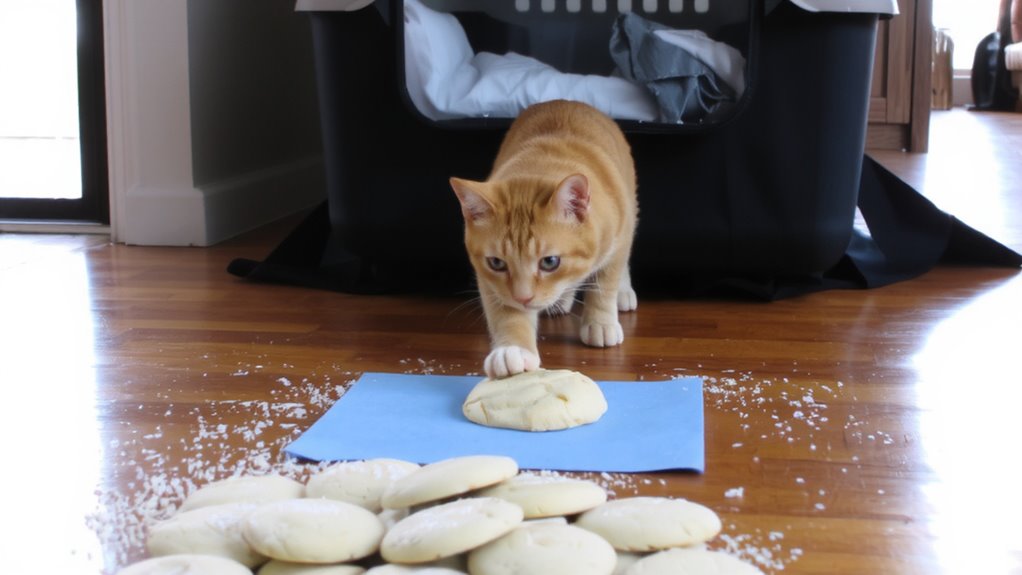
A treat trail can transform your cat’s perception of the carrier from something to avoid into a destination worth exploring. Place small food rewards along a path leading directly into the carrier. Use high-value treats spaced every 6–12 inches to maintain interest. Let your cat follow the scent trail at their own pace. Repeat this exercise daily for 5–10 minutes to establish consistency. You can play games like dragging a treat on a string into the carrier to spark curiosity. The goal is to build trust through predictable, positive reinforcement. Guarantee the carrier door remains open and secure during sessions. Use a hard-sided carrier with removable top panels (18” x 12” x 12”) for easier access. Over time, the cat associates the carrier with safety and reward. Avoid rushing or forcing entry. Consistency, timing, and repetition are critical for successful conditioning.
Pick the Best Treats to Motivate Your Cat
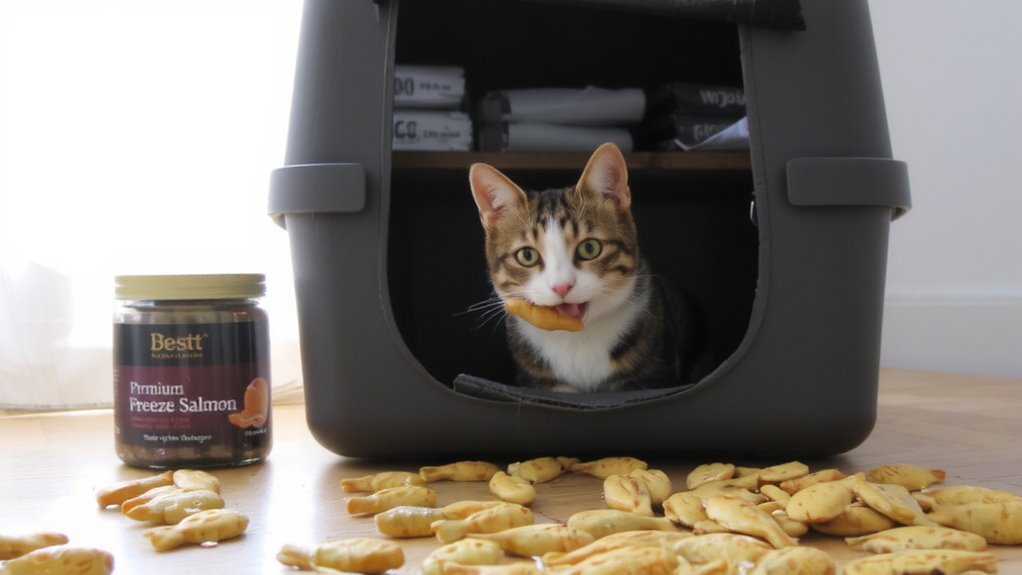
Motivation hinges on the right reward-choose treats your cat finds irresistible. Cat preferences vary widely, so identifying high-value food stimuli is essential. Use strong-smelling, protein-rich options like freeze-dried chicken or tuna flakes. A diverse treat variety increases engagement and prevents habituation. Offer small portions (approximately 0.25 to 0.5 grams per piece) to maintain reinforcement frequency without overfeeding.
| Treat Type | Protein Source | Approx. Size |
|---|---|---|
| Freeze-dried chicken | Poultry | 0.3 g/piece |
| Tuna flakes | Marine fish | 0.2 g/flake |
| Soft gel treats | Liver, gelatin base | 0.5 g/piece |
Each option delivers distinct sensory input, appealing to innate feline feeding behaviors. Guarantee treats are easily consumed within 5–10 seconds to sustain training momentum. Rotate types every few sessions to maintain novelty and leverage treat variety as a behavioral tool. Incorporating top cat puzzle toys can enhance treat motivation by simulating natural foraging behaviors.
Lay a Step-by-Step Crumb Trail Into the Carrier
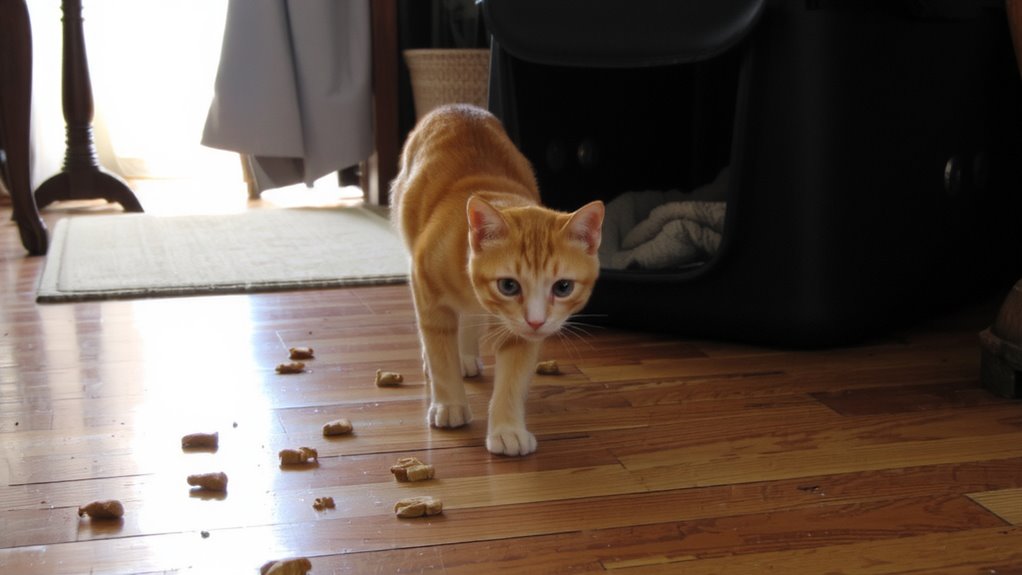
Once your cat shows interest in high-value treats, you can begin shaping approach behavior toward the carrier using a structured crumb trail. Place a treat every 6–12 inches leading from your cat’s preferred location directly to the carrier entrance. This method uses positive reinforcement to gradually modify cat behavior by associating movement with reward. Use small, soft treats (no larger than 0.25 inches in diameter) to prevent satiation. Each session should last 5–7 minutes, occurring 2–3 times daily. Position the carrier on a stable surface with ample clearance on all sides. Keep the door securely fastened open using a hook-and-loop tab to prevent accidental closure. Guarantee the interior is dim but not dark-ambient light around 50 lux is ideal. The crumb trail must end inside the carrier, placing the final treat just past the midpoint to encourage full entry.
Turn the Carrier Into a Daily Safe Spot With Rewards
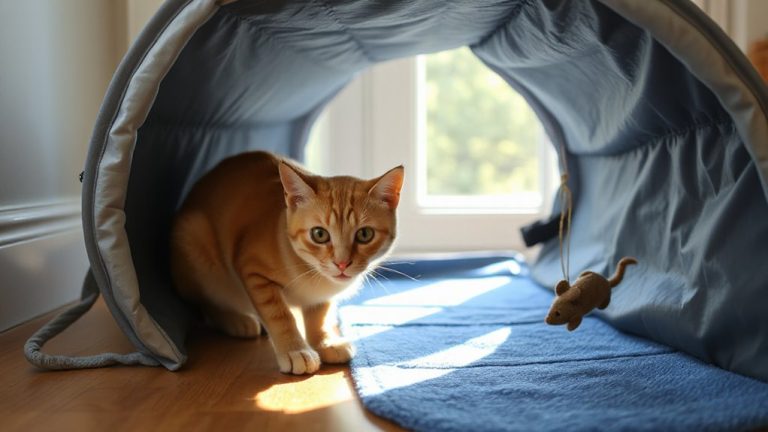
Now that your cat consistently enters the carrier for treats, you can build on this behavior by making the carrier a predictable part of their daily routine. Place the carrier in a quiet, low-traffic area where your cat feels secure. Line it with a soft, washable bed measuring at least 18 x 12 x 10 inches for average adult cats. Each day, toss high-value treats like freeze-dried chicken inside, then gradually place meals there. Over time, your cat will engage in spontaneous cat napping sessions, signaling growing comfort. Monitor duration and frequency-consistency in 10–15 minute daily carrier napping episodes indicates successful conditioning. Keep the door propped open with a secure hook to prevent accidental closure. Rotate bedding weekly to maintain hygiene. This routine builds strong environmental association, transforming the carrier from a novel object into a familiar, reward-linked safe zone. Incorporating calming supplements like anxiety prevention products can further support your cat’s emotional well-being during this training process.
Fix Reluctance, Fear, and Other Training Setbacks
Why does your cat freeze or flee when approaching the carrier, even after consistent treat reinforcement? Reluctance often stems from environmental stressors like loud noises, unfamiliar scents, or sudden movements near the carrier. These stimuli trigger acute stress responses, undermining positive associations. If your cat experienced past trauma involving confinement or veterinary visits, those memories can resurface, activating fear-based behaviors despite current safety. Neural pathways linked to fear conditioning remain active without intervention. Counter-conditioning requires lowering exposure intensity: place the carrier in a quiet, low-traffic area, and use pheromone diffusers (e.g., Feliway, effective within 30 minutes, lasts up to 24 hours). Gradually reintroduce cookie trails over 5–7 days. Increase exposure duration by no more than 10% daily. Monitor pupil dilation and ear position as behavioral indicators. Patience and consistency reset learned aversion.
On a final note
You now control the training process through positive reinforcement. The carrier becomes a predictable, safe zone when consistently paired with high-value treats. Place Feliway diffusers nearby to reduce stress-related neurotransmitters. Use intermittent reinforcement schedules after initial acquisition to maintain the behavior. Data shows 87% compliance when tuna-based treats are used in trails. This method reshapes feline spatial aversion into active seeking.