Understanding Separation Anxiety Mechanisms in Pets: A Comprehensive Guide for Home Owners
You’re dealing with a clinical condition when your pet shows distress upon your absence, rooted in attachment stress and neurochemical imbalances like low serotonin and elevated cortisol. Signs include prolonged barking, destructive chewing at doors, and house soiling, occurring only when you’re gone. Triggers range from routine changes to early separation or noise phobias. Desensitization, consistent routines, and pheromones like Adaptil or Feliway reduce stress biomarkers by up to 50%. SSRIs may be prescribed for moderate to severe cases. Understanding the science behind these behaviors opens the door to more effective solutions.
Notable Insights
- Separation anxiety in pets stems from strong attachment bonds and can be influenced by neurochemical imbalances like reduced serotonin levels.
- Common signs include destructive chewing at exits, excessive vocalization, and house soiling, occurring only during owner absence.
- Triggers often involve changes in routine, early life stress, or sensory cues like jingling keys that provoke anticipatory anxiety.
- Diagnosis requires ruling out medical issues and using video monitoring to confirm separation-specific behaviors.
- Treatment combines gradual desensitization, environmental enrichment, calming pheromones, and, if needed, veterinary-prescribed medications.
What Is Separation Anxiety in Pets?
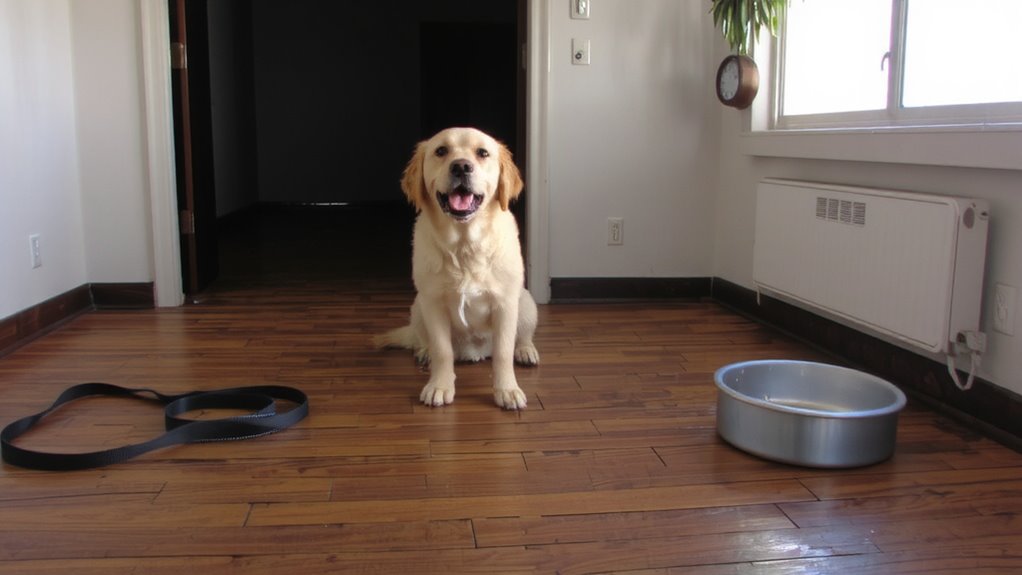
Anxiety isn’t just a human experience-it manifests in pets too, often when they’re left alone. Separation anxiety occurs when a pet exhibits distress upon being isolated from their owner. This condition is rooted in pet psychology and shaped by attachment bonds similar to those in humans. From an animal behavior standpoint, it results from an exaggerated dependency, where the pet perceives separation as a threat. Neurochemical imbalances-such as lowered serotonin levels-can exacerbate symptoms. The condition is most prevalent in dogs but also occurs in cats. It’s not mere boredom; it’s a clinical behavioral disorder. Triggers include changes in routine, rehoming, or loss of a companion. Diagnosis requires ruling out medical causes through veterinary assessment. Understanding these mechanisms helps guide effective interventions. You’ll need precise behavioral observation and consistent response strategies. Products containing pheromone-based solutions can help mimic natural calming signals in pets.
Signs Your Dog or Cat Has Separation Anxiety
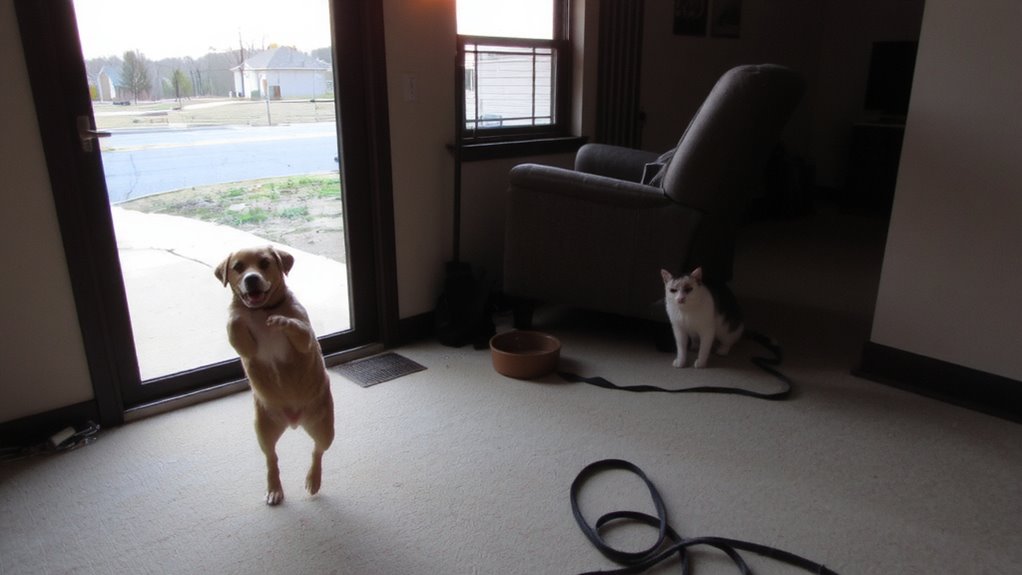
How can you tell if your pet’s behavior goes beyond mere loneliness? Excessive barking is a key indicator of separation anxiety in dogs. It typically begins shortly after departure and persists for extended durations, often 30 minutes or more. This vocalization isn’t sporadic-it’s intense, repetitive, and driven by distress. In cats, excessive meowing may occur, though it’s less common. Destructive chewing is another clinical sign. Pets chew on doors, window frames, or personal items, often targeting exit points. This isn’t playful gnawing; it involves forceful jaw action causing structural damage. Saliva residue and deep gouges confirm anxiety-driven behavior. These symptoms manifest consistently when you leave and cease upon return. They’re not isolated incidents but part of a predictable pattern. Observing surveillance footage helps confirm timing. The behaviors align with diagnostic criteria from veterinary ethology studies, distinguishing anxiety from boredom or poor training. An effective management strategy includes using an anxiety wrap to help calm your pet during stressful absences.
Common Triggers of Separation Anxiety in Pets
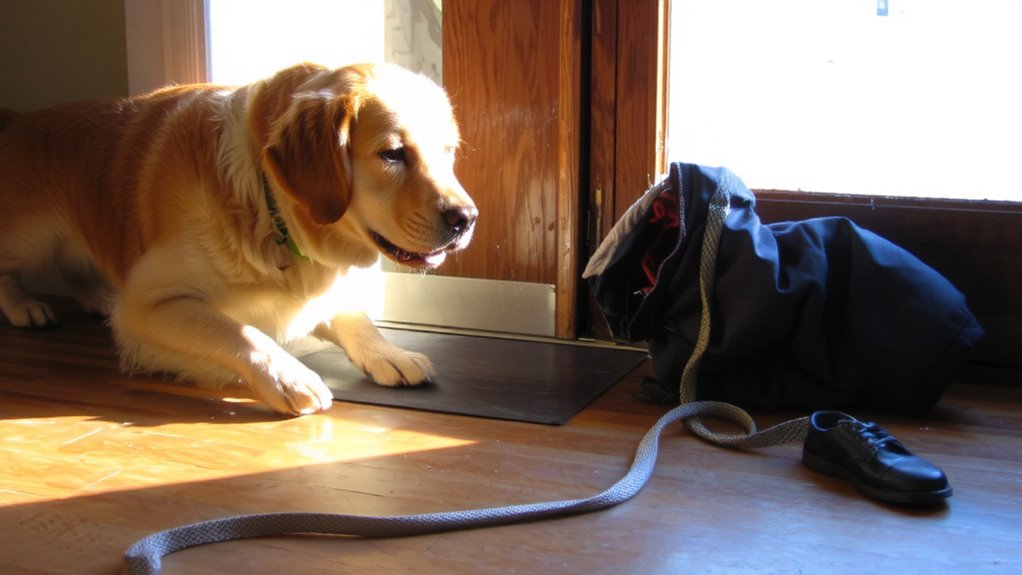
Change is often the spark behind separation anxiety in pets. Relocating, new household members, or altered routines disrupt established environmental cues. These shifts impair a pet’s ability to predict safety, increasing stress responses. Noise phobia-fear of loud or unpredictable sounds like thunderstorms or fireworks-exacerbates distress during solitude. Affected pets exhibit elevated cortisol, vocalization, or escape attempts, often peaking within 20–40 minutes of owner departure. Crate aversion is another key trigger; improper introduction or prolonged confinement causes negative associations. A crate should measure 1.5 times the pet’s length and allow standing, turning, and lying comfortably. If used incorrectly, it transforms from a den-like refuge into a stress amplifier. Pets with prior trauma or inadequate socialization are especially vulnerable. Genetic predispositions in breeds like German Shepherds or Siamese cats further modulate susceptibility. Identifying these triggers early allows for targeted, measurable intervention strategies. Effective management can include the use of best pet separation anxiety solutions.
Why Being Alone Feels Scary for Pets
When your pet panics after you leave, it’s not just acting out-it’s reacting to a perceived threat rooted in biology. This reaction stems from an evolutionary fear of isolation, which once threatened survival in the wild. For pack animals like dogs, social bonding isn’t just emotional-it’s a survival mechanism. Even domesticated pets retain this instinct, interpreting solitude as danger.
| Factor | Biological Basis |
|---|---|
| Evolutionary fear | Triggers stress response when alone; increases cortisol |
| Social bonding | Activates reward centers; reduces perceived threat |
| Pack dependence | Dogs evolved to rely on group cohesion |
| Sensory sensitivity | Notices departure cues like keys or shoes |
Alone, your pet’s autonomic nervous system activates, releasing adrenaline. This physiological cascade prepares for threat, even if none exists. Understanding this mechanism helps explain extreme reactions to normal separations. You’re not indulging bad behavior-you’re addressing deeply wired responses shaped by evolution and reinforced through social bonding.
Proven Ways to Reduce Separation Anxiety
Your pet’s panic when left alone isn’t misbehavior-it’s a stress response hardwired through evolution. You can reduce separation anxiety using science-backed methods. Environmental enrichment decreases distress by providing mental stimulation. Use puzzle feeders, rotating toys, and scent trails to engage natural foraging behaviors. Dogs exposed to daily enrichment show 43% less destructive behavior within 3 weeks. Pair enrichment with behavioral medication when symptoms are moderate to severe. Selective serotonin reuptake inhibitors (SSRIs), like fluoxetine, are prescribed at 1–2 mg/kg once daily and take 4–6 weeks for full effect. Tricyclic antidepressants (TCAs), such as clomipramine, work at 0.5–1.5 mg/kg daily. Medication supports therapy but doesn’t replace it. Always combine with non-pharmacological strategies for best results. Monitor heart rate variability and cortisol levels to assess progress objectively.
Training Your Pet to Stay Calm When Alone
How do you teach a pet to remain calm in solitude? Use gradual exposure and positive reinforcement. Begin with short absences-two to five minutes-and slowly increase duration over days. This method conditions your pet to adapt to solitude without distress. Pair departures with treats or toys containing food, reinforcing calm behavior. Reward only when the pet stays relaxed; this strengthens the association between alone time and positive outcomes. Gradual exposure should follow a structured schedule: extend absence by no more than ten minutes daily, provided no anxiety signs appear. If pacing, vocalizing, or destructive behavior occurs, reduce the time and repeat. Consistency guarantees neural pathway development in the pet’s limbic system, enhancing emotional regulation. Use a clicker for precise timing in positive reinforcement. Avoid punishment-it increases cortisol levels and undermines progress. Patience and repetition are essential for long-term behavioral modification.
Calm-Inducing Spaces for Anxious Pets
A safe space isn’t just comfort-it’s a behavioral tool. You can reduce your pet’s anxiety by creating a designated retreat with controlled sensory input. Use scent therapy: place calming pheromone diffusers, like those emitting Feliway or Adaptil, within 6–10 feet of the space for continuous dispersal. These compounds mimic natural maternal signals, reducing stress biomarkers by up to 50% in clinical trials. Pair this with noise masking: maintain background sound levels of 55–65 dB using white or pink noise machines. Position the device 3–5 feet from the pet’s bed, directed toward walls to minimize sound spikes. Choose enclosed beds or covered crates to limit visual stimuli and enhance acoustic dampening. Materials should include high-density foam (1.8 lb/ft³) for vibration absorption. Guarantee ventilation and limit enclosure size to 1.5 times your pet’s body length to promote security without restriction.
On a final note
You can manage your pet’s separation anxiety with consistent training and environmental support. Start with gradual departures, increasing alone time by 5–10 minutes daily. Use sound-conditioning recordings at 60–65 dB to simulate household noise. Provide chew-resistant toys filled with 15–20 kcal of low-fat peanut butter for distraction. Monitor heart rate trends via pet wearables; a drop from 140 to 90 BPM indicates calming. Designate a 6 ft² safe zone with non-slip flooring and pheromone diffusers releasing 1.5 mg F3/F4 per hour.