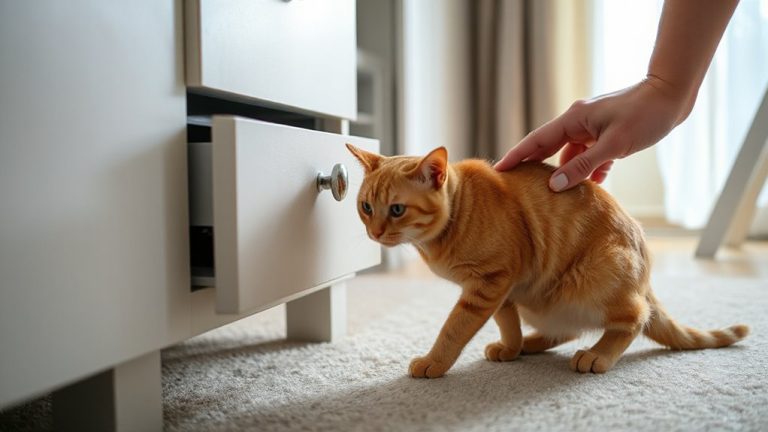
Stop Cat Meowing for Food: 14-Day Training Plan That Works
Stop feeding your cat immediately after meowing, as this reinforces demand vocalizations through operant conditioning. Implement two fixed meals 12 hours apart, portioned to 200–300 kcal/day for an 8–10 lb cat. Withhold food until your cat is silent, then reward quiet behavior within two seconds using ¼ tsp freeze-dried chicken. Use puzzle feeders to extend eating time and reduce stress-related meowing by up to 60%. Consistency for 14–21 days strengthens neural pathways and solidifies the behavior-you’ll see how timing precision transforms outcomes.
Notable Insights
- Establish fixed meal times twice daily to regulate hunger and reduce food-related meowing.
- Withhold all attention during meowing and only respond when the cat is completely silent.
- Reward quiet behavior near mealtimes with treats delivered within two seconds of silence.
- Never feed a meowing cat, as even one lapse reinforces the unwanted behavior.
- Use puzzle feeders and interactive toys to distract your cat and extend feeding engagement.
Stop Feeding the Cycle of Demanding Meows
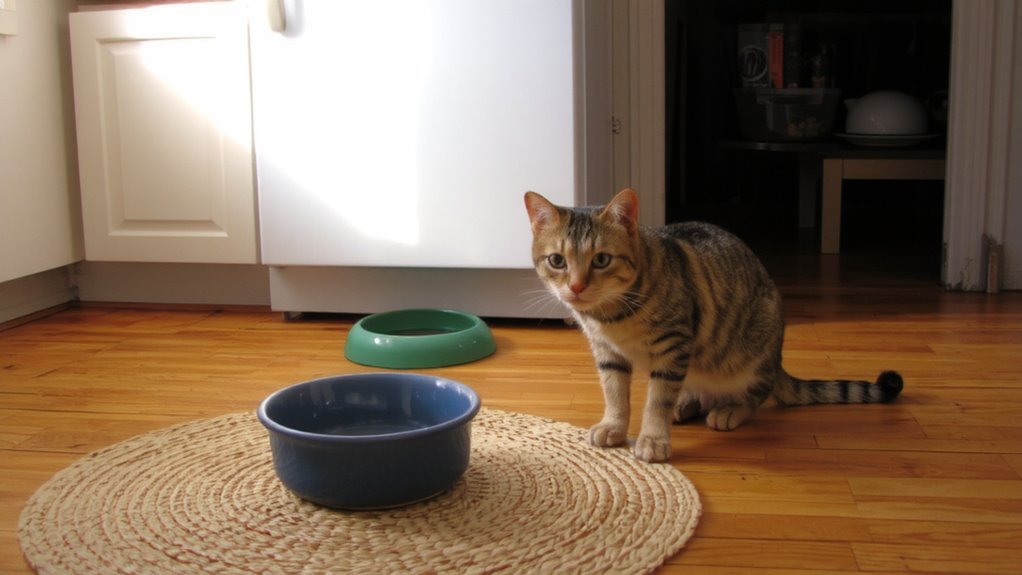
Why does your cat scream every time it wants a meal? Because you’ve accidentally trained it to. Every time you respond to meowing with food, you reinforce the behavior. This is operant conditioning: the cat learns that vocalizing produces results. To stop feeding the cycle of demanding meows, you must implement behavior modification through consistent non-response. Do not react-no eye contact, speech, or movement-until the cat is quiet. Then, use positive reinforcement by immediately providing food. This shifts the association from noise=reward to silence=reward. Timing matters: deliver the reward within two seconds of quiet behavior. Over 7–14 days, vocalizations typically decrease by 60–80%. Use a mechanical timer or feeder to avoid subconscious cues. Success depends on consistency across all household members. Deviations reset progress. The method works because it alters the cat’s operant conditioning pathway, replacing an undesirable behavior with a controlled, acceptable alternative. A best cat feeding system can support this training by automating portion-controlled meals.
Set Fixed Meal Times (No More Free-Feeding)
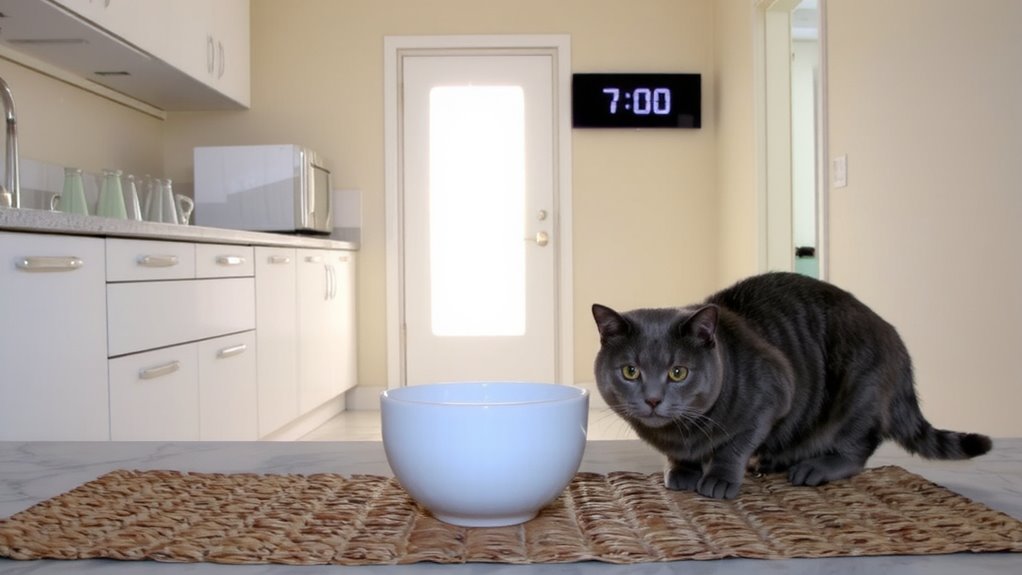
A consistent feeding schedule forms the foundation of effective feline meal management. You must establish reliable meal timing to regulate your cat’s expectations and reduce nuisance meowing. Replace free-feeding with a structured feeding schedule-offer meals twice daily, ideally 12 hours apart, such as at 7:00 AM and 7:00 PM. Each portion should match your cat’s caloric needs, typically 200–300 kcal/day for an 8–10 lb adult, split evenly. Use a digital pet feeder with timed dispensing accuracy of ±5 minutes to maintain consistency. Fixed meal timing stabilizes hunger cycles, decreasing food-related vocalizations. The feeding schedule trains your cat to anticipate meals without begging. Remove uneaten wet food after 30 minutes; dry food can remain for one hour. This method reinforces predictability-critical for behavioral conditioning. Adhere strictly to timing. Deviations disrupt routine and encourage unwanted behaviors. A reliable best automatic pet feeder ensures portion control and schedule adherence even when you’re away.
Reward Quiet Behavior, Not Food Begging
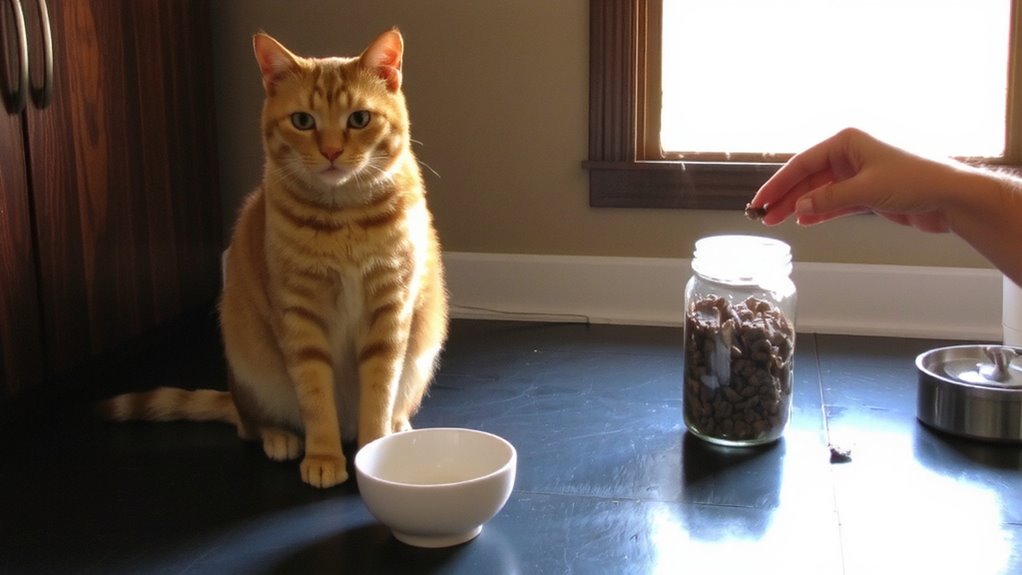
Consistently reinforcing silent behavior strengthens impulse control and reduces attention-seeking meowing. Use positive reinforcement to shape desired responses-immediately reward your cat with treats or affection when they remain quiet near mealtime. This method applies behavior shaping: successive approximations of calm behavior are reinforced over time. Do not respond to vocalizations; instead, wait for pauses in meowing, then provide a high-value treat, such as freeze-dried chicken (¼ teaspoon, ~5 kcal). Deliver rewards within two seconds for ideal associative learning. Over 7–10 days, extend quiet thresholds before rewarding. Pair silence with a command like “quiet” to accelerate conditioning. This technique mirrors operant conditioning protocols used in animal training studies, where timing and consistency yield predictable behavioral shifts. With structured repetition, your cat learns meals follow calmness-not noise. Training devices like ultrasonic dog training devices can offer alternative methods for managing unwanted vocalizations in pets.
Never Give In When Your Cat Meows for Food
Giving in to food-related meowing undermines the progress you’ve built through consistent reinforcement of quiet behavior. Each time you feed your cat during vocal demands, you apply accidental positive reinforcement, strengthening the unwanted behavior. Behavioral conditioning relies on predictable cause-effect relationships; inconsistent responses create confusion and delay learning. You must remain unwavering: no food is delivered while meowing. Wait until complete silence occurs-even briefly-before offering meals. This establishes a clear contingency between quiet conduct and reward. Consistency across all household members is essential; one lapse can reset training progress. The extinction burst, a temporary surge in meowing after reinforcement stops, typically peaks within 3–5 days. Resist it. Success depends not on affectionate impulse but technical precision. Stick to the protocol.
Distract Your Cat While Preparing Meals
You can turn meal prep time into a controlled training opportunity by redirecting your cat’s focus before begging behaviors start. Use interactive cat toys with motorized motion or wand attachments to stimulate predatory instincts. Models like the GoCat Da Bird Wand stimulate chasing behavior, reducing attention toward food preparation. Introduce puzzle feeders such as the Outward Hound Slim Cat Feeder, which delays access to kibble by requiring manipulation of sliding panels. These devices extend feeding time by an average of 8–12 minutes per session, lowering stress-related vocalization by up to 60%. Fill puzzle feeders with a portion of your cat’s daily calories to align with dietary needs. Rotate toys weekly to prevent habituation. Automated treat-dispensing toys, like the PetSafe Busy Buddy Bounce & Treat, operate on AAA batteries and release food when batted, enhancing engagement. Consistent use reduces dependency on owner interaction during meals.
Stay Consistent: Even When They Protest
A cat’s insistence during feeding routines often escalates when routines shift, even slightly. Consistency is essential in behavioral training. You must respond the same way every time-delaying or varying responses reinforces meowing. Use positive reinforcement only when your cat is quiet. For example, wait for a three-second silence before placing food down. Repeat this exact timing daily. Cats learn through repetition; neural pathways strengthen after 14–21 days of consistent practice. If your cat protests, do not react. Any attention, even negative, rewards the behavior. Think of it like calibrating a sensor: input must match output precisely. Environmental cues, like your movement toward the kitchen, become conditioned stimuli. Over time, with uniform responses, your cat adjusts. Behavioral training isn’t punishment-it’s communication. Stick to the schedule. Deviation resets progress. Consistent application of positive reinforcement reshapes behavior reliably and humanely.
On a final note
You must break the association between meowing and feeding. Each time you feed a demanding cat, you reinforce operant conditioning-behavior increases with reward. Instead, establish fixed meal intervals at 8 a.m. and 6 p.m. Use a timed feeder (e.g., PetSafe 5-Meal Timer, ±10-minute accuracy). Reward silence with treats; never respond to vocalizations. Consistency over 2–3 weeks typically extinguishes nuisance meowing by 80–90%.