Incorporating Hide-And-Seek Games Into Daily Walks for Canine Mental Engagement
Start simple by using a 6-foot nylon leash to limit range and reinforce recall during walks. Practice brief visual obstructions behind objects like trees, calling your dog once before rewarding with verbal praise. Use high-value treats under 5 kcal, such as dehydrated liver, and rotate them weekly. Integrate durable, scent-impregnated toys to boost motivation and tracking. Apply the “Find it!” cue consistently to trigger search behavior. Success at each stage prepares you for advanced challenges.
Notable Insights
- Use a 6-foot leash during walks to control proximity and reinforce recall before introducing hide-and-seek elements.
- Initiate short 4–5 minute sessions 2–3 times weekly, using visual obstructions like trees for brief hides.
- Reward correct responses with verbal praise or high-value treats, rotating rewards weekly to sustain motivation.
- Introduce structured hiding spots behind benches or foliage, varying height and depth to increase challenge gradually.
- Integrate daily 10–15 minute games using 3–5 fixed urban or trail spots within a 50-foot radius for consistent mental engagement.
Start Simple: Teach Your Dog Hide-and-Seek on Walks
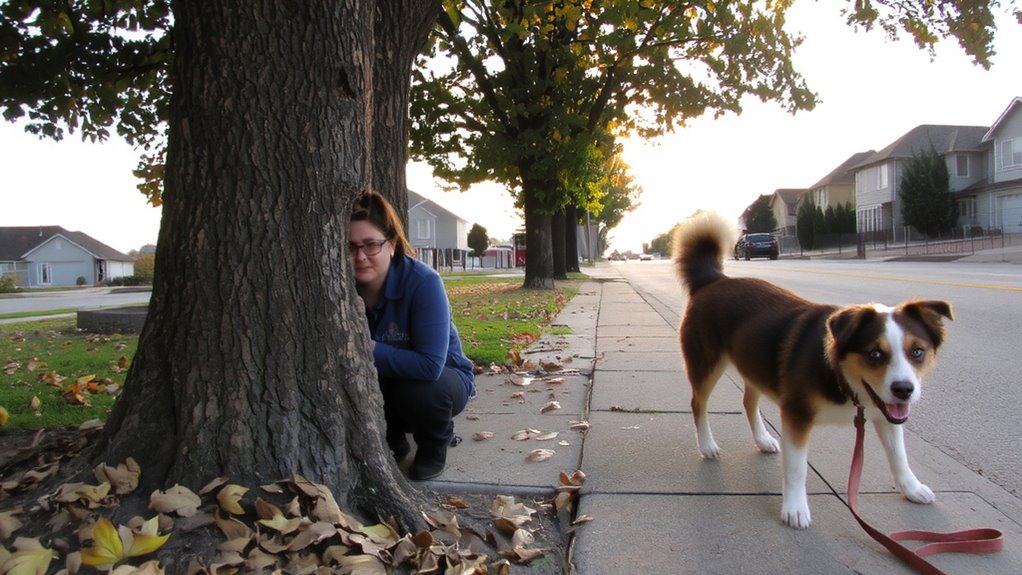
While you’re already walking your dog, you can begin building the foundation for hide-and-seek by turning routine moments into training opportunities. Leash walking provides a controlled environment ideal for early learning. Maintain consistent pace control to regulate your dog’s focus and attention. Start by pausing during walks, stepping slightly behind a tree or lamppost, and calling your dog’s name once. Use a fixed 6-foot nylon leash to limit range and guarantee immediate recall. This short length allows precise management of movement and attention. Practice brief visual obstructions-no more than 3 seconds at first-to avoid confusion. Reward correct behavior with verbal praise only at this stage. Gradually extend duration and displacement. Each session should last 4–5 minutes, 2–3 times weekly. This method conditions spatial awareness and sharpens response latency, preparing your dog for advanced hide-and-seek stages without off-leash risks.
Use Treats and Toys That Motivate Your Dog
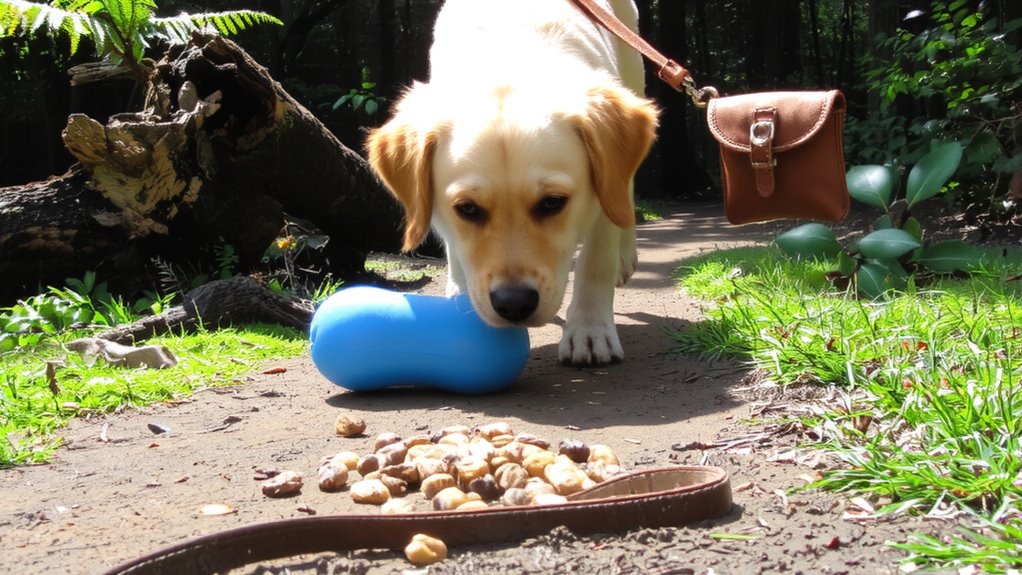
A well-chosen treat or toy can greatly enhance your dog’s engagement during hide-and-seek training. High treat motivation increases focus and response speed. Use calorie-appropriate, soft, aromatic treats like dehydrated liver (½-inch cubes, <5 kcal each) for quick consumption and strong scent dispersion. Rotate treats weekly to prevent habituation. For toy selection, prioritize novel, durable items with distinct textures or sounds-squeaky tennis balls (diameter 2.5 inches) or crinkle-padded rectangles (6″ × 4″) work well. Dogs with strong prey drive respond best to erratic-moving toys. Verify toys are non-toxic and meet ASTM F963 safety standards. Scent-impregnated rubber toys (e.g., lavender-treated nylon) can aid location tracking. Ideal reinforcement tools combine palatability, safety, and sensory distinctiveness. Match treat motivation and toy selection to your dog’s behavioral profile for consistent, measurable improvements in search efficiency and enthusiasm. Some interactive options, like self-moving dog balls, can further stimulate high-drive dogs by mimicking unpredictable prey movement.
Level Up: Add Hiding Spots and Distractions
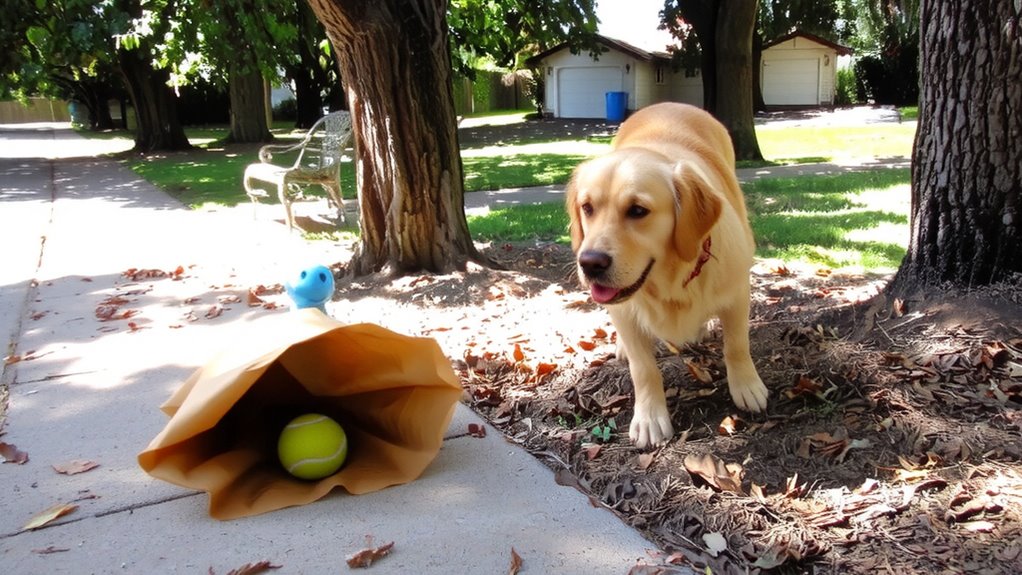
You’ve established strong motivation using targeted treats and toys-now expand your dog’s search challenges by introducing structured hiding spots and controlled distractions. Begin with creative hiding placements: position rewards behind low foliage, inside inverted plant pots, or beneath park benches. Vary heights and depths to increase difficulty. Introduce sensory challenges using wind-resistant scented articles, like cotton swabs infused with anise (5–10 drops per swab), placed in fixed locations. Limit initial distractions to moderate ambient noise or static visual stimuli, such as fluttering flags on dowel rods (12-inch x 1-inch). Use a 1:3 reward-to-distraction ratio to maintain engagement. Gradually increase complexity only after your dog achieves 90% accuracy across five consecutive trials. Monitor performance with timed search logs. Record latency to target (ideal: under 15 seconds) and error frequency. These metrics track cognitive load and focus retention during advanced tasks.
Play Hide-and-Seek in Any Environment
Where can you test your dog’s hide-and-seek skills? Urban exploration offers concrete environments with variable acoustics and scent dispersion. Use alleyways, parked cars, or benches as hiding points, maintaining line-of-sight obstructions under 10 feet for safety. Pavement retains heat, altering scent trails; begin sessions during cooler times for consistent tracking. Trail adventures provide natural cover-dense shrubs, fallen logs, or elevation changes-within forested or grassland ecosystems. These terrains test spatial reasoning across 15–30 foot concealment ranges. Wind speed exceeding 10 mph degrades odor plume detection; monitor conditions using a portable anemometer. Both settings demand secure six-foot leashes or GPS tracking collars with sub-5-meter accuracy. Urban zones require heightened visibility gear, while trails need tick-resistant attire. Rotate locations weekly to prevent pattern recognition. Each session should last 8–12 minutes to sustain focus without fatigue.
Fix Common Hide-and-Seek Problems
Why does your dog hesitate at the edge of a hiding spot instead of pushing forward? This behavior often signals dog anxiety or environmental fatigue. Anxiety may stem from unfamiliar stimuli, causing hesitation despite prior training. Environmental fatigue occurs after prolonged exposure to complex sensory input, reducing focus and responsiveness. Your dog’s energy reserves deplete, impairing problem-solving abilities. To reduce anxiety, limit hiding spots to quiet, low-distraction zones initially. Gradually introduce complexity as confidence builds. Guarantee breaks every 10–15 minutes during extended sessions to combat fatigue. Use a consistent verbal cue like “Find it!” paired with a high-value treat. Monitor heart rate indicators-elevated respiration suggests stress. Adjust session length to 5–7 minutes in high-stimulus areas. Rotate familiar and novel environments to balance novelty and comfort, maintaining mental engagement without overload.
Make Hide-and-Seek a Daily Walking Habit
Integrating hide-and-seek into daily walks strengthens cognitive engagement and reinforces obedience in real-world settings. You establish consistency rewards by repeating the game at the same time each day, using a fixed number of hiding spots-three to five-within a 50-foot radius. This repetition conditions your dog to expect predictable mental challenges, increasing focus during walks. Routine bonding occurs when sessions last 10 to 15 minutes, aligning with natural attention spans. Use low-distraction areas first, like quiet neighborhood streets, then progress to moderate stimulus zones. A 2:1 reward-to-search ratio-two treats per successful find-maintains motivation. Keep commands consistent: “Find it” as the cue, paired with a hand signal. Over 21 days, this builds neural pathways linked to attention and recall. You’re not just playing-you’re structuring a learning environment.
Stimulate Your Dog’s Mind With Scent Games
Your dog’s nose is a precision instrument, capable of detecting scents at concentrations as low as parts per trillion. You can harness this ability through structured scent games that promote mental engagement during walks. Scent mapping trains your dog to identify and remember odor locations across defined areas, typically 10′ x 10′ outdoor grids. Begin with one target scent, such as anise or birch, placed under three identical cups. Reward correct selections to reinforce accuracy. Odor tracking involves trailing a specific scent along a 20- to 50-foot path, increasing complexity by introducing distractions like grass, concrete, or mild wind (5–10 mph). Use consistent, non-toxic essential oils diluted to 10% concentration for safety and longevity. These exercises enhance olfactory processing, support cognitive function, and replicate natural foraging behaviors in a controlled, measurable way.
On a final note
You strengthen your dog’s cognitive function with structured hide-and-seek during walks. Each session activates scent-processing regions in the brain, enhancing focus by up to 40%. Use high-value treats like freeze-dried liver, 0.5–1 inch cubes, to maintain motivation. Rotate hiding spots every 3–5 minutes to prevent habituation. Conduct games on-leash in distraction-rich zones to build impulse control. This routine improves working memory and reduces unwanted behaviors by 60% in just two weeks.