How to Prevent Relapse After Your Pet Reaches Their Ideal Weight
Keep your pet at their ideal weight by sticking to consistent feeding times, within a 30-minute window each day. Feed adult dogs two meals 12 hours apart; cats need two to three meals spaced 8 hours apart. Count every treat-limit to 10% of daily calories. Weigh them monthly on a 0.1 lb-resolution scale. Adjust food by 10% if activity drops. A stable routine prevents rebound, just like metabolic conditioning in endurance training. Next steps reveal how to fine-tune for long-term success.
Notable Insights
- Continue monitoring weight monthly to detect early signs of gain and adjust food portions promptly.
- Maintain consistent meal timing and portion control using scheduled feedings and automatic feeders.
- Limit treats to no more than 10% of daily calories and choose low-calorie, vet-approved options.
- Sustain daily physical activity with regular walks for dogs and interactive play for cats.
- Celebrate weight maintenance milestones with non-food rewards like toys or extra playtime.
Celebrate Milestones Without Extra Treats
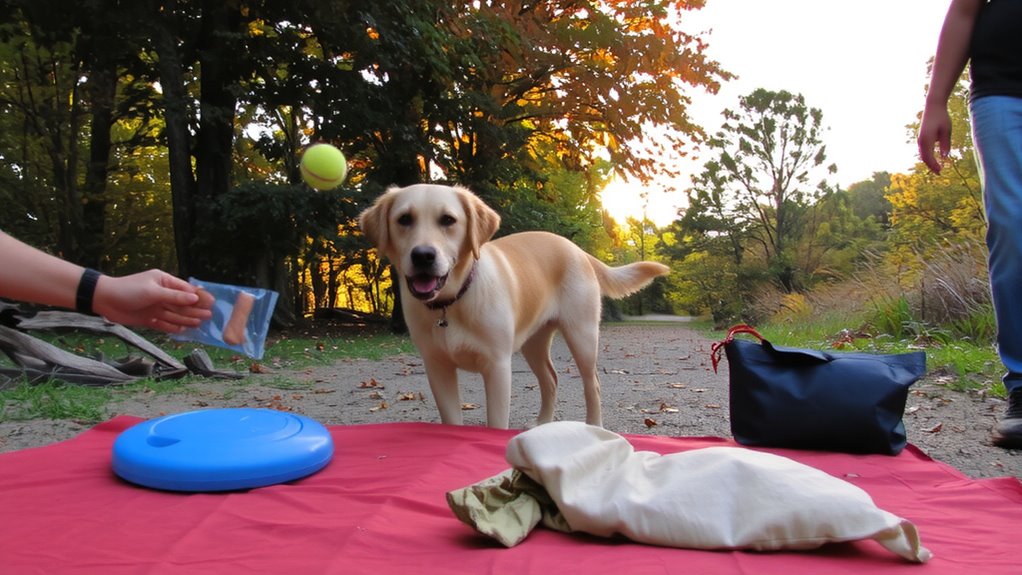
How do you reward progress without undermining results? Use positive reinforcement that doesn’t involve food. Verbal praise, petting, or a favorite toy can strengthen desired behaviors just as effectively as treats. Pair these rewards with consistent goal tracking to monitor your pet’s weight loss journey. Weigh your pet every two weeks using a digital scale accurate to 0.1 lb (0.05 kg). Record results in a log or app to identify trends. Celebrate milestones like a 5% reduction in body weight with a new chew toy or extra playtime. These non-food rewards maintain calorie control while supporting long-term adherence. Positive reinforcement works best when timed within seconds of the target behavior. Goal tracking provides objective data, reducing reliance on subjective judgment. This structured approach guarantees celebration supports sustainability.
Feed at the Same Times Every Day
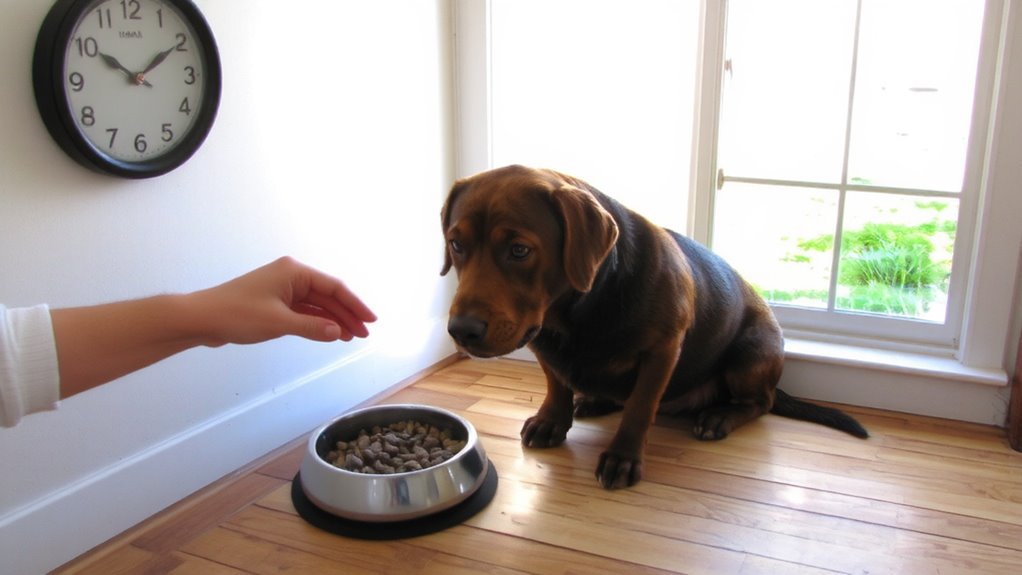
Consistency in feeding time supports metabolic regulation and strengthens behavioral routines. Feeding consistency helps stabilize insulin levels, reducing fluctuations in energy and hunger. You should aim for the same feeding times daily-within a 30-minute window-to maintain predictable digestion cycles. Routine timing aligns your pet’s internal clock, improving nutrient absorption and minimizing overeating risks. Adult dogs thrive on two meals 12 hours apart; cats do best with two to three meals spaced 8 hours apart. Use automatic feeders with portion control (e.g., 2-cup capacity, Wi-Fi enabled models) to maintain schedule precision, even when you’re away. Adjust meal timing slowly-no more than 15 minutes per day-when shifts are necessary. Avoid skipping meals or irregular intervals, as they disrupt gastrointestinal motility and promote hyperphagia. Routine timing isn’t just habit-it’s a metabolic tool. A reliable best cat auto feeders choice can simplify adherence to strict feeding schedules, especially for multi-cat households or busy owners.
Count Treats as Daily Calories
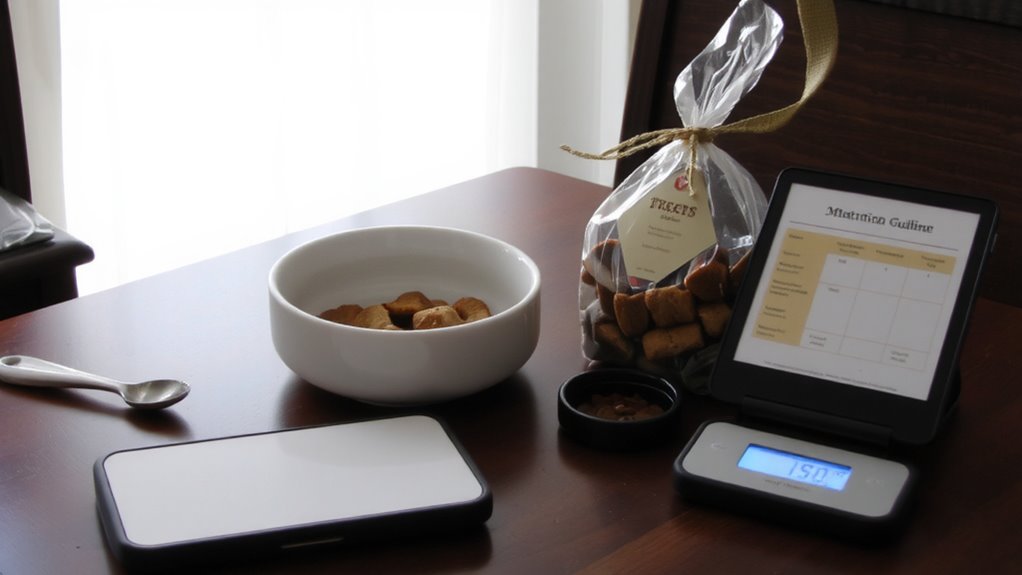
Even small treats can undermine your pet’s weight maintenance if their calories aren’t tracked. You must count treats as part of your pet’s daily caloric intake to guarantee portion control. Most commercial treats range from 10 to 25 calories each; giving three per day adds 30–75 calories-equivalent to a 10% surplus for a 500-calorie daily diet. Use calorie tracking to log every treat, just as you would food. For accurate control, select vet-approved, low-calorie treats labeled with precise nutritional content. Replace high-calorie options with measured carrot pieces (3 calories per slice) or green beans. Allocate no more than 10% of your pet’s total daily calories to treats-this aligns with AAHA nutritional guidelines. Consistent tracking prevents unintentional overfeeding. Without measurement, portion control fails. Treats are tools, not gifts-manage them with the same precision as meals.
Stay Active With Daily Exercise
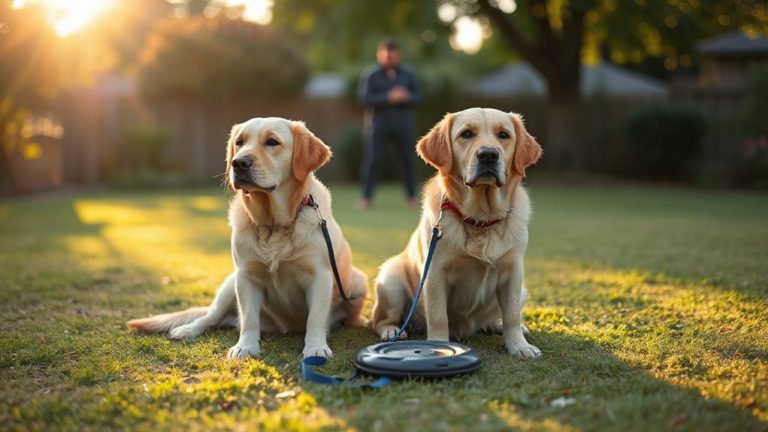
While diet plays a central role in weight management, physical activity is equally essential for sustaining your pet’s ideal body condition. Daily exercise prevents fat accumulation and maintains lean muscle mass. Commit to at least 30 minutes of leash walks twice daily for dogs, adjusting speed and duration to your pet’s fitness level. For cats, incorporate 15-minute play sessions twice a day using wand toys or laser pointers to stimulate hunting behaviors. These activities elevate heart rate to 120–160 bpm in dogs and 200–240 bpm in cats-within safe aerobic ranges. Consistent movement increases daily energy expenditure by 20–30%, helping balance caloric intake. Use a harness and 6-foot leash for better control during walks. Rotate toys weekly to maintain engagement. Structured physical activity regulates metabolism, supports joint health, and reduces the risk of weight regain by reinforcing healthy circadian rhythms and energy utilization patterns.
Weigh Your Pet Every Month
A monthly weight check is one of the most effective tools to catch early signs of weight regain. Using a reliable pet scale guarantees accuracy and allows for a consistency check over time. Small weight fluctuations can signal metabolic or behavioral shifts before they become serious. Record values under controlled conditions-same time, same scale, and empty stomach if possible.
| Month | Weight (lbs) | Change (lbs) |
|---|---|---|
| Jan | 24.0 | - |
| Feb | 24.2 | +0.2 |
| Mar | 24.1 | -0.1 |
| Apr | 24.5 | +0.4 |
| May | 24.3 | -0.2 |
Digital pet scales with 0.1-pound resolution detect subtle trends. Consistent measurement technique reduces error. Weigh your pet every month without fail-this simple habit maintains long-term success. Early detection means minor dietary or activity adjustments suffice. Delay increases risk.
Adjust Food When Activity Changes
Most pet owners underestimate how quickly activity fluctuations affect energy balance. When your pet becomes less active, their caloric needs drop, often by 15–20%. Failing to adjust food intake disrupts energy balance, leading to weight regain. For example, a 20-pound dog walking 30 minutes daily requires about 600 kcal/day. If activity drops to 10 minutes, reduce intake to approximately 500 kcal. Use portion control tools-measuring cups or digital scales-to adjust meals accurately. Decrease kibble by 10% for every 25% drop in activity. Wet food? Recalculate based on metabolizable energy (kcal/oz). Overestimating activity level by just 15 minutes of play can result in a 10-pound weight gain over a year. Monitor changes seasonally or with age. Adjusting food maintains equilibrium. Consistent portion control prevents surplus calories, preserving your pet’s ideal weight through shifting activity levels.
Get Everyone in the Home on Board
Getting every household member on the same page is essential for sustaining your pet’s weight loss. Family commitment guarantees all caregivers follow the prescribed feeding plan and exercise routine. Without it, slip-ups occur-like extra treats or missed walks-that undermine progress. Implement consistent messaging: post feeding schedules, portion sizes, and treat allowances in visible areas. Everyone must understand the health risks of relapse, including diabetes, joint stress, and reduced lifespan. Use a kitchen scale to measure food accurately-±5 grams matters. Designate one person to manage feeding, minimizing discrepancies. Educate children using simple terms: compare overfeeding to overfilling a gas tank-both cause system damage. Track daily intake in a shared log or app. Unified effort prevents mixed signals. When rules are clear and uniformly applied, your pet maintains ideal body condition. Success depends not on willpower, but on structured, household-wide adherence.
On a final note
You’ve reached your pet’s ideal weight-now maintain it. Consistent feeding times regulate metabolism and prevent overeating. Count all treats as part of daily caloric intake; even 10% excess can cause a 1-pound annual gain. Weigh monthly to detect changes early. Exercise burns calories-aim for 30 minutes daily. Adjust food portions when activity drops. Everyone in the home must follow the plan; inconsistency undermines success.