How to Use Positive Reinforcement to Train Dogs to Settle on Cue
Say “settle” in a calm voice while your dog lies down with all four paws and head lowered. Immediately reward stillness with pea-sized high-value treats like freeze-dried liver. Train in a quiet room for 5–7 minutes, 2–3 times daily. Reinforce every calm instance at first, then shift to variable rewards. Use consistent cues, low distractions, and gradual duration increases. You’ll see measurable impulse control improve within weeks. Further refinements can enhance reliability in real-world settings.
Notable Insights
- Use a short, distinct cue like “settle” to signal calm lying behavior, reinforcing it immediately with treats.
- Deliver high-value, pea-sized treats within one second of calm behavior to strengthen positive associations.
- Start training in a quiet, low-distraction space to help your dog focus and succeed consistently.
- Reinforce only relaxed body language, such as four paws down and a lowered head, to shape true calmness.
- Gradually increase distractions and switch to intermittent rewards after your dog performs the cue reliably.
Define “Settle on Cue” and Why It Helps
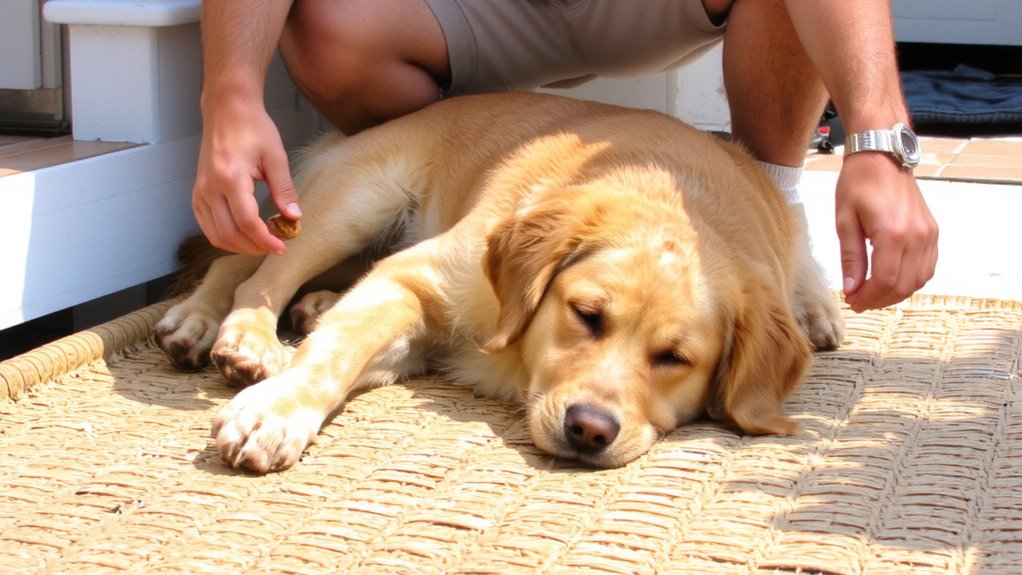
A reliable settle cue is a cornerstone of practical dog training, giving you control over your dog’s arousal level in everyday situations. “Settle on cue” means your dog responds to a verbal or visual signal by calmly lying down and staying in place with relaxed body language. This skill directly supports off leash freedom, allowing safe, controlled behavior in unpredictable environments. Without it, off leash activity increases risk of reactivity or flight. Settle on cue also improves crate relaxation, reducing stress during confinement. You’ll observe lowered heart rate, soft eyes, and even breathing-objective signs of true relaxation. Training this cue builds impulse control, a measurable component of canine self-regulation. It’s not just compliance; it’s emotional regulation. Use consistent markers and reinforcement schedules-ideally variable ratio-to solidify reliability. Mastery enables real-world application: vet visits, travel, and public spaces become manageable. This cue isn’t optional for well-trained dogs; it’s essential for behavioral health and functional obedience.
Choose a Cue Word and Quiet Training Spot
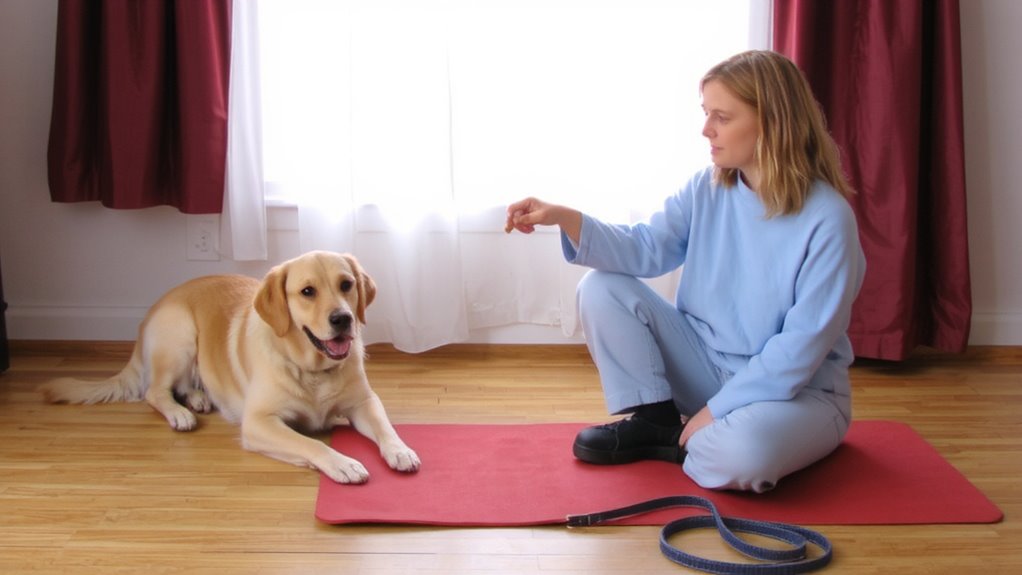
You’ve defined what “settle on cue” means and why it supports long-term behavioral health and safety-now it’s time to set up for success by choosing the right cue word and training location. Proper cue selection guarantees clarity and consistency. Use a short, distinct word like “down,” “settle,” or “place” to minimize confusion. Avoid common phrases you use in daily conversation. A well-chosen cue becomes a conditioned stimulus through repetition and reinforcement. Your training environment should be quiet, low in distractions, and consistent across sessions. Begin indoors, in a single room, with minimal foot traffic and noise. Control variables like lighting and flooring to stabilize your dog’s focus. This controlled setting enhances learning efficiency. Below are recommended parameters for effective cue selection and training environment setup:
| Cue Word | Volume Level (dB) | Room Size (sq ft) |
|---|---|---|
| settle | <45 | 100–200 |
| down | <50 | 150–250 |
| place | <40 | 100–180 |
| relax | <48 | 120–220 |
| easy | <42 | 100–200 |
Use Treats to Reinforce Calm Behavior
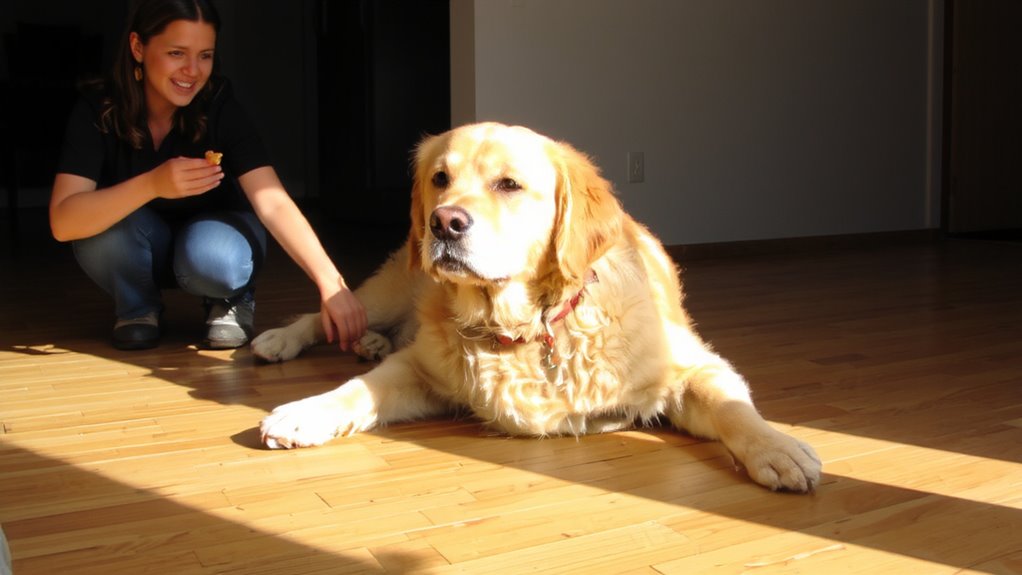
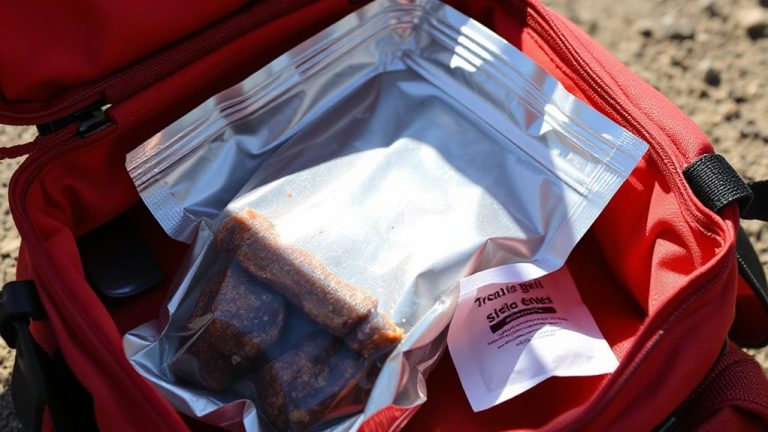
The key to successful conditioning lies in precise timing and high-value reinforcement-offer treats within one second of calm behavior to create a strong associative link between the cue and the desired state. Accurate treat timing strengthens learning by aligning the reward with the exact moment of calmness. Delayed rewards confuse dogs, weakening the behavioral connection. Use high-motivation treats, such as freeze-dried liver or cheese, cut to pea-sized portions to avoid satiation. Reinforcement frequency should be high initially-every instance of calm behavior earns a treat. This continuous schedule builds reliability. Each session should last 5–7 minutes, conducted 2–3 times daily, to maintain focus and prevent fatigue. Gradually shift to intermittent reinforcement once the behavior is consistent. Record progress in a training log, noting duration of calmness and response latency. Over time, this systematic approach produces reliable, cue-driven settling.
Teach Calmness Step by Step
Now that calm behavior is consistently reinforced with well-timed treats, focus shifts to shaping that behavior through structured progression. Begin by cueing your dog to settle in a low-distraction environment. Use mindful breathing to center yourself-dogs respond to your physiological state. Match your calm inhalations and exhalations with relaxed body language: loose shoulders, soft gaze, and slow movements. These signals reduce canine arousal. Hold each calm session for 3–5 minutes, gradually increasing duration by 30-second intervals. Reinforce only when all four paws are down and the head is lowered. Avoid sudden motions; instead, maintain predictable routines. Sessions should occur 2–3 times daily to build neural associations. Precision in timing reinforces operant conditioning. Your steady body language acts as a nonverbal cue, shaping settle behavior more effectively than verbal prompts alone. Consistency across sessions solidifies learning.
Practice Settling Around Distractions
Once your dog reliably settles in a controlled setting, you can begin introducing distractions to strengthen focus and impulse control under varying conditions. Start with low-level distraction exposure, such as tossing a light toy nearby or having someone walk at a distance. Reward your dog immediately for maintaining the settle position. Gradually increase intensity and proximity, using consistent cues and high-value treats. Environmental variety is critical-practice in multiple locations, including parks, sidewalks, and pet-friendly stores. Each setting offers unique sensory inputs that challenge your dog’s ability to comply. Limit session length to 5–7 minutes to maintain reliability. Use a 1:3 ratio-after one distraction, give three successful repetitions in a calm setting. This balances challenge and reinforcement. Track progress weekly, noting duration, location type, and distraction level. Consistent practice guarantees real-world reliability.
Fix Common Settling Problems
Why does your dog jump up, whine, or ignore the settle cue despite prior success? Often, it’s due to unresolved triggers like noise sensitivity or overarousal from leash pulling. These behaviors disrupt focus and weaken cue reliability. You must identify and address the root cause-either environmental or behavioral. Below are common issues and recommended fixes:
| Problem | Solution |
|---|---|
| Noise sensitivity | Gradual desensitization with recorded sounds at low decibels (start at 30 dB, increase 5 dB daily) |
| Leash pulling | Switch to front-clip harness; apply 2-second gentle tension release upon slack |
| Inconsistent settling | Revert to earlier training phase with higher reinforcement rate (treat every 3 seconds) |
Reassess your dog’s environment and arousal level before sessions. Avoid overwhelming stimuli. Reinforce calm behavior immediately. Use consistent cues and timing. Adjust variables systematically to restore reliable settling.
Make Settling Stick in Daily Life
While distractions increase outside the training environment, you can solidify the settle behavior through structured real-world practice. Generalization consistency guarantees your dog responds reliably across environments. Begin with low-distraction locations, then systematically escalate complexity-parks, sidewalks, and homes with visitors. Use a consistent cue word and mat to anchor the behavior. Lifestyle integration means embedding training into daily routines: settle during coffee breaks, meals, or TV time. Practice three to five sessions daily, each lasting 3–5 minutes, reinforcing with treats and praise. Gradually extend settle duration from 30 seconds to 10 minutes. Monitor performance: success is 90% compliance across five different locations. Treats should diminish as behavior becomes habitual. Precision in timing-reward within 1–2 seconds of compliance-guarantees accurate association. This method yields measurable, durable results.
On a final note
You now have a reliable settle response. The cue creates a conditioned behavior through consistent reinforcement. Use a marker like “yes” or a clicker followed immediately by a treat. Reinforce duration, starting with three seconds and increasing by five-second intervals. Practice in 10-minute sessions, three times daily. Generalize across environments using the 70% accuracy rule-move locations when your dog succeeds seven of ten trials. This builds behavioral resilience and long-term compliance.