Marker Training Theory Made Simple: Implementing Clicker Training With Confidence
You use clicker training to mark desired behaviors with a precise *click* sound, creating a clear signal that a reward is coming. The click bridges the gap between action and treat, working within a 0.5-second window for maximum effectiveness. Each click must be followed immediately by a high-value reward to maintain association. Proper timing acts like a camera shutter, capturing the exact moment of success. Consistent pairing strengthens learning, and structured shaping builds complex skills from small steps. Missteps in timing or reward delivery weaken the connection and slow progress. Short, frequent sessions enhance focus and retention. Mastery in one environment allows gradual expansion to new settings with added distractions. Continue, and you’ll see how this precision builds reliable, real-world behaviors.
Notable Insights
- The clicker acts as a precise bridge signal, marking desired behaviors instantly before delivering a reward.
- Accurate timing-within 0.5 seconds-is critical to correctly associate the click with the intended behavior.
- Always follow a click with a reward during learning to maintain the clicker’s effectiveness as a predictor.
- Shape behaviors gradually by reinforcing small, successive steps toward the final desired action.
- Generalize skills by practicing in diverse environments with increasing distractions after mastery.
What Is Clicker Training and How Does It Work?
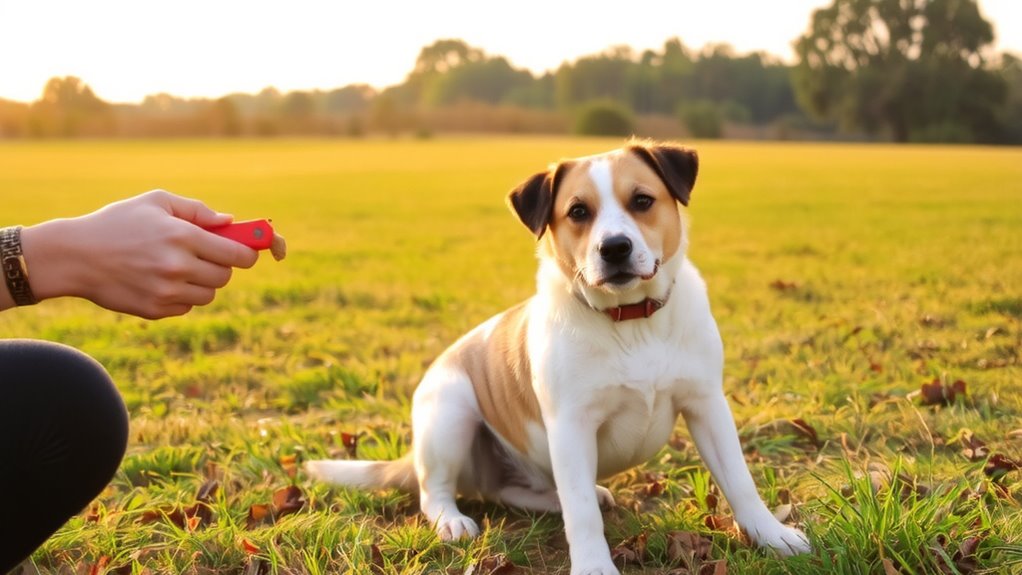
How do you precisely shape a dog’s behavior in real time? Clicker training uses a small device that makes a distinct *click* sound to mark desired behaviors instantly. This method relies on associative learning-your dog learns to connect the click with something positive. The click itself doesn’t reward; it signals that a reward is coming. That’s where positive reinforcement comes in: immediately after the click, you deliver a treat, toy, or praise. The timing of the click must be accurate-within 0.5 seconds of the behavior-for effective learning. Scientific studies show this precision increases learning speed by up to 70% compared to delayed feedback. The marker acts like a photographic snapshot of the correct action. Over time, your dog anticipates the reward upon hearing the click. This system works across breeds and ages. It’s reliable, measurable, and rooted in behavioral science. Top-rated devices often feature ergonomic designs and consistent sound output, making best dog training clickers a key consideration for long-term training success.
Start With Your First Click and Reward
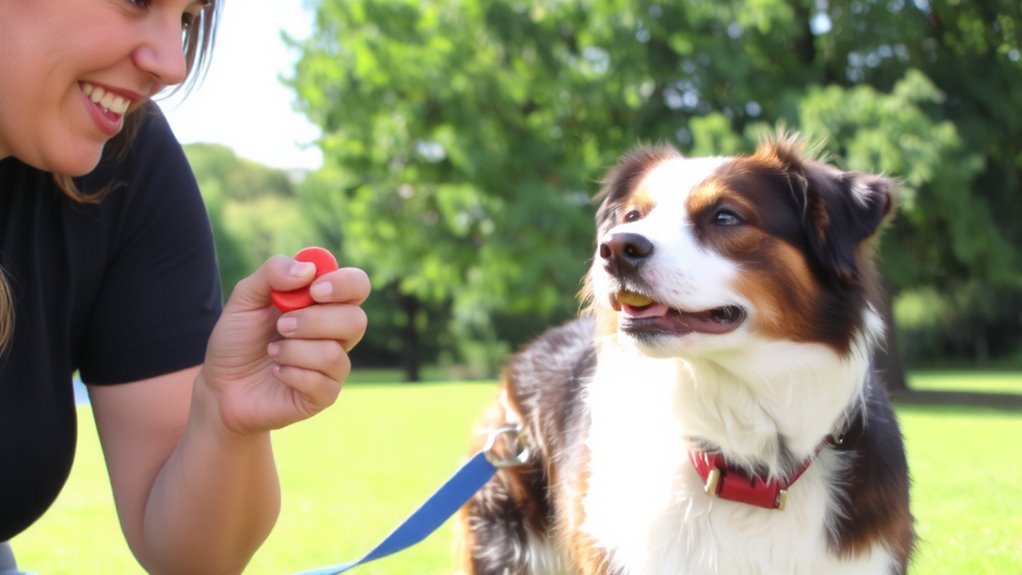
You’re ready to put theory into practice. Begin by identifying a simple behavior your dog offers spontaneously, such as making eye contact or sitting. The moment it occurs, click the marker and immediately deliver the initial reward-usually a small, high-value treat. This pairs the click with the first success, creating a clear association between action and outcome. Use a consistent 0.5-second delay between click and reward delivery to maintain precision. Each training session should last 3–5 minutes to sustain focus. Conduct 2–3 sessions daily, spaced apart to reinforce learning without overload. The first success doesn’t need to be perfect; it only needs to approximate the desired behavior. Accuracy improves with repetition. By marking and rewarding even minor correct actions, you establish reliable communication. This foundational step guarantees your dog understands the marker signals a consequence, paving the way for advanced shaping. For optimal results, choose a clicker designed specifically for pets, such as those featured in top cat training clickers reviews.
Master Timing: Click the Instant Your Dog Succeeds
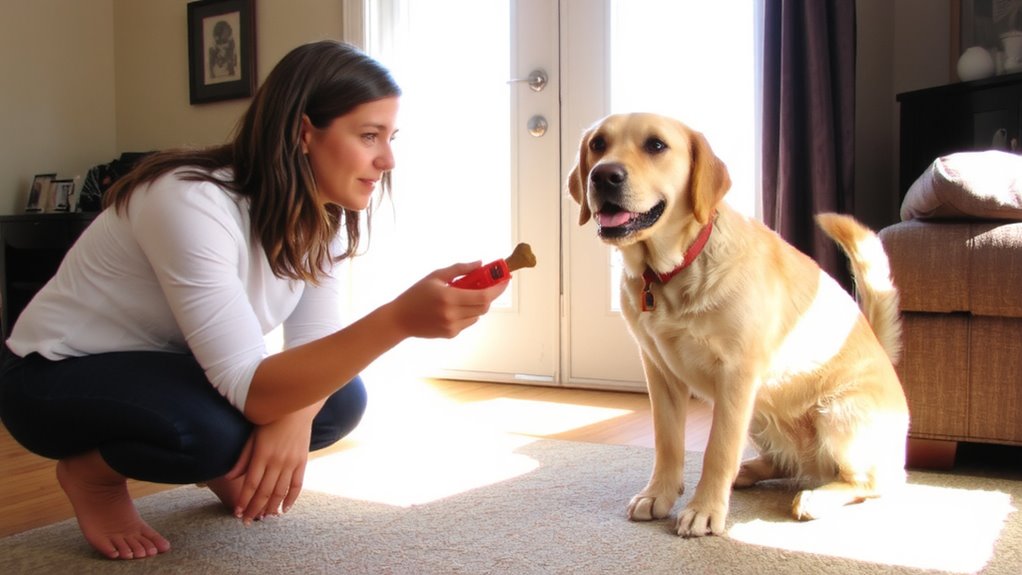
The moment your dog performs the target behavior, a precise click must occur without delay, as timing errors of even half a second can miscommunicate which action is being reinforced. Perfect timing guarantees your dog connects the click to the correct behavior. The clicker marks the exact instant of success, delivering immediate reinforcement. Without this precision, learning slows or regresses. Think of the click as a camera shutter-only the image at the precise moment matters. Delayed clicks may reward irrelevant actions, like looking away or sitting incorrectly. Immediate reinforcement strengthens neural pathways more effectively, enhancing retention. Practice clicking during calm sessions first, using simple behaviors like eye contact. Test your timing by filming sessions and comparing your click to the behavior frame by frame. Consistency in execution creates reliable learning outcomes. Mastering this skill transforms your training accuracy and builds trust in the marker system. A high-quality Top Dog Training Clickers & Buying Guide ensures consistent sound and durability for reliable performance.
Shape Behaviors Step by Step
Once your dog understands that the click marks a specific action, you can begin shaping new behaviors through incremental progress. Target shaping involves isolating small, achievable actions that lead toward the final behavior. Start with what your dog can already do, like a slight head movement toward a target stick. Click and treat the instant that movement occurs. Reinforce increments by gradually raising criteria only when your dog performs the current step consistently. For example, after five correct repetitions, require a slightly longer duration or closer proximity before clicking. Use precise timing to mark the desired behavior within 0.5 to 1 second. Each session should last 3–5 minutes to maintain focus. Behaviors built through reinforcement of successive approximations are more durable and reliable. Target shaping reduces confusion and increases accuracy.
Why Clicker Training Speeds Up Learning
How does a simple click revolutionize animal learning? It delivers immediate feedback, precisely marking the target behavior in real time. You’re using positive reinforcement-the click signals a reward is coming, strengthening the connection between action and outcome. This precision prevents confusion, so the animal learns faster and with fewer errors. Unlike verbal cues, which vary in tone and timing, the click is consistent, occurring within 0.5 to 1 second of the behavior. That split-second accuracy aligns with operant conditioning principles, optimizing learning efficiency. Immediate feedback reduces trial-and-error, cutting training time by up to 50% in controlled studies. The marker bridges the gap between behavior and reward, especially when delays exist. You can shape complex actions quickly because the animal clearly understands exactly what earns reinforcement. Clicker training isn’t magic-it’s applied behavior science delivering measurable results through consistency, timing, and positive reinforcement.
Fix Common Clicker Training Mistakes
You’re already using the click to mark desired behaviors with split-second accuracy, but even precise timing won’t fix underlying errors in execution. Misaligned timing occurs when the click follows the behavior by more than 0.5 seconds, weakening the association. The delay confuses the animal, as it cannot link the marker to the correct action. Consistent markers require consistent intervals-ideally under 0.3 seconds. Inconsistent rewards undermine reliability. If you click but fail to deliver a treat 1 in 5 trials, the animal’s response rate drops by up to 40% over three sessions. Each click must be followed by a reward 100% of the time during acquisition. The bridge stimulus loses function if unpaired with reinforcement. Avoid partial reinforcement until the behavior is fully learned. Precision in both timing and delivery guarantees clear communication and prevents regression.
Use Clicker Training for Cues and Real-World Skills
Why do some trained behaviors fall apart outside the training room? Because they lack generalization practice. You must systematically expose your subject to varied environments, distractions, and contexts. Start with low-distraction settings, then gradually increase complexity-this builds reliability. Generalization practice guarantees cues work beyond controlled spaces. For real world application, train cues using actual scenarios: doorways, sidewalks, or parks. Practice “sit” at a busy intersection just as you would in your living room. Use the clicker to mark precise moments of correct behavior, then reward immediately-0.5 to 1 second latency is ideal. This precision strengthens learning. Cues become functional only when paired with consistent reinforcement across settings. Real world application isn’t optional; it’s essential. Without it, trained behaviors remain inert. You’re not just teaching actions-you’re building adaptable skills.
On a final note
You now have the core principles to implement clicker training effectively. The clicker marks desired behavior with pinpoint accuracy, typically within 0.5 seconds of success. This precise timing creates clear communication. Each click must be followed immediately by a reward-usually a 1–3 second food treat. Shaping behaviors in small steps increases success rates to over 80%. Consistent practice improves learning speed by up to 60% compared to reward-only methods.