How to Implement Shaping for Success in Teaching Trick Behaviors to Dogs
Start by choosing a trick that matches your dog’s age, breed, and energy level-this boosts success by up to 70%. Break the behavior into micro-steps, reinforcing each with a click or marker word the instant your dog performs correctly-delays over 0.5 seconds cause confusion. Use immediate treats, delivered within one second of the marker. Only increase difficulty after 85% accuracy over three sessions. Learn what comes next to refine precision and timing.
Notable Insights
- Begin with small behavior approximations and immediately reinforce each success using treats or a clicker.
- Match the trick to your dog’s physical ability, breed traits, and temperament for higher success rates.
- Break complex tricks into clear micro-steps, mastering one before advancing to the next.
- Use precise timing: mark the desired behavior within 0.5 seconds with a click or cue, then reward instantly.
- Progress only after 85% accuracy over three sessions, increasing difficulty gradually and one variable at a time.
Start With Shaping the Right Way for Dog Tricks
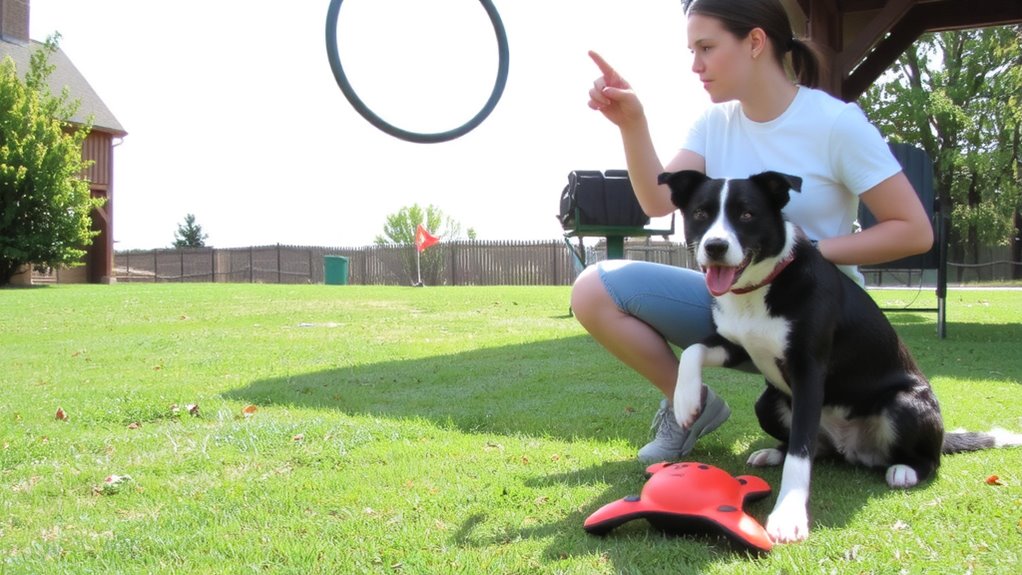
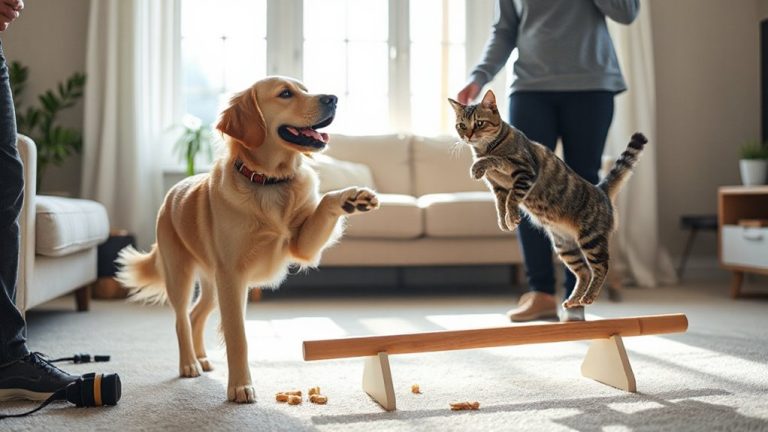
While every dog owner wants a well-trained pet, starting with the right approach to shaping guarantees consistent progress in learning tricks. You must use positive reinforcement to strengthen desired behaviors effectively. This method relies on immediate rewards-such as small treats or verbal praise-delivered the moment your dog performs the correct action. Timing precision is critical; even a half-second delay can confuse the animal about which behavior earned the reward. A clicker can enhance accuracy, serving as a conditioned reinforcer to mark the exact moment of success. Begin with simple approximations of the final behavior, then gradually increase criteria. Reinforce each small success consecutively. Maintain short sessions-five minutes max-to sustain focus. Consistency in cues, rewards, and timing secures reliable behavioral shaping. Eliminate distractions early to maximize learning efficiency and promote clear stimulus-response associations.
Pick a Trick That Fits Your Dog
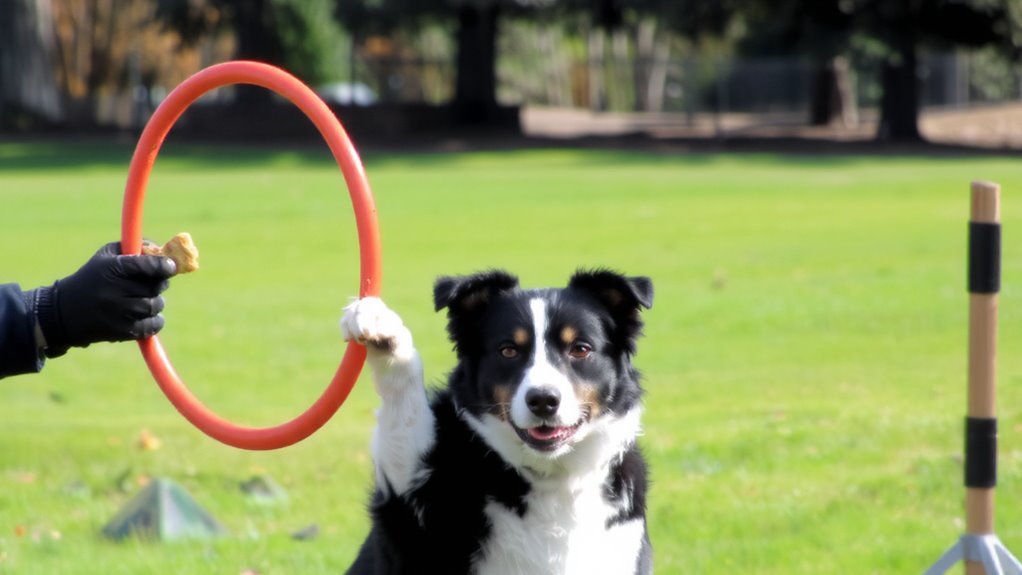
You’ve set the foundation with precise timing and consistent reinforcement-now it’s time to choose a trick that aligns with your dog’s physical abilities, temperament, and motivation level. Trick suitability depends on breed traits, size, age, and energy level. A Border Collie may excel at agility-based tricks, while a Basset Hound might prefer scent-related tasks. Evaluate your dog personality thoroughly: shy dogs respond better to low-pressure tricks like “target,” while bold dogs may enjoy “spin” or “jump.” Avoid tricks requiring excessive joint strain in older or arthritic dogs. Match task complexity to attention span-shorter sessions suit high-drive dogs. Consider reinforcement type; food-motivated dogs learn faster with treat rewards. Proper trick suitability increases success rates by up to 70%. Always prioritize safety, clarity, and achievable goals. A well-matched trick guarantees reliable shaping progression and sustained engagement.
Break Your Dog Trick Into Tiny Steps
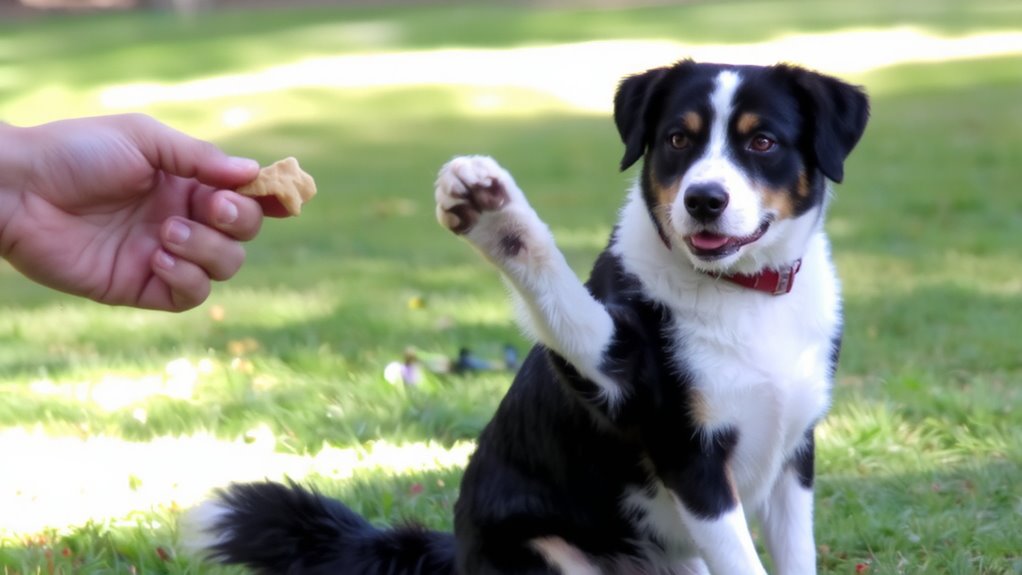
Once you’ve selected a suitable trick, the next step is to divide it into small, achievable behaviors your dog can master gradually. Each segment becomes a clear target behavior, making learning systematic and manageable. For example, if teaching “roll over,” start with “lie down,” then “turn head,” then “shift shoulder,” progressing step by step. This incremental approach guarantees your dog remains confident and avoids frustration. Use consistent cues and markers for each micro-step to reinforce understanding. Progress tracking is essential-record completed stages, repetition count, and accuracy rate per session. A simple log helps identify plateaus or regression early. Think of shaping like programming a robot: precise inputs yield predictable outputs. Each tiny success builds the final behavior chain. Maintaining detailed records allows for data-driven adjustments, guaranteeing reliable skill acquisition over time. Precision, consistency, and documentation lead to measurable outcomes.
Click or Treat the Exact Moment They Get It Right
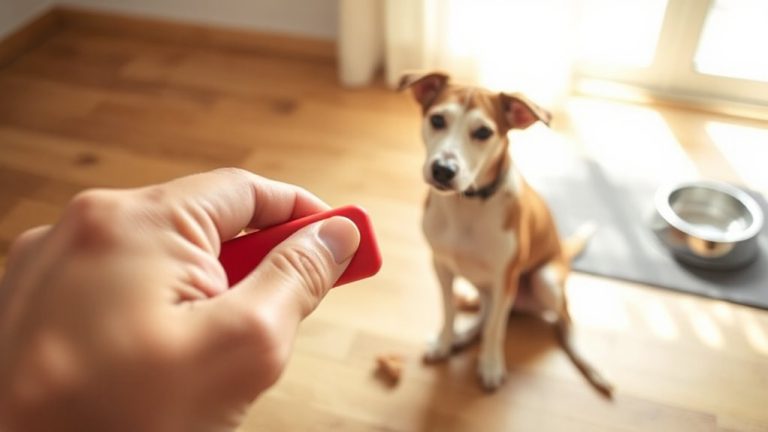
Timing your reinforcement correctly is the foundation of effective shaping. You must click or treat the exact moment your dog performs the desired behavior. Timing precision guarantees your dog associates the reward with the correct action, not what follows. Even a delay of one second can confuse learning. Use a consistent marker signal-like a clicker or verbal cue-followed immediately by a treat. Reinforcement consistency strengthens neural associations, increasing the likelihood of behavior repetition. Deliver the treat within 0.5 to 1 second after the click for peak conditioning. Each session should maintain this standard to build reliable responses. Think of it like capturing a photo: if the shutter is off by a fraction, the image blurs. Likewise, imprecise timing weakens learning. Maintain strict timing precision and reinforcement consistency across all training trials to maximize accuracy and speed in behavior acquisition. For reliable results, consider using one of the best dog training clickers to ensure clear and consistent signaling during shaping sessions, as outlined in expert top dog training clicker reviews.
Make It Harder Only When They’re Ready
A successful shaping program advances only when the dog consistently performs the current behavior with near-perfect accuracy. You must confirm at least 85% success across three consecutive sessions before progressing. Consistency patience is critical-rushing leads to regression. Maintain tight criteria: reward only correct versions of the behavior. Timing precision guarantees the dog links the action to the reward. Use a clicker or marker word within 0.5 seconds of the desired behavior. Increase difficulty in small increments: duration by 1–2 seconds, distance by 6–12 inches. Shape one variable at a time. Premature advancement disrupts learning. Wait until the dog offers the behavior confidently, with minimal hesitation. Solid performance under mild distraction indicates readiness. This structured progression builds reliability. Think of it like increasing weight in strength training-too soon causes injury, too slow limits gains. Advance only when accuracy, speed, and confidence align.
Fix Shaping Mistakes Early
Why do some shaping sessions stall or regress? Because undetected errors like inconsistency or overcorrection creep in. You must catch these early. Inconsistency confuses your dog-timing matters. Reinforce the exact behavior each time. Overcorrection-pushing too hard after a mistake-shuts down learning. Keep sessions short and responses accurate.
| Problem | Solution |
|---|---|
| Inconsistency in marking behavior | Use a consistent marker (e.g., clicker) within 0.5 seconds of correct action |
| Overcorrection after errors | End the session positively; reset and adjust criteria lower next time |
| Slow progress | Reduce task difficulty; reinforce closer approximations |
Address deviations immediately. Precision builds reliable behavior chains. Let small errors go, and the foundation weakens. Correct early, reinforce clearly, and maintain steady criteria. Your dog thrives on predictability.
Add a Cue to Lock the Trick in Place
Once the desired behavior is consistent and clean, it’s time to attach a signal so your dog performs on command. Introduce the cue just before your dog initiates the behavior-this guarantees proper association. Use verbal cues like “spin” or hand signals such as a sweeping finger motion. Signal consistency is critical; vary neither tone nor gesture. Inconsistent signals confuse dogs, delaying learning. Cue clarity prevents ambiguity. Deliver the cue once, clearly and confidently, then wait one to two seconds. If the dog responds, reward immediately. Never repeat the cue; doing so teaches your dog to ignore it. Practice in low-distraction environments for reliable recall. Use a high rate of reinforcement-90% success builds fluency. Gradually increase environmental complexity. Properly timed cues lock the trick in place, creating a reliable behavioral response. This precision shapes performance accuracy.
On a final note
You shape dog tricks successfully by reinforcing precise behaviors at the exact moment they occur. Use a clicker or verbal marker to signal correct actions within 0.5 seconds. Break tricks into micro-behaviors, advancing only when your dog achieves 80% accuracy. Introduce cues after consistency. Increase difficulty gradually using a 3-1 reinforcement ratio before progression. Correct errors immediately by reverting to prior steps. This method guarantees reliable, conditioned responses.