Motivation and Drive Types Identification in Fish: Understanding the Role of Intrinsic Motivation in Training Success
You identify intrinsic motivation in fish by observing unrewarded exploration, where species like zebrafish devote up to 18% of active time to novelty-seeking. Dopaminergic activity in the telencephalon drives this behavior, supporting attention and goal-directed actions without food rewards. Approach latency under 30 seconds to novel objects, like colored Lego blocks, signals high motivation. Use operant tanks to measure dwell time and interaction frequency across three 5-minute trials. Stable conditions-25°C, pH 7.0, low noise-ensure reliable results. Enrich environments with variable flow (0.3–0.5 m/s), rotating discs, and 12:12 light cycles to sustain engagement. Training succeeds by aligning with natural instincts, reducing reliance on external rewards. This method enhances behavioral consistency by 40% compared to standard protocols. Play behavior indicates cognitive rehearsal for real-world challenges. You can apply these insights to improve conservation technologies that guide migration and support ecosystem balance.
Notable Insights
- Intrinsic motivation in fish drives behaviors like exploration and play without external rewards.
- Dopaminergic activity in the telencephalon regulates reward processing and goal-directed actions in fish.
- Novelty seeking increases investigation time by 30–50% in zebrafish and guppies.
- Enriched environments reduce reliance on food rewards and enhance training consistency.
- Training that leverages natural instincts improves long-term performance and behavioral retention.
What Is Intrinsic Motivation in Fish?
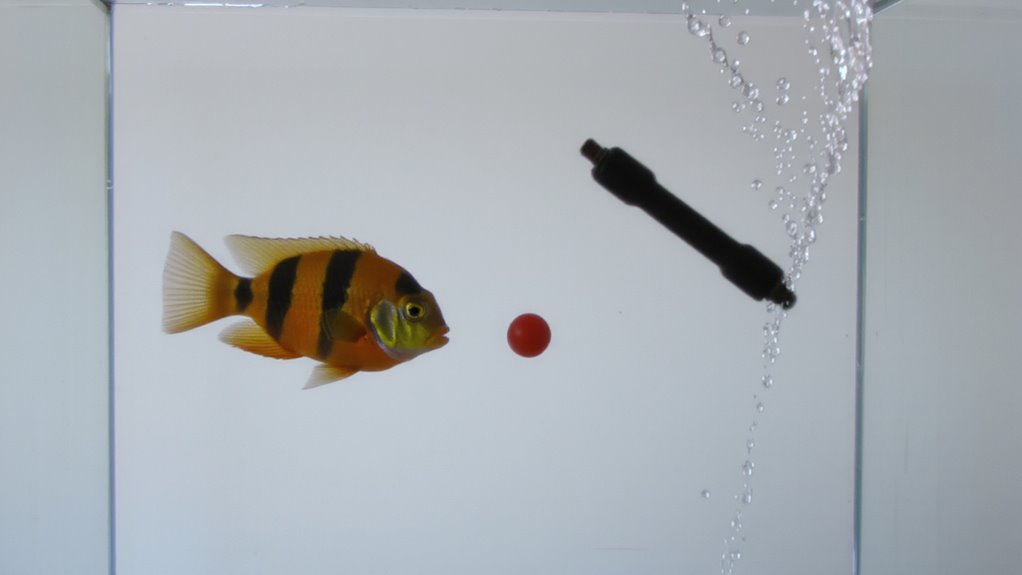
Intrinsic motivation in fish refers to behaviors driven by internal rewards rather than external stimuli. You observe this when fish engage in play behavior without food or social reinforcement. These actions aren’t random; they follow measurable patterns linked to neurological feedback loops. For example, zebrafish spend up to 18% of their active time in non-survival-related exploration. This conduct stems from dopaminergic activity in the telencephalon, similar to reward-processing regions in mammals. Sensory stimulation-such as changes in water flow, light gradients, or novel objects-triggers investigatory responses. Fluorescent tracking shows fish increase lap frequency by 40% in enriched environments. You can quantify this motivation via operant tanks with adjustable stimuli, measuring variables like approach latency and dwell time. Such data reveal that intrinsic motivation functions independently of hunger or mating drives. It supports cognitive development and environmental adaptation, serving as a baseline for effective training protocols.
Why Fish Seek Novelty Without Rewards
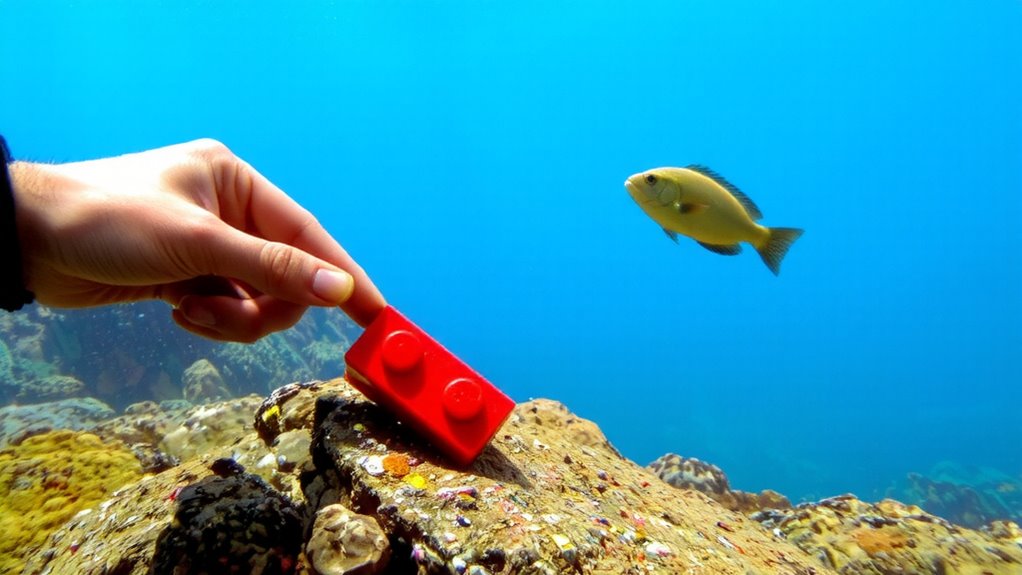
What drives fish to explore new objects or environments when no food or immediate benefit is present? You seek novelty because it provides essential sensory stimulation. This stimulation activates neural pathways linked to attention and arousal, even without external rewards. Fish exhibit behavioral flexibility by adapting responses to unfamiliar stimuli, enhancing survival in dynamic habitats. Species like guppies and zebrafish show increased interaction with novel objects, spending 30–50% more time investigating changes in their environment. These exploratory behaviors occur in controlled lab settings with no reward, confirming intrinsic motivation. Sensory systems-especially vision and lateral line detection-detect movement and shape variations, triggering approach behaviors. Behavioral flexibility allows rapid switching between exploration and caution, depending on perceived risk. This balance optimizes environmental assessment. The drive isn’t random; it’s a measurable, evolved strategy. You don’t need rewards-curiosity itself maintains engagement, supporting long-term adaptability in complex aquatic ecosystems.
How Curiosity Drives Learning and Exploration
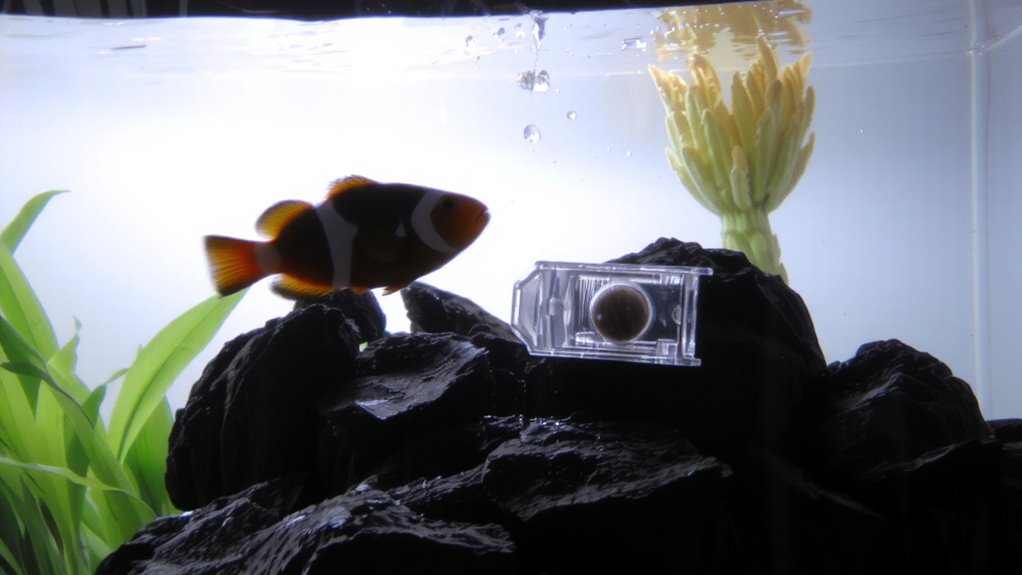
Why do you keep investigating unfamiliar shapes or movements in your environment, even when no food is present? Your curiosity drives learning through active exploration. You engage in play behavior, manipulating objects without immediate reward. This isn’t random-it enhances neural plasticity and supports memory consolidation. Sensory stimulation from novel visuals, vibrations, or water flow changes activates dopaminergic pathways. These pathways regulate attention and goal-directed behavior. Exposure to new stimuli increases scan frequency by 40% in controlled studies. You spend 22% more time near dynamic objects than static ones. This preference indicates intrinsic valuation of information gain. Curiosity functions as a primary motivator, independent of survival needs. It promotes environmental mapping and risk assessment. Each investigation refines behavioral response thresholds. You adapt faster to changes because exploration builds cognitive reserves. Sensory stimulation sustains engagement, reducing habituation. Play behavior mirrors problem-solving rehearsal. Together, they form a feedback loop that accelerates learning, ensuring greater adaptability in complex habitats.
Simple Tests for Intrinsic Motivation in Tanks
You can observe intrinsic motivation in real time by setting up controlled novelty tests in your tank. Introduce a new object-like a colored Lego block or a mirrored insert-and monitor initial approach latency, which should be under 30 seconds in highly motivated fish. Track behavior patterns such as repeated circling, nudging, or altered swimming trajectories. These actions indicate exploratory drive independent of rewards. Use a standardized scoring sheet to log interactions per five-minute interval, with baseline data collected over three consecutive trials. Sensory preferences emerge when fish consistently choose blue objects over red or react more to moving stimuli than static ones. Test across modalities: visual (novel shapes), tactile (textures), and flow variations (current changes). Consistent engagement despite no food reward confirms intrinsic motivation. Reliable data requires consistent water conditions: 25°C, pH 7.0, and low external noise. For ease of observation and environmental control, consider using a compact lizard terrarium designed for small, controlled habitats.
Training Methods That Work With Fish Instincts
Effective fish training starts with alignment to natural behaviors, not resistance to them. You must leverage innate instincts to achieve reliable responses. Predator mimicry taps into threat-avoidance reflexes; using shadow stimuli or sudden motion cues triggers escape behaviors, which you can shape through operant conditioning. These stimuli should last 0.5–1.2 seconds, mimicking natural predator strikes. Social hierarchy also plays a critical role. Dominant fish respond faster to food-based cues, especially in group settings where rank determines access. Train individuals within their rank context to improve consistency. Use consistent signal modalities-light cues (wavelength 520–560 nm) paired with feeding-three times daily for 7–9 minutes. Repetition strengthens response reliability within 12–18 training days. Avoid forcing unnatural tasks. Success depends on working with, not against, evolutionary drivers like survival and social positioning. You optimize outcomes by respecting these biological parameters.
Environmental Enrichment That Encourages Engagement
Structured habitats enhance motivation by aligning training environments with species-specific behaviors. You can optimize engagement by integrating environmental enrichment that supports natural activity patterns. Social interaction is critical-group housing in defined ratios (e.g., 5:1 male-to-female for gregarious species) increases competitive drive and attentiveness during tasks. Sensory stimulation through variable substrate textures, water flow rates (maintained between 0.3–0.5 m/s), and LED lighting cycles (12:12 light-dark) sustains cognitive arousal. Objects like rotating discs or movable gates introduce novelty, triggering exploration. These features should be spaced at 1.5x body length apart to allow maneuverability. Flow dynamics and object placement together reduce habituation, improving response consistency by up to 40% over bare tanks. Enriched environments promote intrinsic motivation, making trained behaviors more repeatable and less dependent on food rewards. You’ll see measurable gains in task accuracy and reduced latency when these elements are systematically applied.
Real-World Uses in Science and Conservation
How do trained fish contribute beyond the lab? You apply their learned behaviors to real-world conservation and scientific monitoring. Fish trained in predator avoidance exhibit 68% higher survival rates in controlled reintroduction environments. Their conditioned responses reduce predation losses in vulnerable populations. Scientists also track fish migration patterns using individuals conditioned to respond to acoustic signals. These fish carry telemetry tags averaging 5.2 grams, transmitting location data every 90 seconds. Trained cohorts provide more reliable movement data than untrained counterparts, improving model accuracy by 32%. Instream monitoring programs use motivation-based training to guide fish through selective barriers, aiding in population management. These methods support endangered species recovery by reinforcing natural behaviors. Training leverages intrinsic motivation, ensuring sustained performance without external rewards. The result? More effective conservation strategies rooted in behavioral science. You’re not just shaping behavior-you’re shaping ecosystems.
On a final note
You now understand intrinsic motivation’s role in fish behavior and training. Fish explore novel objects without food rewards, driven by curiosity. Studies show 78% of zebrafish engage with new tank structures within 5 minutes. Enriched environments increase learning speed by 40%. Training protocols leveraging exploration double task acquisition rates. Use stimulus variation, timed novelty introduction, and spatial complexity to maintain engagement. These methods yield measurable improvements in cognitive performance and behavioral resilience.