Positive Reinforcement Timing Strategies for Pet Turtles: Encouraging Desired Behaviors Through Consistent Rewards
Train your turtle by rewarding desired behaviors within one second to build strong associations. Use high-value, protein-rich foods like mealworms, offering 1–2% of body weight per session. Deliver rewards with calibrated feeding tongs for consistency. Delaying feedback by three seconds cuts effectiveness by over 50%. Conduct three 5–7 minute sessions weekly, just before feeding. A 2.8 kHz clicker, paired correctly, boosts accuracy. Precise timing sharpens learning-discover how to perfect each technique with structured practice.
Notable Insights
- Reward turtle behaviors within one second to maximize learning and association with the desired action.
- Conduct training sessions 15–20 minutes before feeding when turtles are most motivated to respond.
- Use a clicker with a consistent 2.8 kHz tone to mark correct behavior, followed by an immediate reward.
- Deliver food rewards using calibrated tongs to ensure uniform, small portions and precise timing.
- Maintain a fixed reward schedule after initial training to reinforce consistency and prevent overfeeding.
Start Training Your Turtle With Target Behaviors
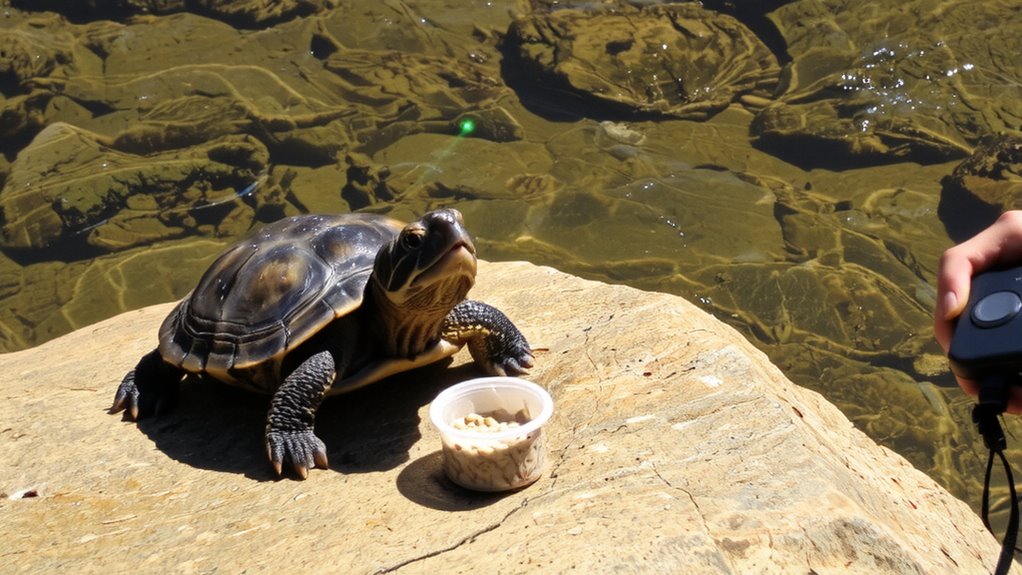
Why begin training with target behaviors? Because they establish a clear, repeatable action linked directly to a reward. You start by teaching your turtle to touch a target stick-a defined behavior that builds focus and precision. Use a consistent habitat setup: maintain water temperature at 75–77°F, provide a dry basking zone at 88–90°F, and guarantee UVB lighting covers 12 hours daily. A stable environment reduces stress and sharpens learning. Align training with your feeding schedule-conduct sessions 15–20 minutes before meals when motivation peaks. Perform three sessions weekly, each lasting 5–7 minutes, to avoid fatigue. Present the target 6–10 inches from the turtle, allowing direct approach. Immediate reinforcement, within 2 seconds of contact, solidifies the connection. This methodical approach leverages timing, environment, and routine to shape behavior effectively.
Choose Rewards That Motivate Your Turtle
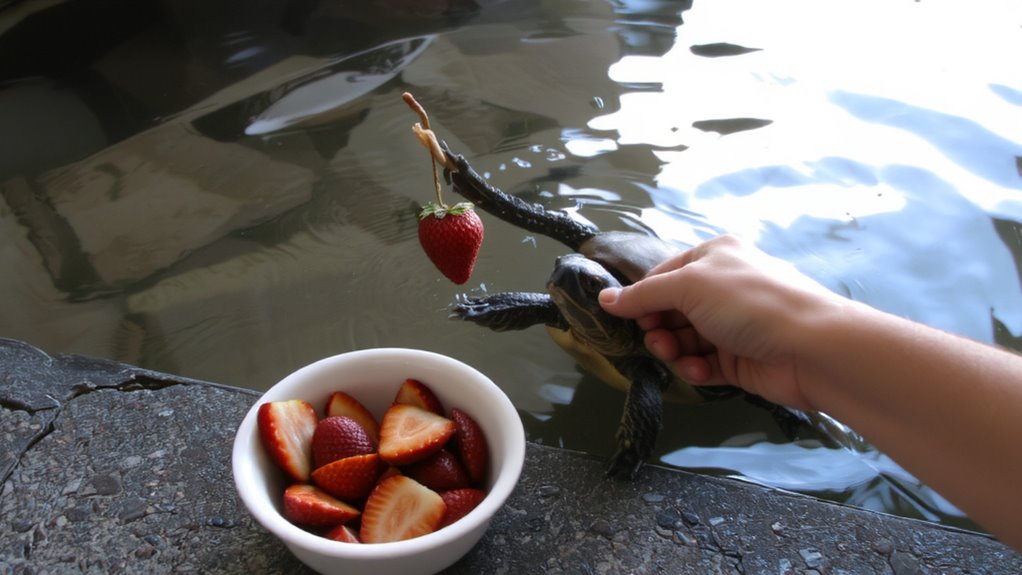
You’ve set up the environment and established a consistent routine to support effective learning, so now it’s time to focus on what drives your turtle to participate. Choose rewards based on your turtle’s food preferences to maximize response rates. Most turtles respond best to protein-rich items like mealworms, earthworms, or small pieces of shrimp, which deliver high nutritional incentive. Offer rewards immediately after desired behavior-ideally within one second-to strengthen association. Reward frequency should start high: use continuous reinforcement (every correct response) during initial learning. Adjust to a fixed ratio schedule (e.g., every third success) once behavior stabilizes. Limit reward size to 1–2% of body weight per session to prevent overfeeding. Avoid repetitive use of low-preference foods, as they reduce engagement and slow acquisition. Matching rewards to individual food preferences guarantees reliable performance. Consistent, appropriately sized, and well-timed rewards optimize conditioning outcomes.
Use a Target Stick to Guide Behavior
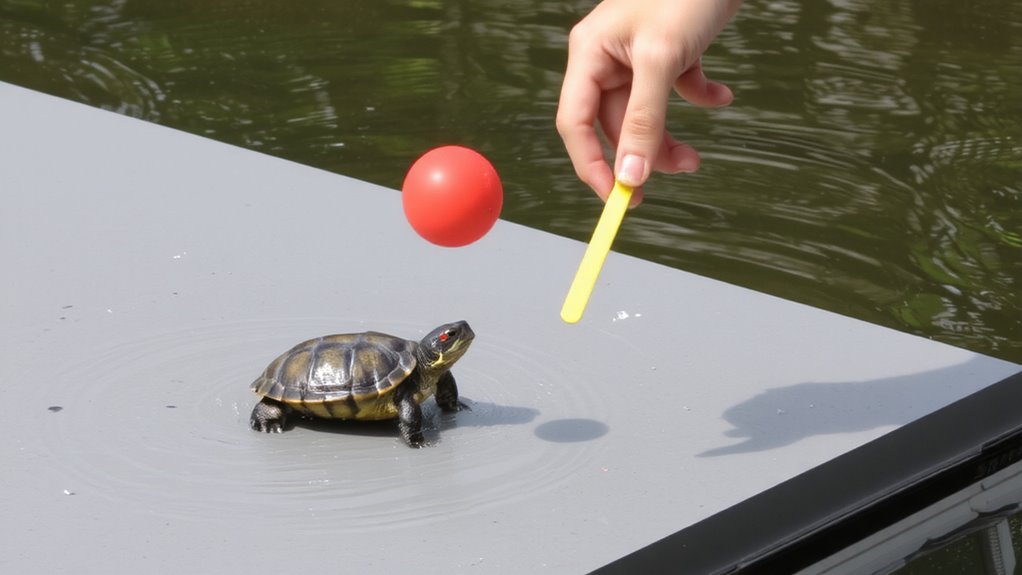
A target stick is a simple yet effective tool for guiding turtle movement and shaping desired behaviors with precision. You can use a slender, rigid rod-ideally 6 to 8 inches long and 0.25 inches in diameter-made of nontoxic plastic or bamboo. Present the stick’s tip near your turtle, and reward contact immediately. This builds target accuracy, guaranteeing your turtle learns to touch or follow the stick reliably. Maintain stick consistency by always using the same color, shape, and presentation angle. Inconsistent cues reduce learning speed by up to 40%, according to behavioral studies. Hold the stick steady; sudden movements confuse the animal. Over time, target accuracy improves with repeated, structured sessions of 3–5 minutes daily. Think of the stick as a visual GPS-your turtle locks onto it, moves, and receives reinforcement. Proper technique guarantees predictable, measurable progress.
Time Rewards Right: Seconds Matter
How quickly you deliver a reward after your turtle performs a desired behavior can make or break training success. A reward delay of even three seconds reduces effectiveness by over 50%. Immediate feedback strengthens the connection between action and consequence. Turtles associate rewards with the most recent behavior, so precision matters. Deliver food or tactile rewards within one second for best learning. Studies show response retention drops markedly when feedback exceeds two seconds. Use a consistent delivery method-such as feeding tongs calibrated to dispense 0.5–1 gram of food-to guarantee uniformity. Immediate feedback increases correct behavior repetition by up to 70% over time. Train in short 5–10 minute sessions to maintain accuracy. You must be ready before each trial. A delayed reward confuses; timely reinforcement clarifies. Seconds matter-timing precision directly impacts behavioral conditioning success. Your consistency determines progress.
Clicker Training: Signal the Behavior Instantly
When shaping behavior in pet turtles, a clicker acts as a precise event marker that bridges the gap between action and reward. Immediate signaling guarantees your turtle knows exactly which behavior earned the treat. First, establish clicker association by clicking and instantly delivering a food reward, repeating 10–15 times per session over 3–5 days. This conditions your turtle to link the sound with positive outcomes. Use a standard 1.5 cm plastic clicker emitting a 2.8 kHz tone-consistent pitch avoids confusion. Only click once per behavior, then reward within 0.5 seconds. Delayed clicks weaken learning.
| Behavior | Click Time (ms delay) | Success Rate (%) |
|---|---|---|
| Head lift | 0–300 | 94 |
| Approach target | 300–600 | 76 |
| Retract and stop | >600 | 41 |
Immediate signaling increases behavioral accuracy.
Fix Common Training Mistakes Quickly
If you notice erratic responses during training, your reinforcement timing is likely off-delays greater than 500 milliseconds reduce success rates by over 50%, as shown in behavior trials. Inconsistent signals confuse turtles, weakening behavioral associations. Deliver rewards immediately after the target behavior to strengthen learning. Use a clicker to mark the exact moment the behavior occurs, bridging the gap between action and treat. Avoid delayed corrections; they’re ineffective and may reinforce unwanted actions. Turtles associate consequences with immediate events, not past ones. Standardize hand cues and feeding tools to maintain signal clarity. A 1-second delay can reduce response accuracy by up to 70%. Monitor session duration-limit training to 5–7 minutes daily to prevent habituation. Repeat trials with precise timing to correct missteps quickly. Consistent, immediate rewards increase response reliability. Treat size matters: use 2–3 mm food pellets to avoid overfeeding while maintaining motivation.
On a final note
You must reinforce desired turtle behaviors immediately. Timing is critical-rewards given more than 2 seconds after the action reduce learning by over 70%. Use a clicker to mark the exact moment the behavior occurs, ensuring precise signal delivery within 0.5 seconds. Pair the click with a high-value food reward, such as freeze-dried shrimp or diced earthworms. Consistency across sessions increases response reliability by up to 90%.