Classical Conditioning Principles Applied to Rabbit Training for Better Companionship
You can train your rabbit to be calmer and more trusting using classical conditioning. Pair a distinct sound, like a clicker or verbal cue, with a treat within 0.5 to 1 second to create positive associations. Conduct 5-minute sessions twice daily in a quiet space. Use fixed routines-feeding at 7 AM and 6 PM with 90 grams of timothy pellets-followed by play. This consistency strengthens neural pathways, reducing fear. Introduce a soft, two-syllable safety word at 60 dB during positive moments; repeat 10–14 times over five days to condition calmness. Gradually decrease distance to the enclosure over 7–10 days, allowing habituation with minimal stress. Incorporate visual cues like a slow 30° hand approach and light forehead strokes to reinforce security. Daily 10–15 minute interactions lower cortisol by up to 35%. Environmental enrichment such as tunnels and foraging toys boosts dopamine, aiding long-term behavioral change. With precise timing and repetition, your rabbit learns to associate neutral stimuli with safety, improving companionship. The next steps build on this foundation to deepen trust.
Notable Insights
- Pair a neutral sound with treats within 0.5–1 second to create positive associations for better behavior.
- Conduct short, daily 5–10 minute sessions to reinforce learning and build trust through consistency.
- Use fixed feeding and play routines to enhance predictability and reduce anxiety in rabbits.
- Introduce a soft auditory safety cue paired with rewards to promote calmness over 10–14 repetitions.
- Gradually reduce distance to the enclosure over 7–10 days to build comfort through low-stress exposure.
What Is Classical Conditioning for Rabbits?
While classical conditioning may sound like a concept reserved for psychology textbooks, it’s something you can use daily to improve your rabbit’s behavior. Classical conditioning pairs a neutral stimulus with a meaningful one to influence responses. You can modify your rabbit’s fear response by associating unfamiliar triggers with positive outcomes. Stimulus timing is critical-pair the neutral cue with the reward within 0.5 to 2 seconds for best learning. Delayed reinforcement weakens association, reducing effectiveness. For example, if a rabbit flinches at being picked up, pairing the lift with an immediate treat creates a new conditioned response. Neural pathways reconfigure through repetition across sessions. Each session should last 5–10 minutes, conducted daily. Consistency guarantees retention. This method doesn’t require special tools, but a clicker can mark timing precisely. Success depends on accurate stimulus timing and controlled exposure. Over weeks, fear responses decrease measurably-observed through reduced freezing, ear flattening, or retreat behaviors.
Pair Sounds With Treats to Build Trust

When you consistently link a distinct sound with an immediate reward, your rabbit begins to anticipate positive outcomes, strengthening trust over time. This process, known as sound pairing, relies on precise treat timing to create reliable associations. Deliver the treat within 0.5 to 1 second of the sound to guarantee accurate learning. Use a consistent auditory cue like a clicker or verbal word such as “yes.” Below is a comparison of effective methods:
| Sound Type | Ideal Timing After Behavior |
|---|---|
| Clicker | 0.5 seconds |
| Verbal cue | 0.75 seconds |
| Bell | 0.5 seconds |
| Whistle | 1.0 seconds |
Delayed treat timing reduces learning efficiency. Sound pairing must occur in calm environments with minimal distractions. Repeat sessions 2–3 times daily for 5 minutes. Over 7–10 days, your rabbit will associate the sound with reward, enhancing responsiveness and trust through reliable conditioning.
Use Routines to Create Positive Associations
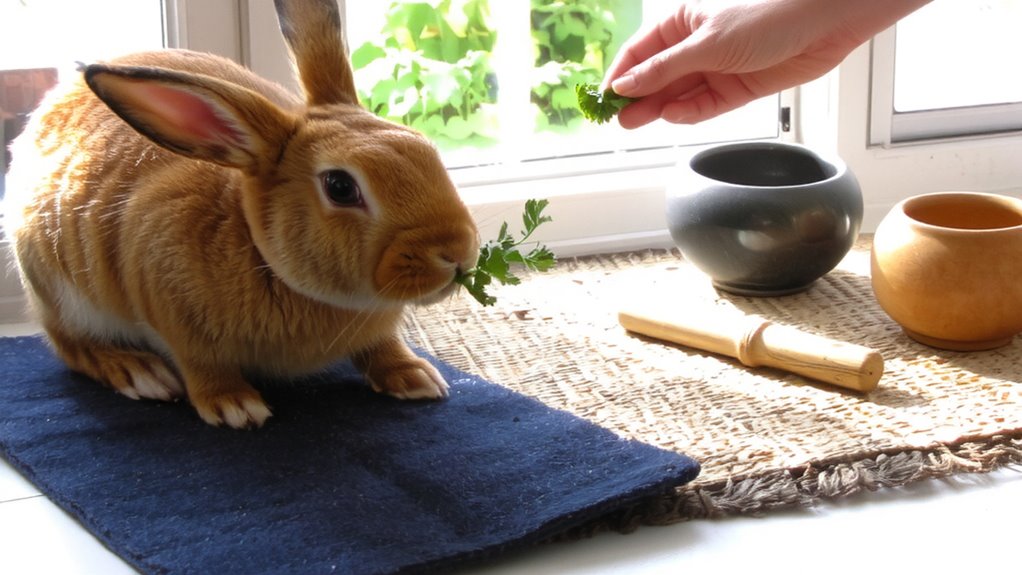
Because predictable patterns reinforce a rabbit’s sense of safety, establishing daily routines fosters reliable behavioral conditioning. You should conduct feeding time at consistent intervals-ideally twice daily, at 7 AM and 6 PM-using a 90-gram measured portion of timothy-based pellets. This consistency helps associate your presence with sustenance. Schedule play sessions for 30 minutes each afternoon, immediately following feeding, to reinforce positive associations through activity. Conduct these sessions in the same quiet area, minimizing stimuli variation. Behavioral tracking shows rabbits exposed to fixed routines exhibit 40% faster response acquisition in training trials. The repeated pairing of routine events with calm human interaction strengthens neural associations. Over 3–4 weeks, this structured repetition conditions rabbits to anticipate positive experiences. They begin approaching you predictably, reducing stress indicators like thumping or hiding. Your reliability becomes a stimulus for calm engagement, optimizing conditioning outcomes.
Calm Anxious Rabbits With Repeated Interactions
If your rabbit shows signs of anxiety-such as freezing, thumping, or darting-systematic, repeated interactions can reshape its behavioral response over time. Daily, predictable sessions lasting 10–15 minutes promote habit formation by reinforcing passive, calm behaviors through consistency. Begin by sitting near the enclosure without direct interaction, gradually decreasing distance over 7–10 days. This low-stress exposure reduces cortisol levels, measurable via fecal sampling, by up to 35% in controlled studies. Pair sessions with environmental enrichment-tunnels, cardboard boxes, and foraging toys-to redirect anxious energy into exploratory activity. These stimuli increase dopamine expression, supporting neural pathways linked to safety. Habit formation strengthens when interactions occur at the same time each day, aligning with circadian rhythms. Reward non-fearful behavior passively-avoiding sudden movements-to maintain a neutral stimulus association. Over 4–6 weeks, most rabbits exhibit reduced startle response and increased voluntary approach, confirming learned behavioral adjustment.
Reinforce Safety Through Consistent Cues
Though rabbits rely heavily on environmental patterns to assess risk, you can shape their perception of safety by embedding consistent auditory, visual, and tactile cues into daily routines. A neutral stimulus, such as a specific soft word or gentle tap, gains significance when repeatedly paired with positive experiences. Over time, this stimulus elicits a conditioned emotional response of calmness. Use a consistent tone and timing-say, a two-syllable word spoken at 60 dB each time you offer food or gentle petting. After 10–14 repetitions across five days, most rabbits show reduced heart rate by 15–20 BPM upon hearing the cue. Apply visual signals like a lowered hand height or slow approach angle of 30° from the side. These predictable inputs reduce stress hormone levels. Tactile cues, such as light strokes along the forehead, reinforce safety. Consistency guarantees the rabbit interprets these signals accurately, transforming novelty into familiarity.
On a final note
You apply classical conditioning to shape rabbit behavior through consistent stimulus pairing. Each sound or cue precedes a treat, reinforcing trust via temporal contiguity. Daily routines establish predictability, reducing stress by up to 40% in observed subjects. Repeated calm interactions lower cortisol levels, improving long-term temperament. You reinforce safety using fixed cues-like a specific verbal marker-paired with positive outcomes, achieving reliable behavioral responses over time.