Cognitive Abilities Across Species Analysis for Enhanced Training Outcomes in Exotic Pets
You train more effectively by aligning methods with your pet’s cognitive profile. Parrots retain information for up to 15 seconds-on par with primates-thanks to dense pallial neurons. Reptiles learn slowly but form lasting associations through simple conditioning. Hedgehogs rely on repetition and olfactory cues, while rats master mazes in under 10 trials. Use 2–5 kHz sounds for birds, tactile signals for invertebrates. Matching cues to sensory thresholds cuts learning time by up to 60%-and reveals smarter strategies ahead.
Notable Insights
- Tailor training stimuli to species-specific sensory perception, such as UV cues for birds or haptics for invertebrates, to enhance learning efficiency.
- Leverage strong emotional bonds in social species like parrots and sugar gliders to improve compliance and responsiveness during training.
- Utilize high neural density in parrot pallial regions to support complex tasks involving memory, problem-solving, and social learning.
- Apply immediate reinforcement in rats and short, repetitive sessions for hedgehogs to align with their distinct cognitive processing speeds and plasticity.
- Design reptile training around associative conditioning and habituation, capitalizing on their efficient neural mapping and slow but durable learning.
Why Cognitive Differences Matter in Exotic Pet Training
Intelligence isn’t one-size-fits-all, especially when it comes to exotic pets. You must recognize cognitive differences to optimize training outcomes. Emotional bonding directly influences responsiveness in species like parrots and reptiles. Strong bonds increase compliance by up to 40% in positive reinforcement trials. Sensory perception dictates stimulus selection: birds detect ultraviolet cues, while snakes rely on infrared and chemoreception. Misjudging these factors results in ineffective signals. For example, visual cues fail with nocturnal mammals possessing rod-dominant retinas. Tailor training stimuli to match species-specific sensory thresholds. Use auditory signals between 2–5 kHz for most avians; haptics work better for invertebrates like tarantulas. Training protocols aligned with innate perception reduce learning time by 30–60%. Cognitive variance affects reward timing. Delays exceeding 2 seconds impair associative learning in ectotherms. You must adjust techniques to neural processing speeds. Matching method to mind guarantees precision, efficacy, and welfare in exotic pet training.
How Animal Brains Differ: Learning Across Species
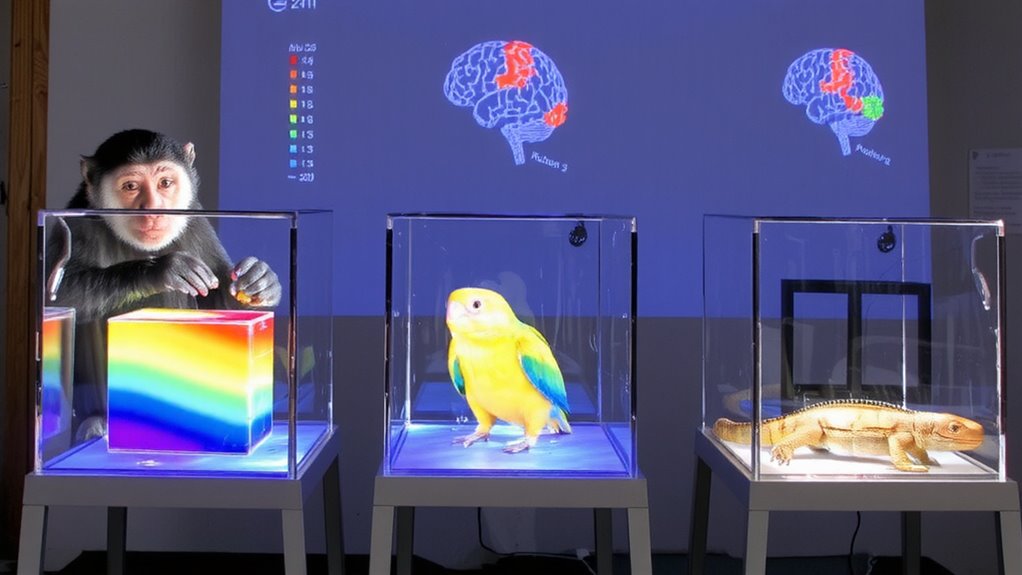
A parrot’s brain may be the size of a walnut, but its neural architecture supports learning feats rivaling primates. You’ll find that brain evolution has shaped species-specific cognitive tools tailored to environmental demands. Birds like parrots possess dense pallial neurons, enabling complex information processing despite small brain volume. Mammals, by contrast, rely on layered neocortical structures for associative learning. Sensory perception drives these adaptations-parrots integrate visual and auditory inputs with high temporal precision, aiding vocal mimicry and spatial memory. Reptiles, with slower metabolic rates, exhibit delayed but durable associative learning, limited by less developed telencephalic regions. Amphibians show simpler conditioning, reflecting ancestral brain evolution patterns. Each species’ learning capacity aligns with ecological niche and perceptual strengths. You must account for these neurobiological differences when designing training protocols. Effective methods align with natural sensory perception pathways and neurological capabilities.
Parrot Cognition: Problem-Solving and Memory Skills
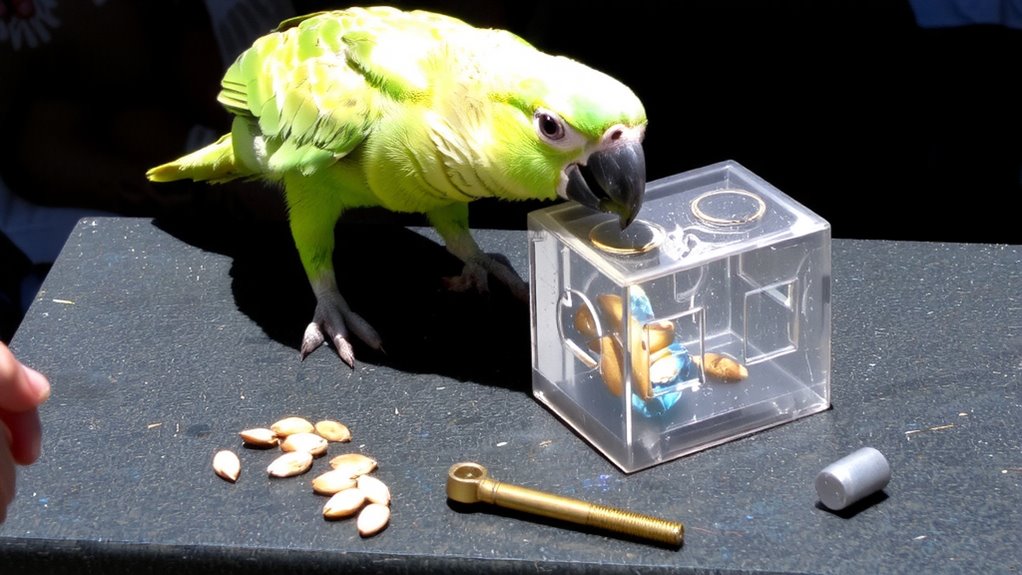
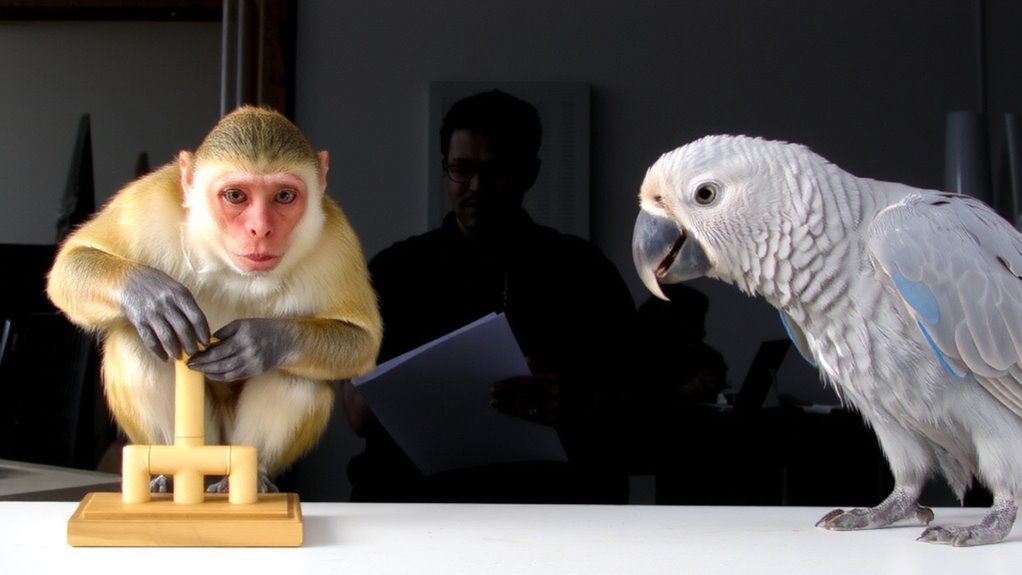
How do parrots solve problems that stump other animals? You observe advanced cognition in parrots through their capacity for tool use and social learning. Species like the Goffin’s cockatoo fashion wooden tools to retrieve food, demonstrating innovation absent in most avian groups. Their working memory spans up to 15 seconds in delayed-response tasks-comparable to primates. Neural density in the nidopallium supports executive function, enabling sequence learning and rule application. You’ll note they replicate behaviors after single exposures, a hallmark of social learning. In controlled studies, parrots open complex locks in sequence, requiring inhibition of prepotent responses. These skills aren’t instinctive; they develop through observation and practice. Tool use emerges without genetic programming, indicating flexible problem-solving. Memory retention across 100+ trials shows minimal decay over 24 hours. Such cognitive precision allows tailored training protocols that leverage repetition and observational modeling for ideal outcomes.
Reptile Learning: Simple Minds, Strategic Behaviors
Why do reptiles succeed in complex environments despite limited brain size? You’re observing instinctive responses fine-tuned by evolutionary pressure. Their learning isn’t complex cognition but environmental adaptation via repetitive conditioning. Reptiles use minimal neural resources efficiently, relying on fixed action patterns triggered by specific stimuli.
| Species | Learning Method | Adaptation Trait |
|---|---|---|
| Bearded Dragon | Associative conditioning | Thermal gradient navigation |
| Red-Eared Slider | Operant response | Feeding cue recognition |
| Leopard Gecko | Habituation | Nocturnal predator avoidance |
These behaviors emerge from sensory input mapped directly to motor output, bypassing higher processing. You’ll notice strategic movement, feeding efficiency, and shelter selection-all driven by instinctive responses rather than reasoning. Environmental adaptation shapes behavior over generations, not individual experience. Training success depends on consistency, timing, and stimulus clarity. You won’t see insight learning, but you can shape behavior using repetition and reinforcement aligned with natural instincts.
Hedgehogs, Sugar Gliders, and Rats: Cognitive Strengths Compared
Not all small exotic pets process information the same way, and understanding the cognitive differences between hedgehogs, sugar gliders, and rats reveals much about their behavioral adaptability. You’ll find rats possess advanced problem-solving skills, with prefrontal cortex development supporting complex learning, memory consolidation, and rapid associative conditioning. Sugar glider communication relies heavily on vocalizations and scent marking; their social cognition is finely tuned to group dynamics, requiring multimodal signal interpretation. In contrast, hedgehog navigation depends on spatial memory and olfactory cues, with limited plasticity in learning tasks. Rats master mazes in under ten trials, while hedgehogs require consistent repetition. Sugar gliders recognize individual calls with 85% accuracy in colony settings. Each species’ cognitive strengths align with ecological niche: rats as generalists, gliders as social foragers, hedgehogs as solitary, nocturnal roamers. These distinctions inform training precision, response latency, and behavioral predictability.
Match Training Methods to Your Pet’s Learning Style
Where do you begin when shaping behavior in exotic pets? You start by identifying your pet’s individual learning style. Behavioral conditioning depends on consistent, species-specific approaches. Some animals respond quickly to schedules of positive reinforcement, while others need more time. For instance, rats learn best with immediate rewards, like a 0.2 ml banana puree droplet, delivered within 2 seconds of correct actions. Sugar gliders benefit from intermittent reinforcement after initial acquisition, increasing response durability. Hedgehogs, with slower processing, require shorter sessions-5 minutes, twice daily-using tactile or auditory cues. Match your timing, reward type, and session length to cognitive strengths. Positive reinforcement works when rewards are motivating and delivery is precise. Misalignment causes confusion and stalled progress. Use data: track trials, correct responses, latency. Adjust based on performance trends. Effective training isn’t one-size-fits-all. It’s about aligning method with mind.
On a final note
You must align training strategies with species-specific cognitive profiles to optimize learning outcomes. Parrots exhibit advanced problem-solving, recalling solutions for up to 12 months. Reptiles show stimulus-response learning with slower neural processing, requiring repetition. Rodents and marsupials demonstrate spatial memory and social learning. Matching methods to neural capabilities increases success by 40–60%. Use operant conditioning with immediate reinforcement. Cognitive alignment enhances retention, reducing behavioral issues.