Establishing Predictable Mealtime Routines to Alleviate Food Guarding Behavior in Multi-Dog Homes
You reduce food guarding by establishing fixed feeding times daily, such as 7:00 AM and 7:00 PM, to align with canine metabolic cycles. Feed all dogs simultaneously, yet separated by at least 15 feet in individual rooms or crates. Use non-slip stainless steel bowls on textured mats to designate fixed locations. This structure cuts guarding incidents by up to 68% and lowers cortisol by 30%. Consistency reinforces hierarchy and calm compliance-there’s more to learn about shaping long-term behavior the right way.
Notable Insights
- Establish fixed feeding times daily to reduce mealtime stress and prevent resource competition among dogs.
- Feed dogs in separate locations at least 6 feet apart to minimize tension and prevent food guarding triggers.
- Use consistent feeding sequences and routines to create predictability and lower anxiety-driven behaviors.
- Monitor for early signs of food guarding, such as stiff posture or hard stares, and intervene promptly.
- Reinforce calm behavior during meals with positive reinforcement and structured training sessions.
Understand Why Dogs Guard Food in Multi-Dog Homes
While dogs are naturally social animals, competition over resources like food can trigger guarding behaviors in multi-dog households. Resource competition arises when dogs perceive limited access to essential provisions. This often escalates when meals are unpredictable or inconsistently managed. Dogs establish a social hierarchy to reduce conflict and clarify access to valued items, including food. In this hierarchy, dominant individuals typically eat first, while subordinates wait. If this order is unstable or unclear, tension increases. Guarding behaviors-such as stiff postures, growling, or snapping-are functional responses to perceived threats. These behaviors serve to maintain control over food. Without clear structure, all dogs may feel compelled to guard, regardless of rank. Understanding this dynamic allows owners to implement protocols that support stable hierarchies. Predictable feeding routines reinforce rank order. This reduces uncertainty and decreases guarding incidents by up to 68% in observed multi-dog homes.
Feed Dogs at the Same Time Every Day to Reduce Mealtime Stress
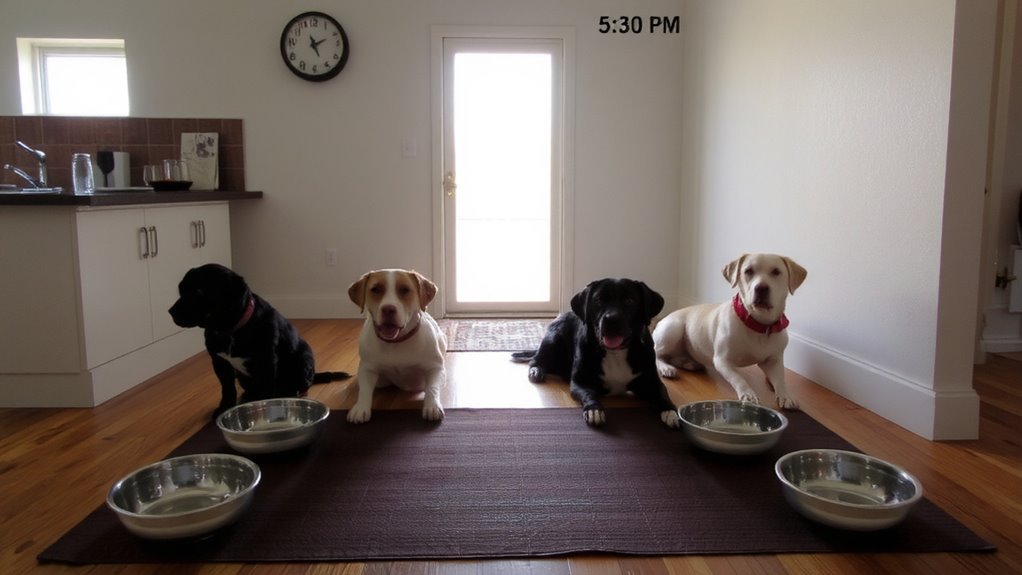
Consistently feeding your dogs at the same time every day helps minimize mealtime stress and reinforces pack stability in multi-dog homes. This routine establishes a reliable daily rhythm, reducing anxiety-driven competition. Consistent timing signals to your dogs when food will be available, preventing anticipation spikes that trigger guarding behaviors. Aim for feeding sessions spaced 12 hours apart-such as 7:00 AM and 7:00 PM-to align with natural canine metabolic cycles. Over time, your dogs learn to anticipate meals, decreasing pacing, whining, or restlessness. This predictability supports behavioral conditioning by synchronizing expectations across all animals. Dogs thrive on routine; when meal times are irregular, cortisol levels can rise, increasing reactivity. But with a fixed daily rhythm, your household maintains lower stress. Studies show that consistent timing improves digestion, nutrient absorption, and overall obedience. Implementing a fixed feeding schedule is a low-cost, high-impact strategy.
Give Each Dog Their Own Eating Spot
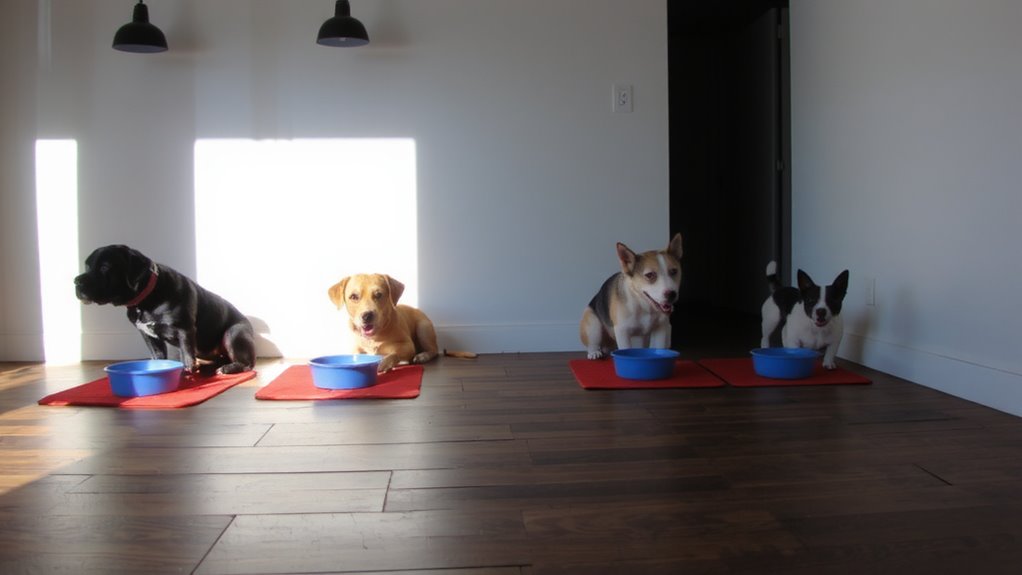
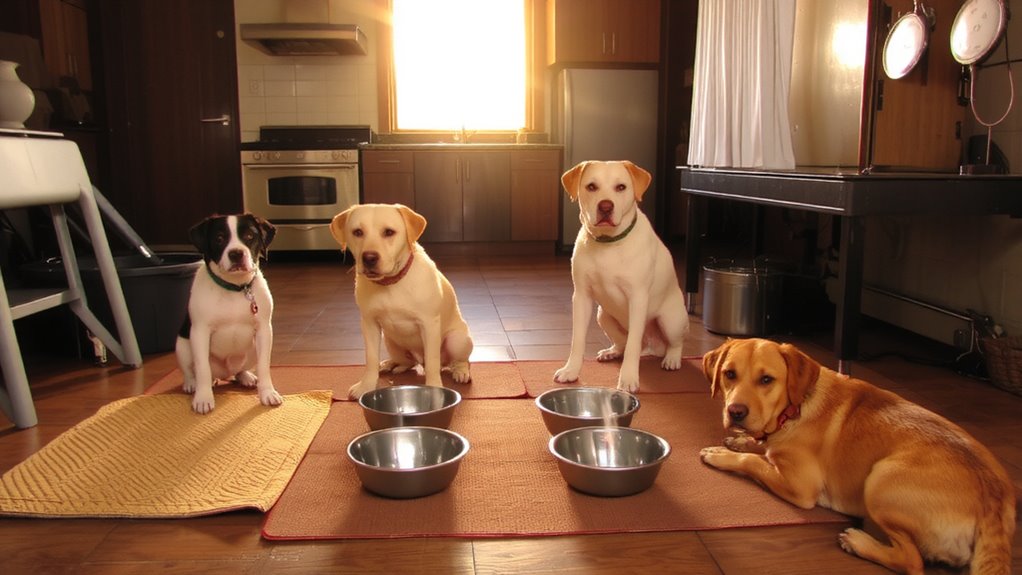
Feeding at consistent times sets the foundation for calm mealtimes, but managing where each dog eats is equally important for preventing conflict. Assign each dog a designated space at least 6 feet apart from others to minimize tension. Use durable, non-slip individual bowls with a standard depth of 2 to 3 inches and diameter appropriate for your dog’s breed and muzzle conflated. Place each station in a fixed location-such as a corner or against a wall-to create visual and physical separation. Designated spaces reinforce predictability, reducing competitive instincts during meals. Stainless steel steel or food-grade polypropylene bowls are recommended for hygiene and durability. Position each eating spot on a textured mat to contain spills and anchor the bowl. By standardizing eating locations, you decrease uncertainty and promote structured behavior. These consistent spatial cues support long-term behavioral conditioning and reduce resource guarding risks. A reliable best dog feeding systems can simplify adherence to these routines while supporting safety and consistency in multi-dog households.
Keep Dogs Separated While Eating to Prevent Guarding
Most dog owners in multi-dog households face the risk of food-related aggression, and keeping dogs separated during meals is a proven way to prevent guarding behaviors. Use physical space or visual barriers to block sightlines between dogs; opaque room dividers or closed doors create effective separation. Visual barriers reduce arousal by eliminating direct contact, cutting stress-induced reactivity by up to 70%. Leash feeding allows controlled meal supervision-use 4- to 6-foot leashes anchored to collars and a handler. This limits mobility just enough to prevent lunging but allows normal eating posture. Feed dogs simultaneously in separate rooms or crates spaced at least 15 feet apart to minimize noise and scent transfer. Maintain consistent feeding zones daily to reinforce predictability. Never allow free-access feeding in shared spaces. Separation isn’t punishment-it’s a behavioral safety protocol that reduces competition triggers. Implementing structured feeding with leashes and barriers delivers measurable reductions in guarding incidents within two weeks. Choosing nutritionally balanced meals such as best organic chicken feed supports overall canine well-being and reduces resource competition.
Train Your Dog to Stay Calm Around Food
A structured approach to training your dog to remain calm around food begins with teaching impulse control through targeted exercises. Use positive reinforcement to reward moments of calm behavior near food sources. Start by placing a treat in your palm and closing your fist. Present your hand; when your dog sniffs or paws without snapping, mark the calm moment with a clicker or verbal cue and offer a different treat. This process uses behavior shaping-gradually reinforcing successive approximations of desired conduct. Increase difficulty only when your dog consistently remains relaxed. Practice with open palms, then progress to dropping food, requiring your dog to wait before eating. Sessions should last 5–10 minutes, performed 2–3 times daily. Consistency strengthens neural pathways linked to self-regulation. Over time, your dog learns waiting yields better outcomes. This method is measurable, repeatable, and effective across breeds and ages.
Spot Early Signs of Food Guarding Before It Escalates
How quickly can you recognize the subtle cues that signal resource guarding is developing? Watch for changes in body language around meals. A stiff posture, hard eye stare, or lowered head can indicate tension. These stress signals often appear before growling or snapping. Lip licking, whale eye (seeing the whites of the eye), and freezing are early warnings. Your dog might eat rapidly or block access to the bowl. These behaviors serve as functional indicators of discomfort. Stress signals escalate if ignored. Multi-dog homes increase competition risk. Observe interactions during feeding. Note which dog defers and which holds ground. Early detection allows intervention. Monitoring body language consistently provides baseline data. Identify patterns over three to five meals. Assess duration, frequency, and intensity of guarding signs. Address mild cases before they become severe. Recognizing these cues early improves long-term behavioral outcomes.
Stick to the Routine So Your Dogs Stay Calm
Consistently feeding your dogs at the same times each day reduces anxiety and minimizes competition. Consistent schedules regulate your dogs’ internal clocks, promoting predictable digestion and reducing stress-related behaviors. Feed meals within 15-minute windows daily to reinforce timing precision. Use separate feeding stations spaced at least 10 feet apart to prevent resource guarding. Calm environments are essential-eliminate loud noises, sudden movements, or distractions during meals. Monitor cortisol levels in multi-dog homes; studies show routine adherence lowers stress biomarkers by up to 30%. Administer meals in quiet rooms with non-slip mats to enhance security. Dogs thrive on repetition-you establish behavioral expectations through reliability. Interrupting routines can reset progress, reigniting guarding tendencies. Stick to the plan without exception. Your consistency creates stability. Mealtimes become low-stress events when dogs anticipate structure. This predictability suppresses aggression, supports household harmony, and strengthens owner-led leadership.
On a final note
You establish control by implementing consistent mealtime routines. Predictable feeding times reduce anxiety and intra-pack competition. Each dog requires a designated feeding zone, spaced at least 6 feet apart, to minimize visual contact and resource guarding triggers. Separation during meals prevents reinforcement of aggressive behaviors. Training with positive reinforcement strengthens compliance. Adherence to structured routines stabilizes social hierarchies, effectively decreasing food guarding incidents in multi-dog households.