Implementing Positive Reinforcement Training to Build Confidence in Shy Rescue Rabbits
You can build trust with your shy rescue rabbit by using positive reinforcement in a secure, low-stimulus environment. Start with a solid-sided enclosure, at least 4 ft x 2 ft, and keep noise below 50 dB. Offer high-value treats like banana chips (1 cm³, ~4.2 kcal) within one second of desired behavior. Use consistent 12-hour light cycles and teach “touch” and “come” with 5-minute daily sessions. Distress signs-flattened ears, freezing-mean you should pause and reassess. Over time, precise rewards and quiet consistency rewire fear responses, strengthening neural pathways linked to safety cues. Further refinements in scheduling and reinforcement timing can enhance progress.
Notable Insights
- Use solid-sided enclosures at least 4 ft x 2 ft to reduce visual stress and support emotional security.
- Deliver high-value treats like banana chips or apple slices within one second of desired behavior for effective association.
- Start training with “touch” using a target stick, rewarding nose contact to build confidence gradually.
- Conduct brief 5-minute sessions daily, aiming for 8–10 successful trials to reinforce learning without overwhelm.
- Watch for flattened ears or freezing; pause if stressed and reduce stimuli to maintain a positive experience.
Start With a Safe Space for Shy Rescue Rabbits
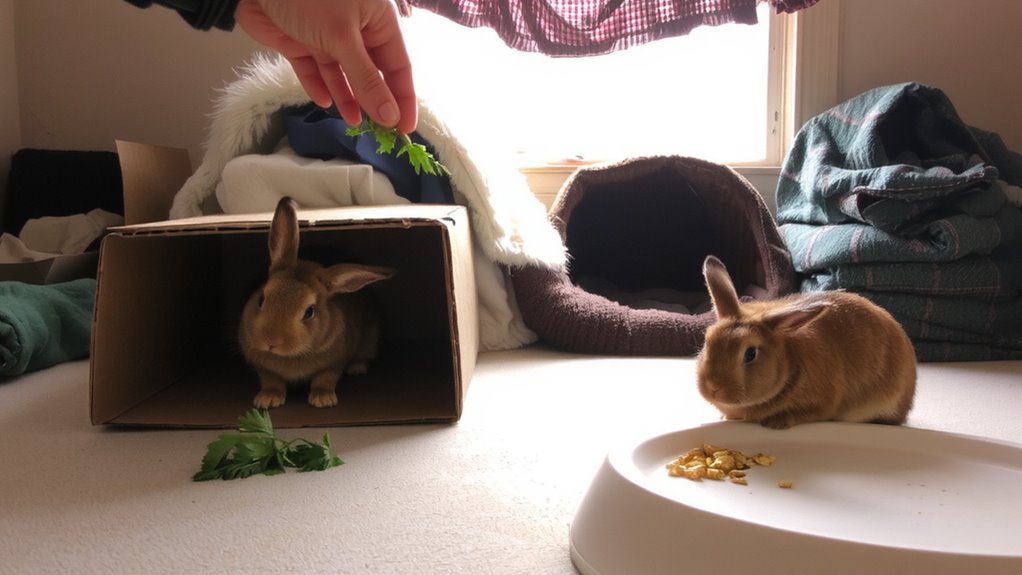
A secure enclosure is the foundation of successful rehabilitation for shy rescue rabbits. You must provide a safe space that minimizes stress and supports gradual acclimation. Use a solid-sided enclosure measuring at least 4 feet long by 2 feet wide to prevent visual overstimulation. Wire cages with open sides often heighten anxiety; solid panels create necessary psychological security. Include a hide box-minimum 12” x 12” x 10”-positioned away from direct light and foot traffic. This refuge allows the rabbit to retreat when overwhelmed, reinforcing feelings of safety. Maintain a quiet environment with sound levels below 50 decibels, similar to a library, to avoid auditory stress. Position the enclosure in a low-traffic room, away from appliances and sudden movements. Consistent lighting cycles of 12 hours light, 12 hours dark support circadian regulation. You are building behavioral stability through environmental predictability. For portable safety during travel or vet visits, consider using a mini rabbit travel cage designed for secure, stress-free transport.
Use High-Value Treats to Encourage Brave Behavior

Once the rabbit has a secure enclosure established, you can begin reinforcing positive interactions using targeted food rewards. High-value treats increase motivation and promote repeat behaviors. Use treat variety to identify which foods elicit the strongest response-options like banana chips, apple slices, or crushed pellets can be tested. Timing precision is critical; deliver the reward within one second of the desired behavior to create a clear association.
| Treat Type | Portion Size | Caloric Content (kcal) | Response Duration (sec) |
|---|---|---|---|
| Banana Chip | 1 cm³ | 4.2 | 8–12 |
| Apple Slice | 2 cm² | 3.8 | 6–10 |
| Crushed Pellet | 0.5 g | 2.1 | 4–7 |
| Oat Flake | 1 flake | 1.5 | 5–9 |
| Carrot Tip | 0.5 cm³ | 0.8 | 3–5 |
Consistent delivery enhances learning efficiency.
Teach ‘Come’ and ‘Touch’ to Build Bunny Confidence
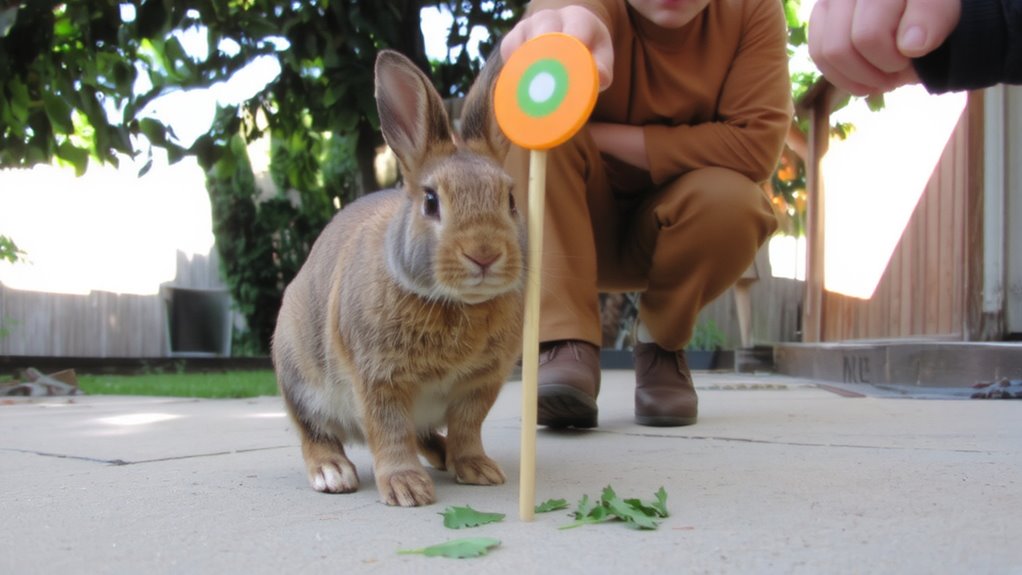
Though shy rabbits may hesitate to approach, you can shape their behavior systematically using targeted cues like ‘come’ and ‘touch’. Begin with target training using a handheld stick or spoon; present the target gently, and reward any nose contact. Repeat in short 5-minute sessions daily, achieving 8–10 successful trials per session. Pair the behavior with a verbal cue like “touch” immediately after consistent contact. Once reliable, advance to “come” by placing the target a few inches away, rewarding movement toward it. Use high-value treats such as banana chips or oats to maintain motivation. Target training builds predictability, which supports trust building by allowing the rabbit to anticipate outcomes. Work at the animal’s pace, ensuring each step is mastered before progressing. Distance, duration, and distraction should increase incrementally-no more than 10% per week. Accuracy exceeds 90% when reinforcement is consistent and timing precise.
Fix Fear, Refusal, and Slow Progress Fast
Why does your rescue rabbit freeze or turn away when you extend the target? Fear responses stem from past trauma or uncertainty, disrupting trust building. Your rabbit’s body language-flattened ears, tense muscles, or sudden stillness-signals distress, not defiance. Recognize these cues immediately. Pause sessions at the first sign of discomfort. Reduce environmental stimuli: limit noise, enclose the space, and stay at floor level to appear less threatening. Shorten training to 3–5 minute sessions, two to three times daily, allowing incremental desensitization. Use high-value treats (e.g., fresh parsley or apple snippets, 1–2 cm³) delivered quietly to avoid startling. Never force interaction. Consistent timing-offering rewards within one second of desired behavior-strengthens associative learning. Progress isn’t linear. Adjust criteria based on daily observations of body language. Confidence grows through predictable, calm repetition. Patience accelerates results.
Why Positive Reinforcement Works for Timid Rabbits
Positive reinforcement builds trust by aligning your rabbit’s natural behaviors with predictable, positive outcomes. Trust building occurs when rewards consistently follow desired actions, creating clear behavioral contingencies. You reinforce approach, sniffing, or stillness with treats like crushed oats or hay cubes-measured in 1-gram portions to prevent overfeeding. Each reward is delivered within 1–2 seconds post-behavior, ensuring temporal contiguity. This precision strengthens associative learning. Emotional safety emerges as your rabbit learns the environment isn’t punitive. Avoid punishment; it increases cortisol, impairing learning. Instead, use marker signals-like a quiet click-to precisely indicate correct behavior. Sessions last 3–5 minutes, twice daily, maintaining cognitive engagement without overload. The rabbit’s heart rate, typically 180–250 bpm under stress, decreases with consistent positive conditioning. Over 2–4 weeks, behavioral shifts-increased exploration, reduced freezing-confirm efficacy. You’re not just rewarding actions-you’re shaping a calm, responsive mindset through systematic reinforcement.
On a final note
You build confidence in shy rescue rabbits by consistently applying positive reinforcement. Each rewarded behavior strengthens neural associations, increasing the likelihood of repetition. Use high-value treats like banana chips or fresh herbs in 1/2-inch cubes, delivered within 1.5 seconds of desired actions. Train in 5–10-minute daily sessions in a low-stimulus environment. Shaping through successive approximations improves approach, touch, and recall responses within 4–6 weeks.