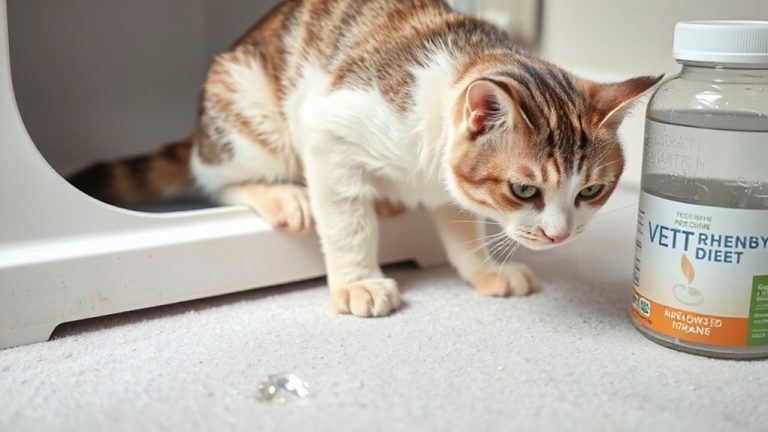
Designing a Weight-Control Strategy for Indoor-Only Cats With Minimal Activity
You must control portion sizes and increase activity to manage your indoor cat’s weight. Most adult cats need 20–30 calories per pound daily; use a digital scale for accuracy. Feed in two or three meals to stabilize metabolism. Use food puzzles that dispense 1–3 kibbles per roll, boosting engagement by 5–10 minutes and raising heart rate 20–30%. Schedule two 10-minute play sessions daily with wand toys at 0.5–2 m/s. Add vertical spaces 1.2–1.8 meters high. Track progress weekly with photos and body condition scoring. A structured plan delivers measurable results over time.
Notable Insights
- Match daily calorie intake to your cat’s low activity level, typically 20–30 calories per pound of body weight.
- Use precise portioning with a digital scale or measuring cup to prevent overfeeding and portion creep.
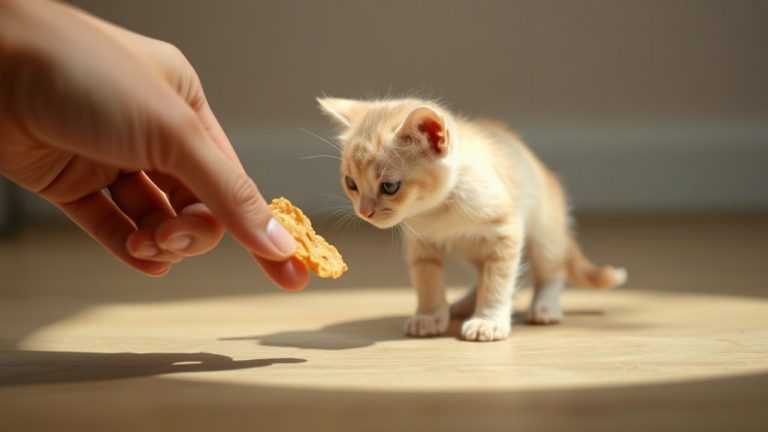
- Incorporate food puzzles that dispense kibbles through rolling or pawing to increase physical and mental engagement.
- Schedule two 10-minute interactive play sessions daily using prey-mimicking toys to boost activity and energy expenditure.
- Monitor body condition weekly using a 1–9 scale, assessing rib cover, waistline, and consistent photo tracking.
Understand Why Indoor Cats Gain Weight
What makes indoor cats so prone to packing on extra pounds? Their sedentary lifestyle directly contributes to weight gain. Metabolism slowdown occurs as cats age, reducing caloric needs by up to 20% after age seven. Indoor cats often burn fewer than 60 kilocalories per kilogram daily due to minimal physical activity. Yet, feeding remains unchanged, leading to excess energy storage. Portion creep exacerbates the problem-over time, owners unknowingly increase meal sizes by 10–15%, mistaking begging for hunger. This gradual escalation can result in a 10% body weight gain within six months. High-calorie diets, typically 350–450 kcal/cup, compound the issue. Without activity to offset intake, fat accumulation follows. You must recognize that weight gain isn’t willful but driven by biological and behavioral factors. Addressing root causes like metabolism slowdown and portion creep is essential before implementing dietary or activity interventions. Incorporating vet-recommended weight management supplements can support metabolic health and help maintain ideal body condition in low-activity cats.
Measure Meals to Control Cat Weight
A precise feeding routine is your most effective tool for managing your cat’s weight. Portion control prevents overfeeding, a leading cause of feline obesity. Use a digital kitchen scale or measuring cup calibrated in grams for accuracy. Most adult indoor cats need 20–30 calories per pound of body weight daily. Calorie counting guarantees intake matches energy expenditure. Divide the daily allotment into two or three measured meals to stabilize blood sugar and reduce begging.
| Emotion | Feeding Freely | Measuring Meals |
|---|---|---|
| Guilt | High | Low |
| Regret | Common | Rare |
| Pride | Low | High |
Over time, consistent portion control improves mobility and extends lifespan. Use manufacturer guidelines but verify with your vet. Adjust as weight changes occur. Automation with portion-controlled feeders can improve adherence. Precision today prevents disease tomorrow. A reliable auto feeder for cats can simplify portion control and support long-term weight management.
Use Food Puzzles to Increase Activity
You’ve already taken control of your cat’s intake by measuring meals, but managing weight isn’t just about limiting food-it’s also about increasing energy expenditure. A food puzzle forces your cat to work for kibbles, turning eating into activity. These devices slow consumption and require rolling, pawing, or nudging to release food. Simple models dispense one to three kibbles per roll; complex versions require multi-step manipulation. Engaging a cat for five to ten minutes per session, they elevate heart rate by 20–30%. Beyond physical effort, a food puzzle provides mental stimulation, activating problem-solving behaviors. Studies show cats using food puzzles exhibit 40% more daily movement. Choose durable, non-toxic plastic units with adjustable difficulty. Some hold up to 1/2 cup of dry food, suitable for 12-hour use. Rotate styles weekly to prevent habituation. This combination of physical and cognitive engagement supports weight management more effectively than feeding alone. For dogs, the benefits of mental and physical stimulation are similarly supported by specially designed canine puzzle toys.
Add Play and Climbing to Daily Routine
Because physical activity directly impacts caloric expenditure, integrating structured play and vertical climbing into your cat’s day can greatly enhance weight control. Schedule two 10-minute play sessions daily using interactive toys like wand toys with feathers or motor cyclers laser pointers. These mimic prey movement, stimulating predatory behaviors and increasing heart rate. Choose toys with variable speeds (0.5–2 m/s) to sustain engagement. Provide vertical spaces such as cat trees or wall-mounted shelves at heights of 1.2 to 1.8 meters, encouraging climbing and muscle use. Climbing engages major muscle groups, boosting energy expenditure by up to 游戏副本 compared to floor activity. Position perches near windows to promote spontaneous jumping. Use durable materials like sisal and solid wood to guarantee stability. Rotate toys weekly to prevent habituation. Vertical spaces also reduce stress by expanding territory perception, supporting consistent activity levels critical for weight management.
Track Your Cat’s Progress Without a Scale
Monitoring your cat’s weight loss doesn’t require a bathroom scale or veterinary visits every week. You can effectively track progress using body condition scoring, a standardized method veterinarians use to assess fat distribution and muscle mass. Assign your cat a score from 1 to 9, where 5 is ideal; ribs should be palpable with minimal fat cover and a visible waistline when viewed from above. Perform visual progress tracking weekly by photographing your cat from the side and above under consistent lighting. Compare images sequentially to detect subtle changes in body contour. Changes in mobility, grooming habits, or energy levels also indicate progress. Use a fixed reference point, like a tile floor or specific blanket, to maintain image consistency. Body condition scoring combined with visual progress tracking provides accurate, non-invasive assessment. This method avoids stress associated with frequent weighing and delivers reliable long-term data.
On a final note
You control your cat’s weight through precise meal portions and activity monitoring. Feed 20–30 kcal per pound of ideal body weight daily, split into two measured meals. Use calibrated food puzzles to extend feeding time by 5–10 minutes, increasing mental and physical engagement. Schedule two 10-minute play sessions daily with wand toys to stimulate hunting behaviors. Track progress via monthly body condition scoring; a palpable ribcage under a thin fat layer indicates ideal weight.