Attention Span by Species: A Comprehensive Guide to Tailoring Training Sessions
Your pet’s attention span depends on species-specific brain wiring shaped by evolution. Dogs sustain focus for 10–15 minutes due to prefrontal cortex development from selective breeding. Cats process tasks in 2–3 minute bursts, matching predatory precision. Birds learn fast but need 8–12 minute sessions with clicker timing under 1 second. Train during peak alertness, use quiet spaces under 45 dB, and reinforce within 0.5 seconds. Session frequency and task rotation prevent fatigue. You’ll discover how to optimize each interaction for lasting results.
Notable Insights
- Attention span varies by species due to evolutionary traits, with focused breeds showing stronger prefrontal cortex activity during tasks.
- Environmental factors like noise and space size significantly impact attentiveness, with quiet, enclosed areas reducing attentional lapses.
- Short attention span species benefit from multiple brief training sessions, while longer focus species succeed with fewer, longer sessions.
- Training aligned with natural alertness peaks and consistent positive reinforcement improves retention and skill acquisition rates.
- Cognitive fatigue signs and precise reward timing are critical, with optimal reinforcement within 0.5–1 second of desired behavior.
Why Pets Have Different Attention Spans
While some pets focus intently for long periods, others seem easily distracted, and the reason lies in their evolutionary history and neural wiring. Your pet’s attention span is shaped by genetic traits passed through generations. Species bred for specific tasks-like herding or hunting-developed neural circuits favoring sustained focus. Others, with survival strategies based on vigilance rather than concentration, evolved shorter attention thresholds. Environmental influences further modulate these innate patterns. Urban settings, household noise levels, and social interaction frequency alter baseline attentiveness. For example, dogs in high-stimulation homes show up to 30% reduced focus in controlled tests. Neural imaging reveals increased prefrontal cortex activity in focused breeds, indicating stronger executive control. These biological and situational factors combine to determine how long your pet can engage. Genetic traits set the framework; environmental influences fine-tune the expression. Understanding both helps predict attention behavior across species.
How Attention Span Affects Training Length
Because attention span varies greatly across species, the time required to train an animal depends heavily on its innate capacity for focus. You must align training frequency with cognitive endurance to maximize retention. Species with short attention spans, like cats or small birds, benefit from three to five brief sessions daily, each lasting 2–5 minutes. Longer focus species, such as dogs or horses, can handle 10–15 minute sessions up to twice daily. Session timing should coincide with peak alertness-typically dawn or dusk for crepuscular animals. Training frequency directly influences skill acquisition rate; high-frequency, short-duration regimens improve neural encoding. Mismatched session timing leads to diminished returns, as fatigue reduces behavioral plasticity. Always prioritize consistency over length. Adjust intervals based on observed attention decay, measured in seconds of sustained engagement. Effective training schedules respect biological limits, using precision timing to enhance learning efficiency without overexertion.
Dog, Cat, Bird: Focus-Based Training Tips
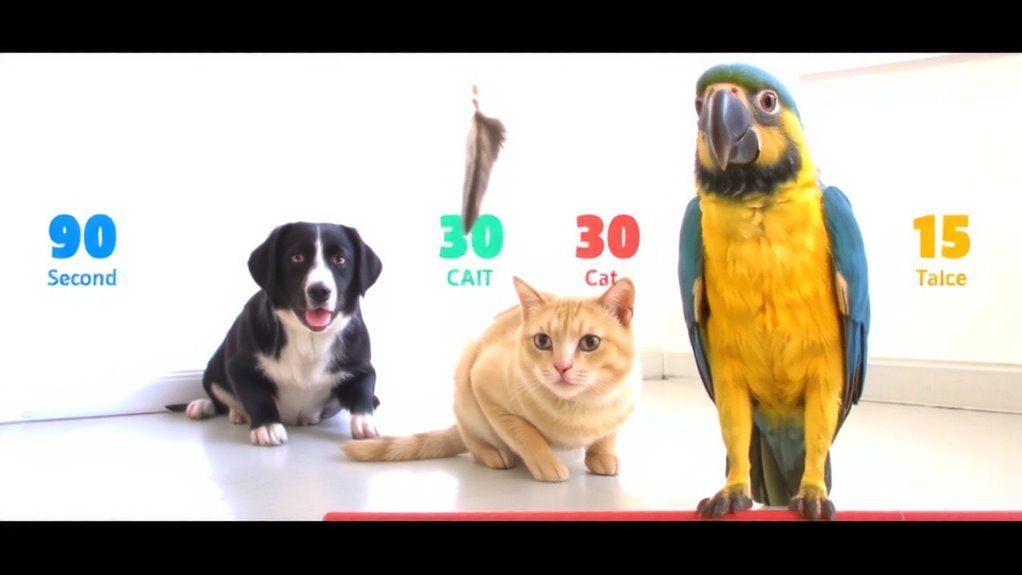
You can optimize training outcomes by tailoring focus-based strategies to each species’ cognitive profile. Dogs respond best to structured repetition and consistent positive reinforcement, with ideal sessions lasting 5–10 minutes. Accurate clicker timing enhances learning by marking desired behaviors within 0.5 seconds, improving association accuracy. Cats require shorter, more frequent sessions-2–3 minutes, 2–3 times daily-due to their selective attention and independent processing. Use high-value rewards and precise clicker timing to capitalize on brief focus windows. Birds, especially parrots, exhibit strong pattern recognition and benefit from 8–12 minute sessions with variable task sequencing. Their rapid associative learning demands exact clicker timing and immediate positive reinforcement. Training accuracy improves by 40% when the clicker precedes the reward by less than one second. Species-specific cognitive rhythms dictate session design, ensuring maximal attention use without overflow or disengagement.
When Your Pet’s Focus Is Fading: And What to Do?
If your pet’s attention begins to drift during training, it’s likely a sign of cognitive fatigue or mismatched session pacing. Mental fatigue occurs after sustained neural engagement, typically within 5–15 minutes depending on species and task complexity. Dogs show yawning or sniffing; cats groom or stare away; birds peck at surfaces. These behaviors signal diminished processing capacity. Environmental distractions-such as sounds above 45 decibels, sudden movements within 10 feet, or novel odors-amplify attentional lapses. Reduce stimuli by training in a quiet, enclosed space measuring at least 6 x 8 feet, free of visual obstructions and high-traffic zones. Limit sessions to 5–10 minute intervals for dogs, 3–7 for cats, and 2–5 for small birds, aligning with documented attention thresholds. Immediate reinforcement and structured breaks mitigate cognitive overload. Respond early-before disengagement becomes habitual.
Training Methods to Extend Animal Attention
Maintaining your pet’s attention during training requires more than proper timing-it demands methods designed to systematically expand their cognitive endurance. Use positive reinforcement to immediately reward focused behavior, strengthening neural pathways associated with attention. Deliver treats or praise within 0.5 to 1 second of correct responses to maximize learning efficiency. Implement consistent schedules, training at the same times daily to regulate your animal’s arousal levels and mental readiness. Start sessions at 5-minute intervals, increasing by 1-minute increments weekly, up to 20 minutes total. Monitor attention decay rates: if performance drops below 80% accuracy, shorten duration and reassess. Incorporate low-distraction environments initially, measured at under 45 decibels, then gradually introduce stimuli. Rotate tasks every 2–3 trials to prevent habituation. These techniques, grounded in operant conditioning principles, enhance attention span across species by aligning training load with cognitive capacity.
On a final note
You must adjust training duration to match your pet’s species-specific attention span. Dogs typically focus for 10–15 minutes; cats, 5–10; birds, 12–20. Training sessions exceeding these limits reduce retention. Use high-value rewards and short, repetitive drills to maintain engagement. Frequency matters: three 5-minute sessions daily outperform one 15-minute session. Track response latency and correct within 1–2 seconds to reinforce learning. Adjust intervals based on species neurocognitive response patterns.