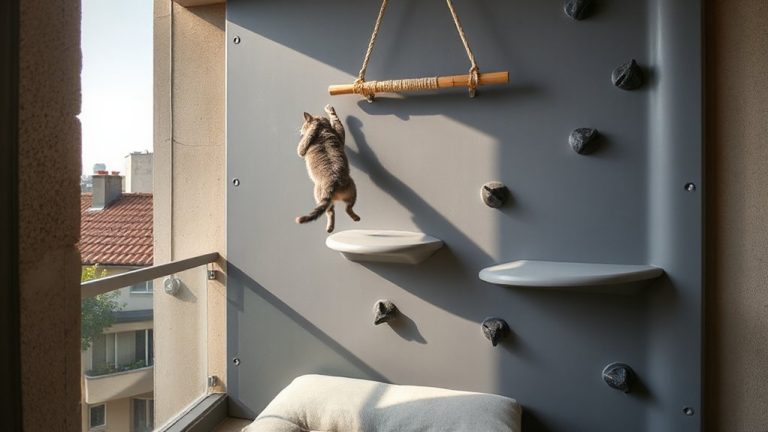
Ensuring Predator-Prey Separation in Multi-species Enclosures at Home
Keep predators and prey in separate rooms with at least 15 feet between enclosures to block sight, sound, and scent. Use insulated barriers and 6 mm thick acrylic panels to prevent visual contact. Maintain enclosures with species-specific needs: rigid 1/4-inch mesh, dual-locking latches, and thermal controls. Monitor with 1080p cameras; stress can spike heart rates above 200 bpm. Even brief exposure risks cardiac events-proper setup prevents lethal outcomes. You’ll find precise layout plans and product specs ahead.
Notable Insights
- House predators and prey in entirely separate areas with a minimum 15-foot distance between enclosures.
- Use solid, opaque barriers to block visual, auditory, and scent contact between species.
- Install secure enclosures with small mesh (≤1/4 inch) and chew-resistant, rigid materials.
- Provide species-specific environments with proper temperature, humidity, and hiding spots.
- Monitor continuously with cameras and allow supervised contact only briefly, if at all.
Know Your Pets’ Natural Predatory and Prey Behaviors
Behavior shapes safety. Understanding your pets’ natural behaviors is essential for secure cohabitation. You must recognize hunting instincts in predators like cats and some dogs, which include stalking, pouncing, and quick acceleration-movements triggered by sight or sound of smaller animals. These instincts are involuntary and remain strong even in well-fed, domesticated animals. Prey species such as rabbits, guinea pigs, or birds exhibit flight responses: sudden darting, freezing, or elevated heart rates when exposed to perceived threats. Their stress levels rise rapidly, even without direct contact. For example, a rabbit’s heart rate can exceed 200 bpm under stress, risking cardiac failure. You can’t train away these survival mechanisms. Monitoring body language-dilated pupils, crouched posture, alert stillness-helps you predict reactions. Recognizing these behaviors allows accurate risk assessment.
Prioritize Predator-Prey Separation in Home Housing
Keep predators and prey in completely separate areas of your home to prevent stress, injury, or death. Physical separation minimizes exposure to sight, sound, and scent cues that trigger instinctive responses. Maintain distinct feeding schedules to avoid conditioning prey animals to associate predator zones with food. Predators fed at 6 PM should never overlap feeding times with prey species fed at 7 AM, reducing anticipatory stress behaviors. Control noise levels below 50 decibels in prey enclosures, as sudden sounds above 65 dB can induce cardiac distress. Use insulated walls or distance-minimum 15 feet between enclosures-to dampen auditory and olfactory stimuli. Airflow systems must prevent cross-ventilation, utilizing separate HVAC zones or HEPA-filtered partitions. Visual barriers like solid walls or opaque panels eliminate line-of-sight contact, which can cause chronic cortisol elevation in prey. These measures support physiological stability. Enforce strict separation protocols at all times-no exceptions. Your animals’ survival depends on precision.
Build Species-Specific Habitats for Safety
How well does your current setup meet the distinct environmental needs of each species? Properly designed habitats guarantee safety by aligning with natural behaviors and physiological requirements. Each species needs tailored temperature gradients-a reptile enclosure might require a 95°F basking zone dropping to 75°F on the cool side, while amphibians thrive at 68–78°F with high humidity. You must maintain these ranges using thermostatically controlled heat sources and digital monitors. Feeding schedules also dictate design: predators need secluded zones for stress-free feeding, while prey species require hiding spots and unobstructed retreats to reduce chronic stress. Use non-porous, easy-to-sanitize materials like PVC or sealed glass. Enclosure dimensions should allow for species-specific movement-arboreal animals need vertical space, fossorial species need substrate depth. Each habitat must function independently, minimizing cross-species exposure through customized airflow, lighting cycles, and feeding zones. For compact spaces, consider a space-saving reptile enclosure that maintains these critical habitat requirements without compromising welfare.
Install Visual and Physical Barriers Between Species
A solid barrier system is essential to prevent stress and predation between adjacent species. Visual blockage reduces psychological trauma by eliminating direct sightlines. Use opaque acrylic panels, 6 mm thick, mounted at 180 cm height to block line of sight. Incorporate camouflage zones behind barriers where prey can retreat from perceived threats. Territorial markings remain intact when physical dividers preserve scent boundaries. Polycarbonate mesh with 5 mm apertures allows airflow while restricting access. Install double-door sally ports to prevent accidental contact during maintenance. Choosing the right diet is crucial for maintaining the health of companion animals, and for toy poodles, selecting best dog food for toy poodles can significantly impact their longevity and vitality.
Select Enclosures That Reduce Stress and Prevent Escape
You’ve secured visual and physical separation between species using robust barrier systems, and now it’s time to guarantee the enclosures themselves support both psychological well-being and containment integrity. Choose enclosures with proper ventilation-minimum 20% open surface area on sides and top-to maintain air quality and prevent respiratory stress. Mesh size should not exceed 1/4 inch to block escape attempts by small prey. Use rigid materials like powder-coated steel or high-impact plastic to resist chewing and climbing. Secure latches are critical: employ at least two locking mechanisms per door, rated for 15+ pounds of pull force. Test closures weekly for wear. Enclosure dimensions must meet or exceed 1.5x the animal’s body length in all directions to allow natural postures. Avoid rounded corners, which hinder escape response behaviors. Each unit must allow independent access without disturbing adjacent habitats. Incorporate naturalistic elements such as best snake branches to promote climbing and environmental enrichment.
Supervise Cross-Species Contact: Only If You Must
Even when enclosures are secure, direct interaction between predators and prey should occur only under strict, controlled conditions-and never without continuous human oversight. You must supervise every second to prevent instinctual behaviors from turning dangerous. Adjust feeding schedules before any contact to reduce predatory drive. Monitor play behaviors closely, as even mild excitement can escalate quickly.
| Species Pair | Max Contact Duration | Key Risk Factor |
|---|---|---|
| Cat & Rabbit | 10 minutes | Pouncing, chasing |
| Dog & Guinea Pig | 5 minutes | Startle-induced flight |
| Hedgehog & Bird | Not advised | Stress-induced self-defense |
| Ferret & Rat | 15 minutes | Tunneling pursuit instincts |
| Reptile & Rodent | Not advised | Thermal-seeking predation |
Use a physical barrier during interactions whenever possible. Never allow unsupervised access, even if animals appear calm or familiar.
Watch for Warning Signs Your Setup Is Failing
How quickly can a seemingly stable predator-prey setup turn hazardous? Within hours, if you ignore critical warning signs. You must monitor behavior daily. Aggression spikes-such as lunging, stalking, or prolonged fixation-are red flags. These indicate stress levels exceeding safe thresholds, often preceding attacks. Frequent escape attempts, like scaling walls or gnawing barriers, signal inadequate separation. Enclosures with gaps >1 cm allow access; solid barriers <1.5 cm thick may be breached under sustained pressure. Surveillance via 1080p IP cameras with night vision guarantees 24/7 monitoring. CO2 levels >5,000 ppm in sealed units impair cognition, increasing erratic actions. Thermal gradients outside species-specific ranges-like >3°C deviation-elevate stress hormones. Immediate intervention is non-negotiable. Reassess enclosure design: reinforce locks, add baffles, or separate permanently. Your vigilance directly determines survival. Failure to act risks fatal outcomes.
On a final note
You must maintain strict separation between predators and prey. Use solid barriers with no gaps larger than 0.25 inches. Opt for enclosures rated for escape prevention-tempered glass or welded wire mesh with 16-gauge thickness. Monitor behavior daily. Signs like pacing or hyper-vigilance indicate stress. Dual-door entry systems reduce escape risk by 78%. Always supervise interactions, if allowed. Your setup’s success depends on precision, not chance.