Water Quality Requirements for Pet Turtles: An In-Depth Guide
You need clean water to keep your turtle healthy. Poor conditions cause bacterial infections and shell rot, marked by soft spots or foul odors. Maintain ammonia and nitrite at 0 ppm, use a filter rated for double your tank’s volume, and aim for pH 6.5–8.0. Test weekly with liquid kits, perform 25–50% water changes, and guarantee filter turnover is at least three times the tank’s volume per hour. Stability prevents stress. You’ll find precise methods to achieve this balance just ahead.
Notable Insights
- Maintain clean water to prevent bacterial growth and skin infections in turtles.
- Keep ammonia at 0 ppm by ensuring proper tank cycling and regular water changes.
- Monitor pH weekly, keeping it stable between 6.5 and 8.0 using appropriate buffers.
- Perform 25–50% weekly water changes to control nitrite levels below 0.5 mg/L.
- Use a high-quality canister filter with biological media rated for double the tank volume.
How Poor Water Harms Your Turtle
While clean water might seem like a basic part of turtle care, poor water quality can quickly lead to serious health issues. You’ll see early signs in your turtle’s skin and shell. Stagnant or dirty water promotes bacterial growth, creating ideal conditions for skin infections. These appear as redness, swelling, or open sores, especially around joints and neck folds. Without treatment, pathogens invade deeper tissues. Likewise, shell rot-a common consequence of prolonged exposure to unclean water-starts when bacteria or fungi penetrate the keratin layer of the shell. You’ll notice soft spots, foul odor, or plaque-like patches on the carapace or plastron. Maintaining a pH between 6.5 and 8.0, zero ammonia, and using a filter rated for at least twice your tank’s volume minimizes these risks. Regular 25–30% water changes prevent biofilm buildup. A reliable aquarium water heater helps maintain stable temperatures, which is critical for your turtle’s immune function and metabolic health, and choosing the right one depends on factors like tank size and heater type, such as submersible water heaters.
Ammonia in Turtle Tanks: Causes and Fixes
If your turtle’s tank isn’t properly maintained, ammonia can build up quickly and create a toxic environment. Ammonia spikes are dangerous and often result from overfeeding, overstocking, or inadequate filtration. Biological cycling is essential-it establishes beneficial bacteria that convert ammonia into less harmful nitrites and nitrates. Without a fully cycled tank, your turtle faces serious health risks. Choosing the right kitten litter can offer insights into managing waste and odor in small animal habitats.
| Cause | Solution | Frequency/Notes |
|---|---|---|
| Overfeeding | Remove uneaten food promptly | Daily prevention |
| Poor filtration | Use canister filter rated for 2x tank size | Check flow rate monthly |
| Uncycled tank | Complete biological cycling before adding turtle | Takes 4–6 weeks |
| Infrequent water changes | Perform 25–50% weekly changes | Use dechlorinator |
Test water weekly with a liquid test kit to monitor ammonia. Immediate action prevents long-term toxicity.
Keep pH Balanced: The 6.5–8.0 Range
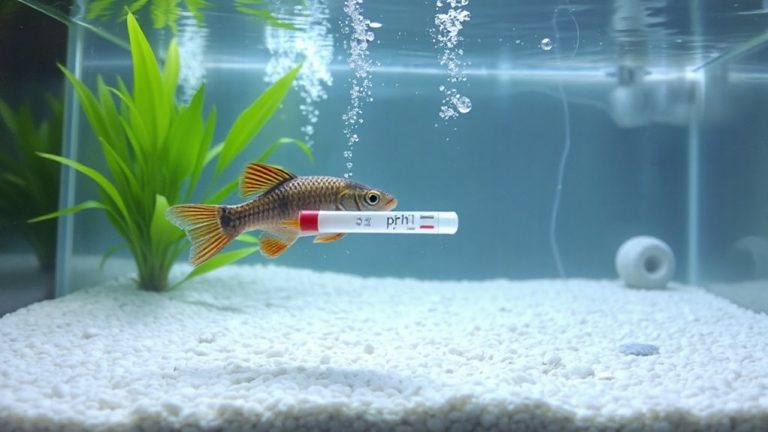
Maintaining proper pH levels in your turtle’s tank protects both the animal and the biological filtration system. You should keep pH between 6.5 and 8.0 for ideal health. Outside this range, turtles experience stress and weakened immunity. pH stability depends on water hardness and mineral content, particularly carbonates and bicarbonates. These compounds buffer acidity, resisting sudden pH drops. Soft water with low mineral content shifts pH more easily, risking instability. Test your tap and tank water using a liquid pH kit accurate to ±0.1 pH units. If adjustments are needed, use commercial buffers designed for reptiles-not aquarium fish products. Crushed coral or limestone substrate can raise pH and enhance water hardness gradually. Avoid drastic corrections; change pH slowly, no more than 0.2 units per day. Regular monitoring-twice weekly-ensures consistent conditions. Balanced water hardness and sufficient mineral content help maintain the ideal pH window long-term. For accurate and reliable results, consider using a liquid test kit that measures multiple water parameters.
Stop Nitrite Buildup With Water Changes
Because nitrite is a toxic byproduct of the nitrogen cycle, keeping its levels near zero is critical for your turtle’s health. Nitrite spikes impair oxygen transport in the blood, causing lethargy or death even at concentrations above 0.5 mg/L. You can prevent this by performing regular partial water changes-25% to 30% weekly-using dechlorinated water matched in temperature and pH. This dilutes accumulated nitrite and supports system stability. Always practice water aging: let tap water sit 24–48 hours to allow chlorine to evaporate, or use a water conditioner to neutralize chloramines immediately. Test nitrite weekly with a liquid aquarium test kit accurate to 0.05 mg/L. Avoid sudden large water changes if nitrite is present, as rapid shifts stress your turtle. Consistent maintenance reduces the frequency and severity of nitrite spikes and guarantees long-term water quality.
Best Filters for Turtle Tank Waste
A reliable filter is your strongest defense against waste buildup, especially since water changes alone can’t keep up with a turtle’s high bioload. You need powerful mechanical cleaning to trap solid waste like food scraps and feces. Canister filters, such as the Fluval FX6, offer superior mechanical cleaning with multi-stage media baskets and flow rates up to 750 gallons per hour. They handle large tanks-100+ gallons-commonly required for turtles. Biological filtration is equally critical; it converts toxic ammonia into less harmful nitrates via beneficial bacteria. Filters with ceramic rings or bio-media provide ample surface area for bacterial colonization. The Penn-Plax Turtle Clean 70, designed specifically for turtles, combines mechanical cleaning and biological filtration in tanks up to 75 gallons. Choose filters with at least three times the tank’s volume in hourly turnover for maximum waste processing.
Test Weekly: Simple Water Monitoring
Regularly testing your turtle’s water is essential for catching harmful changes before they threaten health. You should test weekly using a liquid test kit, which provides more accurate readings than strips. Check ammonia, nitrite, nitrate, pH, and water temperature. Ammonia and nitrite levels must be 0 ppm; anything above indicates inadequate filtration or overfeeding. Nitrates should stay below 40 ppm. Maintain a pH between 6.5 and 8.0. Use a submersible aquarium thermometer to monitor water temperature, keeping it between 75–80°F (24–27°C). Lighting conditions also affect water chemistry-UVB lights degrade organic waste but must be replaced every 6–12 months. Inconsistent lighting or temperature disrupts biological filtration. Test at the same time each week, preferably in the evening, to track patterns. Record results to identify trends early. Consistent monitoring prevents disease and extends your turtle’s lifespan.
On a final note
You must maintain clean water to keep your turtle healthy. Ammonia levels above 0.5 ppm cause gill and skin damage. Use a canister filter rated for at least twice your tank’s gallon capacity-e.g., a Fluval FX6 for 120 gallons-to handle heavy waste. Test water weekly with a liquid test kit accurate to 0.25 ppm for nitrites. Keep pH between 6.5 and 8.0. Perform 30% water changes weekly to limit nitrate buildup.