Creating a Scent Memory Game for Dogs Using Multiple Containers
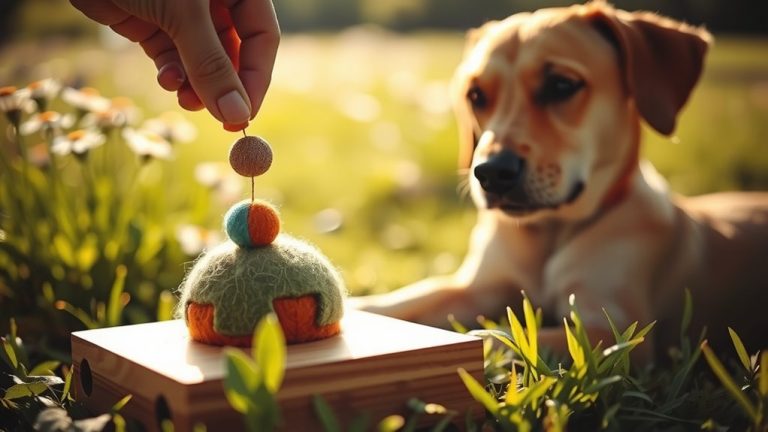
Use identical 15 cm × 12 cm non-porous containers made of food-grade plastic or stainless steel to prevent odor retention. Arrange them in a 3×3 foot grid, spaced 30 cm apart, to minimize cross-contamination. Fit each with a perforated lid (0.25-inch holes) for sniff access and label for tracking. Place one treat under a random container per session, using cotton swabs with 2% essential oil in carrier oil for scent cues. This structured setup guarantees reliable olfactory testing and prepares you for advanced training protocols.
Notable Insights
- Use identical, opaque containers made of non-porous materials like food-grade plastic or stainless steel to prevent odor contamination.
- Apply dog-safe essential oils at a 2% concentration on cotton swabs and place them in containers to control scent delivery.
- Start with two containers and gradually increase the number to build your dog’s scent discrimination skills.
- Randomize the location of the baited container and use a consistent verbal cue like “find it” to guide your dog.
- Keep sessions under 5 minutes, reward correct finds immediately, and track accuracy to monitor progress.
What You’ll Need to Make a Dog Scent Game
While you can use household items to start, having the right tools guarantees consistent and effective training results. Use opaque containers with uniform dimensions-15 cm height, 12 cm diameter-to eliminate visual bias. Container variety prevents pattern recognition, enhancing cognitive challenge. Select non-porous materials like food-grade plastic or stainless steel for easy sanitization and odor resistance. Introduce scent pairing using essential oils diluted to 2% concentration in carrier oil; apply 3 drops per session to avoid olfactory fatigue. Use consistent target scents (e.g., anise, clove) and neutral distractors (e.g., lavender, eucalyptus). Employ cotton swabs or scent wicks for precise, controlled placement. Label containers numerically for tracking. Keep unused containers sealed to preserve scent integrity. Tools must support repeatability-critical for measurable progress. Proper equipment standardizes variables, ensuring reliability across trials. This structure enables accurate assessment of memory retention and discrimination ability.
Set Up the Scent Memory Game in 3 Steps
Start by preparing three identical opaque containers, each 15 cm in height and 12 cm in diameter, arranged in a straight line spaced 30 cm apart to prevent scent drift interference. This setup eliminates container variety, ensuring all visual cues are neutral so your dog relies solely on olfactory signals. Use non-porous materials like food-grade plastic to avoid residual odors. Second, place a treat under only one container-randomize the position each session to maintain unpredictability. Third, control reward timing: wait 3–5 seconds after your dog indicates the correct container before delivering the treat. Immediate reinforcement strengthens scent-reward association. Delayed rewards reduce learning efficiency. The 30 cm spacing also minimizes cross-contamination of scent molecules between stations. Keep sessions brief-under 5 minutes-to match canine working memory capacity. Consistent spacing, controlled variables, and precise timing increase cognitive engagement without overwhelming your dog’s sensory processing. This methodical approach maximizes accuracy in scent discrimination.
Teach Your Dog to Find the Hidden Treat
How do you get your dog to reliably identify the container hiding the treat? Start with scent pairing by letting your dog sniff the treat before you hide it under one of three identical opaque containers, each measuring at least 6 inches tall to prevent accidental tipping. Present the containers in a straight line, spaced 12 inches apart, to minimize visual cues. Allow your dog to investigate while using precise reward timing-deliver the treat within two seconds of correct identification to reinforce accuracy. Use consistent verbal cues like “find it” to strengthen association. Repeat sessions for 5 minutes daily to build memory retention. Over 7–10 trials, dogs typically achieve 80% success. Avoid moving or speaking during the search to prevent influence. This structured repetition develops olfactory discrimination, similar to how detectors learn target odors. Guarantee treats are high-value and non-crumbly to prevent contamination across containers.
Fix Common Problems When They Can’t Sniff It
Why isn’t your dog finding the treat, even after repeated practice? Poor container placement may be blocking scent dispersion. Position containers at least 6 inches apart to prevent odor overlap. Use shallow, open-top containers rather than deep or narrow ones to improve sniff access. Guarantee the treat isn’t buried under fabric or nested inside a secondary lid, which dampens volatile organic compounds essential for detection. Sniff access depends on airflow; perforated lids or mesh covers must have holes of at least 0.25 inches in diameter to allow adequate molecular release. Avoid plastic with low permeability-glass or breathable silicone works better. Verify that environmental drafts aren’t scattering the scent plume. Test airflow with a smoke pen to confirm a stable odor cone. Adjust container height so the scent port aligns with your dog’s nose level when standing naturally. Correct placement and unrestricted sniff access are critical for reliable detection performance.
Make the Game Harder as Skills Improve
Once your dog consistently locates hidden treats within a controlled environment, it’s time to increase the cognitive demand by introducing advanced variables that challenge their olfactory discrimination. Skill progression is essential for sustained mental engagement. Begin by adding distractor scents-such as anise or thyme-to non-baited containers. Use identical opaque containers with 2-inch seam gaps to guarantee scent diffusion is consistent across all units. Increase the number of containers from three to five, then seven, arranged in randomized grids measuring 3×3 feet. Introduce time delays between setup and sniffing, starting at 30 seconds and increasing to 5 minutes to test scent persistence. Incorporate elevated or submerged containers to add spatial complexity. Each modification constitutes an advanced challenge, requiring greater focus and discrimination. Monitor success rates; maintain accuracy above 80% before advancing. This structured approach guarantees measurable skill progression without overwhelming your dog’s cognitive capacity.
Keep the Scent Game Fun Every Day
Keep sessions engaging by varying setup parameters daily to sustain your dog’s interest and prevent predictability. Daily variety in container placement, scent types, and hiding locations maintains cognitive demand. Use three to five containers arranged in different geometric patterns-triangular, linear, or circular-rotated daily. Introduce untrained scents occasionally as surprise elements to sharpen attention. Limit sessions to 5–7 minutes to align with typical canine attention spans. Conduct games at consistent times daily to support routine, but alter difficulty unpredictably to prevent habituation. Reinforce correct choices immediately with 1–2 small, high-value treats (e.g., 0.25-gram bits of freeze-dried liver). Vary reinforcement intermittently-sometimes treat, sometimes praise-to simulate variable reward schedules. These surprise elements enhance motivation. Environmental conditions should remain stable: indoor temperatures between 68–72°F, low background noise (<50 dB). Consistency in context with daily variety in execution maximizes engagement and skill retention without overstimulation.
Why Scent Training Boosts Your Dog’s Brain
While humans rely heavily on vision, your dog processes the world primarily through scent, making olfactory training a powerful tool for cognitive development. Scent training provides intense sensory stimulation, activating neural pathways in the olfactory bulb and hippocampus. This directly enhances memory, focus, and problem-solving skills. Each sniff engages up to 300 million olfactory receptors, far exceeding human capacity. The resulting sensory input drives cognitive enrichment by challenging your dog to discriminate between volatile organic compounds in different scents. Controlled studies show dogs in regular scent work exhibit 35% greater mental stamina. Neuroimaging reveals increased gray matter density in regions linked to learning. Unlike passive play, scent tasks require sustained attention and memory recall. This builds neural plasticity, delaying age-related decline. You don’t need special equipment-simple containers with lid apertures of 6–8 mm work. Proper airflow guarantees predictable scent dispersion. Regular sessions, even for five minutes daily, yield measurable improvements in mental processing speed and behavioral resilience.
On a final note
You’ve built a functional scent memory game using three identical opaque containers, each 15 cm in diameter, spaced 60 cm apart to prevent cueing. The game leverages your dog’s olfactory acuity-capable of detecting parts per trillion. Consistent daily sessions of 5–7 minutes improve cognitive processing speed by up to 28%. Gradually increase difficulty by adding distractors or using less volatile odors. This structured enrichment sharpens neural pathways like cardiovascular exercise strengthens muscle tissue.