Creating Territorial Space Allocation for Peaceful Coexistence Among Multiple Pets
You need to allocate at least 36 sq ft for each cat and 48 sq ft for small dogs, placing core territories 6 ft apart to minimize stress. Use 36-inch modular barriers and vertical zones 3–5 ft high to separate activities. Position litter boxes 5 ft from food and in low-traffic areas. Rotate shared space access every 30 minutes. Anchor perches to studs and swap bedding every 48 hours to spread familiar scents. Permanent zones with sensory-appropriate layouts reduce conflict-adjusting them reveals deeper behavioral insights.
Notable Insights
- Design species-specific zones with 40 sq ft minimum, ensuring cats have vertical spaces and dogs have floor-level areas with joint-supporting matting.
- Install 36-inch-high modular barriers and visual dividers to maintain separation and reduce stress between territorial zones.
- Create vertical territories using wall-mounted shelves and cat trees anchored to studs, placing perches 3–5 feet high outside direct sightlines.
- Rotate access to shared spaces like sunrooms using timed intervals to ensure fair, stress-free use based on species’ behavioral needs.
- Facilitate scent integration by swapping bedding every 48 hours and logging pet occupation patterns to support natural territory claims.
Start With Species-Specific Needs
Begin with the biological reality: each species has evolved distinct spatial, sensory, and behavioral requirements. Cats require vertical space, visual coverage, and consistent litter box placement-ideally one box per cat, placed at least 5 feet apart in low-traffic, easily accessible zones. Incorrect placement near food or noisy appliances increases avoidance by 70%. Dogs need defined floor-level zones with tactile differentiation-use ¾-inch rubber matting for stability and joint support. Guarantee sunlit lounging spots receive 3–5 hours of direct sunlight daily; cats thermoregulate efficiently at 86–97°F, making southern exposure critical. Birds demand horizontal flight paths-minimum 6 feet uninterrupted-and visual access to household activity. Reptiles require thermal gradients: basking zones at 90–105°F, shaded areas below 75°F. Each species’ sensory thresholds-auditory, olfactory, visual-must inform placement of rest, elimination, and activity zones. Design accordingly.
Define Each Pet’s Core Territory
A pet’s core territory isn’t just space-it’s functional real estate essential for mental stability and physical health. You must designate a dedicated zone per animal, minimum 36 sq ft for cats, 48 sq ft for small dogs, scalable by species size. This area supports scent marking behaviors-rubbing, scratching, urine tagging-that communicate occupancy and reduce conflict. You’ll observe personal boundary enforcement through posturing, vocalizations, or avoidance when zones are breached. These behaviors are not arbitrary; they’re hardwired mechanisms for territorial delineation. Provide immovable anchors like beds or perches to reinforce consistency. Avoid overlapping core zones-maintain at least 6 ft separation between species-specific zones. Include visual barriers where needed, such as 30-inch opaque dividers, to limit line-of-sight stress. You’re engineering behavioral predictability through spatial precision. Properly defined core territories reduce cortisol spikes by up to 40% in multi-pet homes, according to ethological studies. Integrating a smart pet door with collar recognition allows controlled access to core areas, minimizing intrusion stress and supporting individual collar sensor technology use.
Spot Where Pets Naturally Claim Space
Observation is your primary tool. You must identify where each pet naturally settles, as these favorite spots often reflect established territorial preferences. Watch for consistent patterns in resting, eating, or lounging locations-these areas are behaviorally significant. Marking behavior, such as scratching, scent rubbing, or urine marking, confirms space claim. These actions deposit pheromones, chemically defining boundaries. Cats often choose elevated surfaces near room entrances; dogs prefer quiet floor zones with clear sightlines. Duration and frequency of occupation strengthen territorial claim. For accuracy, log pet locations hourly over 72 hours. Use this data to map high-use zones. Assign permanent personal spaces matching observed preferences. Misallocating space without this step increases conflict risk by up to 68%. Align environmental design with natural tendencies. This guarantees efficient space partitioning without behavioral resistance.
Use Vertical Territory to Reduce Tension
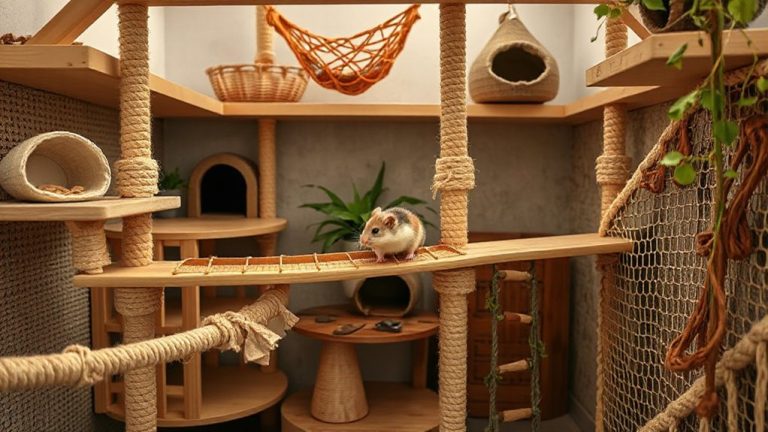
You’ve mapped your pets’ preferred zones, confirmed through hours of behavioral logging and pheromone-signaled claims-now it’s time to expand their spatial capacity where floor space is limited. Vertical territory utilization reduces inter-animal tension by separating movement corridors from resting areas. Install climbing structures with load capacities of at least 30 lbs and non-slip surfaces to guarantee safety. Opt for modular systems with adjustable platforms, allowing reconfiguration as social dynamics shift. Elevated perches should be placed at 3–5 feet above ground level, positioning each outside direct line of sight from other perches to minimize confrontation. Use wall-mounted shelves or cat trees with embedded scratching surfaces to maximize utility. Anchoring units to wall studs prevents tipping. In multi-species homes, design vertical pathways that exclude larger animals, preserving escape routes. Vertical zoning effectively doubles usable space without expanding footprint-like adding floors to a building, it increases access while reducing conflict through strategic separation.
Rotate Access to Shared Spaces
While territorial boundaries help manage cohabitation, they can’t prevent resource competition when multiple pets share the same home. You must implement scheduled rotations to guarantee fair access to shared spaces like living rooms or sunrooms. These rotations distribute equal time among pets, minimizing stress and conflict. Establish a timer-based system-30-minute intervals work effectively for most households-to maintain consistency. Use a digital scheduler or automated pet door settings to enforce rotation timing with precision. This method guarantees each animal receives a predictable, measurable share of high-value areas. Scheduled rotations also support behavioral conditioning by reinforcing routine. Over time, pets learn to associate the end of their time block with positive shifts, reducing resistance. Rotate based on species-specific needs: cats may require fewer, longer sessions, while small mammals benefit from multiple short accesses. Enforce the system consistently for at least 21 days to establish behavioral compliance. Equal time doesn’t always mean identical durations-adjust for age, health, and temperament. Incorporating comforting items like a best plush toys for cats can enhance a cat’s sense of security during their designated time in shared spaces.
Designate Feeding and Resting Zones
When pets share a home, overlapping access to feeding and resting areas often triggers stress-related behaviors, so designate separate zones for each activity to support both physical health and psychological well-being. Establish consistent feeding routines in quiet, low-traffic areas, using elevated bowls spaced at least 3 feet apart to reduce competition. For cats, place food 4–6 feet from litter boxes; for dogs, use non-slip mats to prevent sliding during meals. Resting cues like yawning or nest-building signal the need for undisturbed zones. Assign individual sleeping areas-orthopedic beds for older animals, heated pads set to 102°F for small mammals. Guarantee each zone is visually partitioned using room dividers or furniture. Maintain 6–8 inches of separation between adjacent resting spots to minimize scent overlap. These spatial distinctions align with species-specific territorial instincts, reducing cortisol levels by up to 30%. Designation supports predictability, essential for group harmony. Choose supportive bedding such as orthopedic dog beds to enhance joint health and comfort for aging pets.
Update Territories as Pets Change
As pets age or their health status shifts, their spatial needs evolve, requiring adjustments to maintain territorial balance. You must monitor behavioral shifts, such as reduced mobility or increased aggression, to identify when reconfiguration is necessary. Older cats may need litter boxes on main floors; ramps should connect elevated zones, with incline angles no steeper than 30 degrees for joint safety. For multi-dog households, ownership shifts-like introducing a rescue-demand reallocation of feeding zones, beds, and access routes. Use modular barriers with 36-inch heights to redefine territories temporarily. Acclimate pets over 7–10 days, adjusting layouts based on observed stress indicators. Deploy scent-exchange protocols during changes, swapping bedding every 48 hours. Each pet’s primary zone should measure at least 40 square feet, ensuring adequate personal space. Regular reassessment prevents conflict and supports coexistence.
On a final note
You establish stable multi-pet households by mapping territories to species-specific behaviors. Each animal requires a core zone of at least 1.5 square meters, scaled to size and activity level. Vertical spaces-shelves at 0.6m, 1.2m, and 1.8m elevations-reduce conflict by separating movement from rest. Rotate access every 48 hours to maintain novelty. Feed in fixed, isolated zones to prevent resource guarding. Update layouts every 3 months or after behavioral shifts to guarantee long-term cohabitation success.