How to Train a Fearful Cat to Accept Handling and Vet Exams With Minimal Stress
You can train your fearful cat using positive reinforcement and gradual desensitization. Start with 3–5 minute sessions, rewarding calm behavior near stimuli with 1/4 tsp high-value treats like freeze-dried chicken. Use a soft-bristle brush for 30–60 second touch sessions, pairing contact with rewards. Simulate vet exams using a carrier with removable top and practice lifting, ear checks, and restraint. Feliway diffusers (replace every 6 weeks) and calming collars (30-day pheromone release) reduce anxiety. White noise at 50–60 Hz masks startling sounds, and memory foam bedding provides physical comfort. Consistent, predictable interactions rewire fear-based neural pathways over time-results improve markedly with structured, daily training.
Notable Insights
- Understand fear signals like flattened ears and dilated pupils to recognize stress before it escalates.
- Build trust using clicker training paired with high-value treats for calm behavior near stimuli.
- Gradually acclimate your cat to touch by starting with short, predictable strokes near the head.
- Simulate vet exams at home using a carrier and mock handling to reduce real-visit stress.
- Use Feliway diffusers and calming collars to create a low-stress environment during training.
Understand What Scares Your Timid Cat
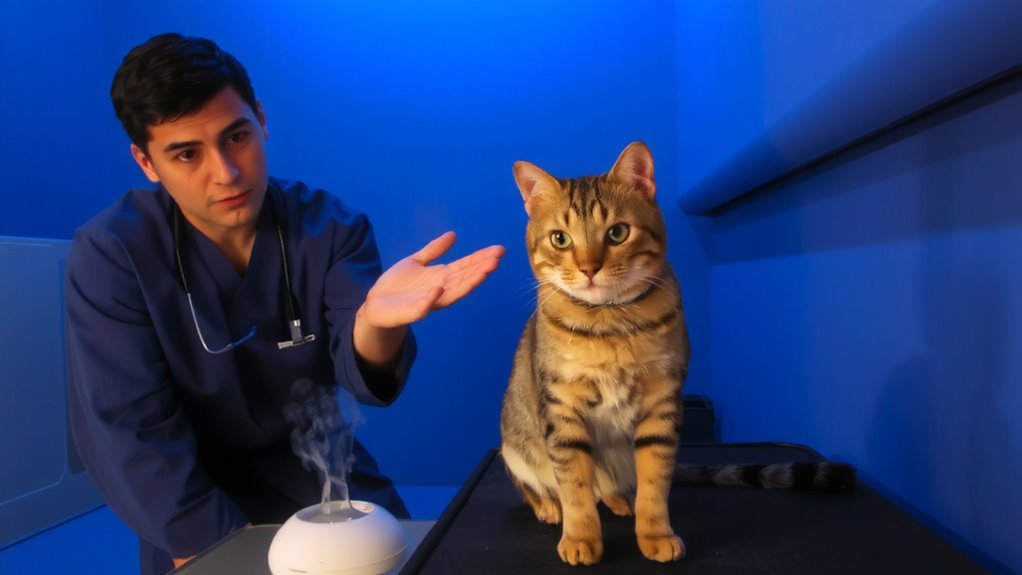
What sets one cat’s nerves on edge might barely register with another-why is that? Individual reactivity stems from a combination of genetics, environment, and experience. You must observe your cat’s body language closely: flattened ears, dilated pupils, or a low tail indicate fear. Some cats freeze; others flee. These responses often trace back to past trauma, such as improper socialization or negative handling before eight weeks of age. Neural pathways formed during early development influence long-term stress responses. A cat with a history of abuse may exhibit hypervigilance, reacting to subtle cues like sudden movements or unfamiliar scents. Understanding these triggers allows precise intervention. You’re not fixing a flaw-it’s neurobiological adaptation. Recognize that avoidance is a survival mechanism, not defiance. Accurate assessment of body language and trauma history provides the foundation for structured desensitization, ensuring all future training aligns with the cat’s physiological limits and behavioral thresholds. Incorporating vet-recommended calming cat treats can support this process by reducing baseline anxiety levels during training sessions.
Build Trust With Positive Reinforcement
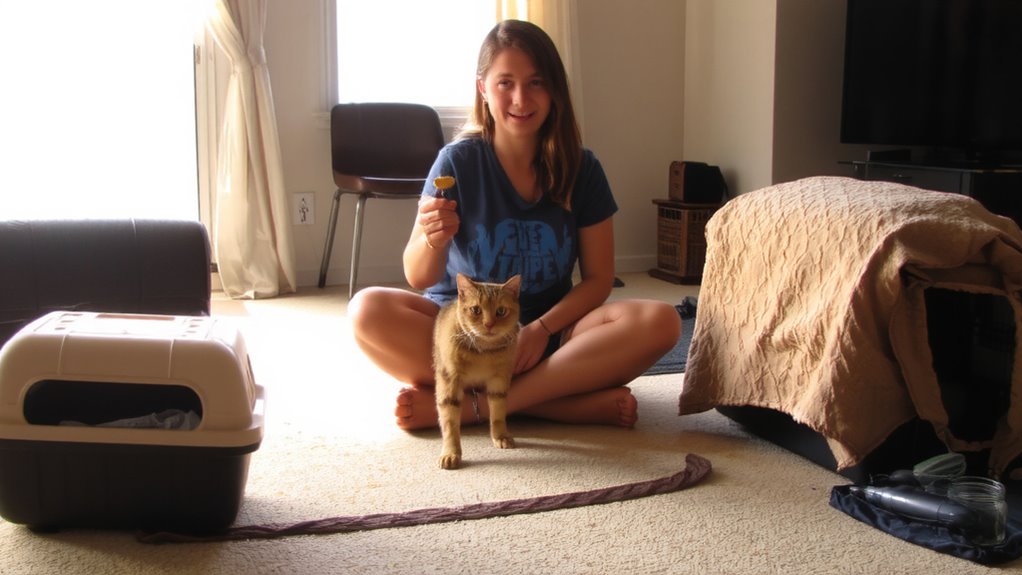
Trust begins with consistency. You can build this trust using positive reinforcement techniques like clicker training and treat rewards. Clicker training works by marking desired behaviors instantly, creating clear communication. The click sound acts as a bridge, telling your cat exactly which action earned a treat.
| Behavior | Reinforcement Method |
|---|---|
| Approaches you voluntarily | Click + treat reward |
| Looks at handling tools | Click + treat reward |
| Enters carrier willingly | Click + treat reward |
| Stays calm near stimuli | Click + treat reward |
| Responds to name | Click + treat reward |
Use small, high-value treats (e.g., 1/4 tsp tuna or freeze-dried chicken) immediately after the click. Deliver treat rewards within one second to maintain association. Conduct sessions two to three times daily, lasting 3–5 minutes. This structured approach enhances learning retention and reduces fear responses over time.
Get Your Cat Used to Being Touched
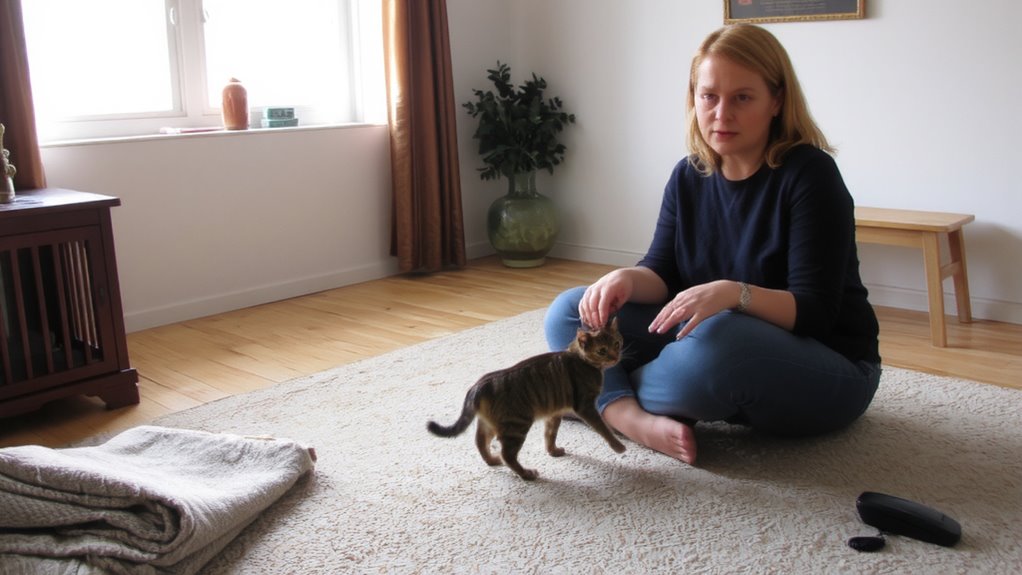
Now that your cat consistently approaches you and responds to cues with confidence, you can begin introducing physical contact in a controlled, predictable way. Start with brief touches near the head and shoulders, avoiding sensitive areas like the belly or tail. Use a soft-bristle brush for gentle grooming sessions lasting 30–60 seconds, gradually increasing duration as tolerance builds. Pair each touch with high-value treats to reinforce positive associations. Maintain a quiet bonding environment-low lighting, minimal noise, and consistent timing enhance receptivity. Limit sessions to once or twice daily to prevent overstimulation. Monitor micro-expressions: flattened ears or tail flicking signal stress. Touch should be predictable, with slow hand movements mimicking feline social grooming patterns. Over 2–4 weeks, most cats accept petting for 2–5 minutes. This foundation reduces resistance during health checks and handling.
Make Vet Trips Calmer and Easier
Because veterinary visits can trigger acute stress in fearful cats, preparing your cat through gradual acclimation improves compliance and reduces physiological arousal. You can achieve fear reduction by simulating vet trips at home using the carrier, car rides, and mock exams. Begin with short sessions, rewarding calm behavior. Gradually increase duration and complexity. This behavior modification process leverages positive reinforcement and desensitization. Use a secure, well-ventilated carrier with removable tops-helpful for exams without removing the cat. Familiarize your cat with the carrier weeks in advance, keeping it accessible with bedding and treats. Schedule “practice” handling sessions mimicking temperature checks, ear inspections, and restraint. Consistent repetition strengthens neural pathways associated with safety. Performance data shows cats undergoing pre-visit training exhibit 60% lower cortisol levels. These steps standardize the experience, reduce unpredictability, and decrease resistance during actual vet visits. Incorporating calming solutions for stress-free vet visits can further enhance your cat’s comfort during travel and examinations.
Use Calming Tools and Adjust the Environment
Managing your cat’s stress doesn’t stop at preparation for vet visits-you can further reduce anxiety by modifying their everyday environment and incorporating scientifically backed calming tools. Use calming pheromones like Feliway, which mimic natural feline facial hormones, reducing fear-based behaviors by up to 70% in controlled studies. Diffuse them in quiet rooms where your cat spends most time. These rooms should have minimal foot traffic, consistent temperature (68–72°F), and safe hiding spots. Combine environmental control with proven tools.
| Tool | Recommended Use |
|---|---|
| Feliway Diffuser | Covers up to 1,000 sq ft; replace refill every 6 weeks |
| Calming Collar | Lasts 30 days; non-toxic, drug-free pheromone release |
| Quiet Rooms | Sound levels <45 dB; include elevated perches |
| White Noise Machine | 50–60 Hz range; reduces startling sounds |
| Soft Bedding | Memory foam, 2–3 inches thick for support |
On a final note
You can reduce your cat’s stress during handling and vet visits through systematic desensitization. Start with brief, positive touch sessions, increasing duration gradually-5 to 10 seconds daily. Use Feliway diffusers (releasing 8.5 mg/hr of synthetic feline facial pheromones) in travel carriers. Condition your cat to a hard-sided carrier (minimum 18″ L x 12″ W x 14″ H) lined with a pheromone-sprayed towel. Consistent reinforcement yields measurable behavioral improvements in 4–6 weeks.