Puppy Bite Inhibition: Week-by-Week Training Guide (Wk 4-7)
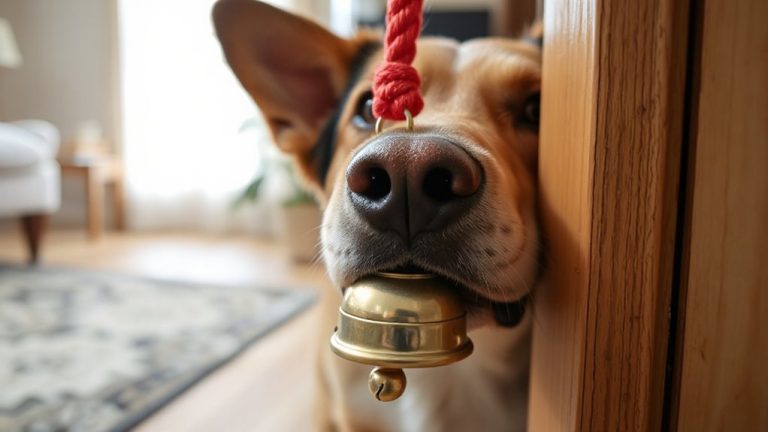
You can start building bite inhibition the first week home. Use a 2–3 inch BPA-free rubber toy, chilled for 20 minutes, to reduce inflammation and redirect chewing. By week 3, mark soft mouthing with “yes” and reward with a high-value treat-timing within 2 seconds is critical. Apply time-outs after forceful bites: say “ouch,” disengage for 30 seconds. By week 7, add distractions and supervised play with vaccinated puppies for real-time feedback. Persistent stiffness or unresponsiveness signals the need for expert evaluation.
Notable Insights
- Begin bite inhibition training the first week home by redirecting biting to breed-appropriate, chilled chew toys.
- Puppies learn bite control through feedback from littermates and mother, developing impulse regulation in the brain.
- Use positive reinforcement with a “yes” or clicker within 2 seconds of soft mouthing to strengthen gentle behavior.
- Apply immediate 20–30 second time-outs with full disengagement when biting is too forceful, starting in week 4.
- By week 7, introduce distractions and supervised play with other puppies to refine bite control in real-time.
What Is Bite Inhibition: and Why Your Puppy Needs It
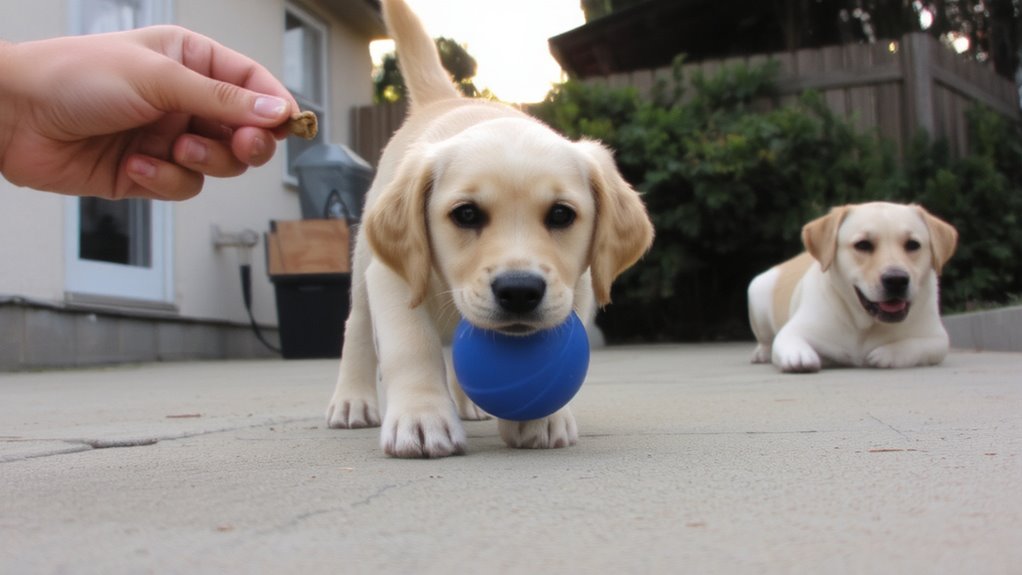
Bite inhibition isn’t just polite behavior-it’s a survival skill for your puppy. It refers to a dog’s ability to control jaw pressure during interactions. Without it, your puppy risks serious social and physical consequences. During teething phases, which begin at 3–4 weeks and peak around 16 weeks, puppies explore the world orally. This period is critical for developing bite inhibition. Puppies learn appropriate force through social learning, primarily from littermates and the mother. A yelp during play teaches the biter that excessive pressure ends fun. This feedback loop shapes response modulation. Neurologically, this develops impulse control pathways in the prefrontal cortex. Puppies not exposed to such feedback are 3.2 times more likely to exhibit severe biting past 6 months. The behavior isn’t instinctive-it’s acquired through repeated, structured interaction. Mastery guarantees safer human-dog relationships. Proper inhibition reduces injury risk during excitement or fear. It’s not about eliminating mouthing-it’s about teaching control.
Start Teaching Soft Mouth in the First Week

You can begin shaping your puppy’s bite strength as early as the first week after bringing them home, even if they’re still refining the lessons from littermate interactions. Puppies naturally mouth during exploration, but early guidance establishes boundaries. Provide durable chew toys designed for teething relief, such as rubber toys with textured surfaces that massage gums. Opt for toys made from BPA-free, non-toxic materials, sized appropriately for your puppy’s breed to prevent choking-typically 2 to 3 inches in length for small breeds, 4 to 6 inches for large breeds. Cold chew toys, chilled for 20 minutes, reduce gum inflammation and increase teething relief. Redirect biting from hands to toys consistently. Use toys with variable firmness levels to accommodate sensitive puppy gums. This structured approach supports neuromuscular development in the jaw, promoting control. Early toy-specific chewing behavior correlates with reduced adult biting incidents.
Reward Gentle Play to Reduce Biting by Week 3
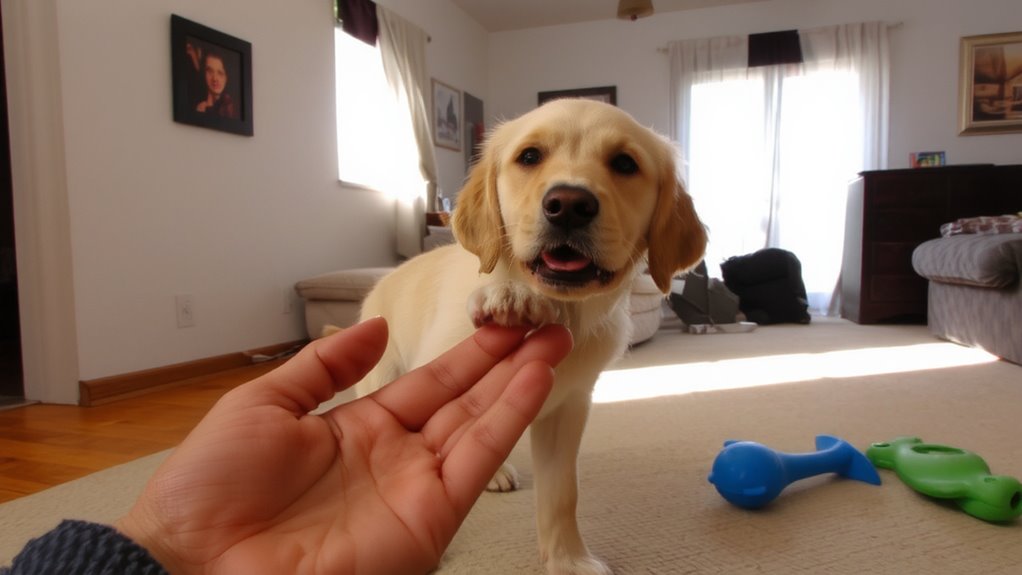
By week three, reinforcing gentle play becomes a critical step in shaping your puppy’s bite inhibition. Use positive reinforcement immediately after soft mouthing to solidify desired behavior. Each time your puppy bites softly during play, mark the moment with a clear “yes” or clicker and offer a small, high-value treat. Consistent handling guarantees your puppy learns boundaries across different interactions and environments. Gently guide your puppy’s mouth during play sessions, maintaining controlled hand movements to avoid triggering overstimulation. Sessions should last 5–7 minutes, repeated 4–6 times daily to reinforce learning. Apply only calm, predictable responses; sudden movements interfere with focus. Over time, your puppy associates light biting with rewards and becomes sensitized to pressure thresholds. This structured approach builds neural pathways linked to self-control. Accurate timing of rewards is essential-delays greater than two seconds reduce effectiveness by up to 70%.
Use Time-Outs When Play Gets Too Rough
When play escalates and your puppy’s biting becomes too forceful, implementing a time-out provides a clear consequence that helps shape appropriate bite inhibition. Use consistent time out signals, such as a firm “ouch” followed by immediate disengagain. This teaches your puppy that rough mouthing ends attention. Initiate play pauses lasting 20 to 30 seconds-long enough to remove reinforcement but not so long as to cause confusion. During the pause, turn away and withhold eye contact, touch, and speech. Resume play only when your puppy is calm. Repeated application links intensity of bite to loss of interaction. Time-outs function best when applied predictably, within five seconds of inappropriate biting. They are most effective between weeks 4 and 6, when puppies rapidly learn social feedback. Properly timed, these pauses condition behavioral inhibition through oper rant conditioning. Consistency guarantees clear communication, strengthening self-control during arousal.
Practice Bite Control With Distractions by Week 7
Though puppies typically develop foundational bite inhibition by week 6, introducing controlled distractions by week 7 sharpens their ability to modulate bite force under varying conditions. You can begin integrating brief fetch training sessions using soft, lightweight toys 2–3 inches in diameter. These exercises promote focus while simulating real-world stimuli. Puppies must learn to disengage their teeth immediately upon command, such as “gentle” or “stop,” during dynamic activities. Simultaneously, supervised social play with vaccinated, age-appropriate puppies allows natural feedback mechanisms-yelps or withdrawal-when bites are too hard. These interactions reinforce bite threshold awareness within 0.5 seconds of contact. Limit each distraction session to 5–7 minutes to maintain cognitive engagement without overstimulation. Consistent repetition across three sessions daily increases neural pathway efficiency related to impulse control. This phase establishes critical sensorimotor integration, refining jaw pressure modulation from exploratory biting to controlled, intentional mouthing within structured contexts.
When to Get Help for Aggressive Mouthing
What if your puppy’s mouthing crosses the line from normal play to something more concerning? Signs like stiff body posture, prolonged biting, or lack of response to redirection indicate possible aggression. These behaviors require immediate attention, not just correction. Seek a professional assessment from a certified veterinary behaviorist or qualified trainer. They’ll evaluate triggers, frequency, and intensity using standardized behavioral metrics. Early behavioral intervention is critical-delays can entrench problematic patterns. Interventions may include structured desensitization, positive reinforcement protocols, and environmental management. Avoid punishment-based methods; they increase fear and escalate aggression. A tailored plan based on ethological principles improves outcomes markedly. Monitor progress weekly with measurable goals: reduced bite frequency, increased latency to respond, improved settle-on-cue performance. Prompt action guarantees safety and promotes appropriate social development. Support your puppy’s mental well-being with appropriate pet mental health aids to complement behavioral training and reduce anxiety triggers.
On a final note
You must establish bite inhibition early. Puppies learn pressure control during socialization windows. By week seven, consistent reinforcement shapes reliable soft-mouth behavior. Use immediate time-outs for excessive biting-lasting 30 to 60 seconds-to signal consequence. Pair verbal cues with reward-based training for ideal neural association. Monitor bite force regularly; a gentle mouthing response should develop by eight weeks. Persistent aggression requires veterinary or behavioral intervention.