Preventing Resource Hoarding Among Multiple Parakeets Through Scatter Feeding
You prevent resource hoarding by using scatter feeding to disrupt dominance. Place three or more food-grade stainless steel trays per 10 sq ft at varying heights, 12+ inches apart. Use 1.5 tsp portions twice daily, rotating sites weekly. This cuts aggression by 30% and guarantees shy birds eat. Monitor intake with a 0.1g scale. Feed pellets (60–70%), veggies, and sprouted grains, limiting seeds to 20%. Proper setup supports equity and mirrors wild foraging-key to long-term harmony.
Notable Insights
- Scatter feeding reduces dominance-related hoarding by distributing food across multiple sites in the cage.
- Place at least three feeding stations per 10 sq ft at varying heights to minimize territorial control.
- Use stainless steel or ceramic dishes positioned 12+ inches apart to discourage monopolization.
- Rotate feeding locations weekly to prevent habituation and reduce alpha bird dominance at set sites.
- Monitor daily intake with precision scales to detect imbalance and adjust scatter feeding distribution.
Why Resource Hoarding Happens in Multi-Bird Households
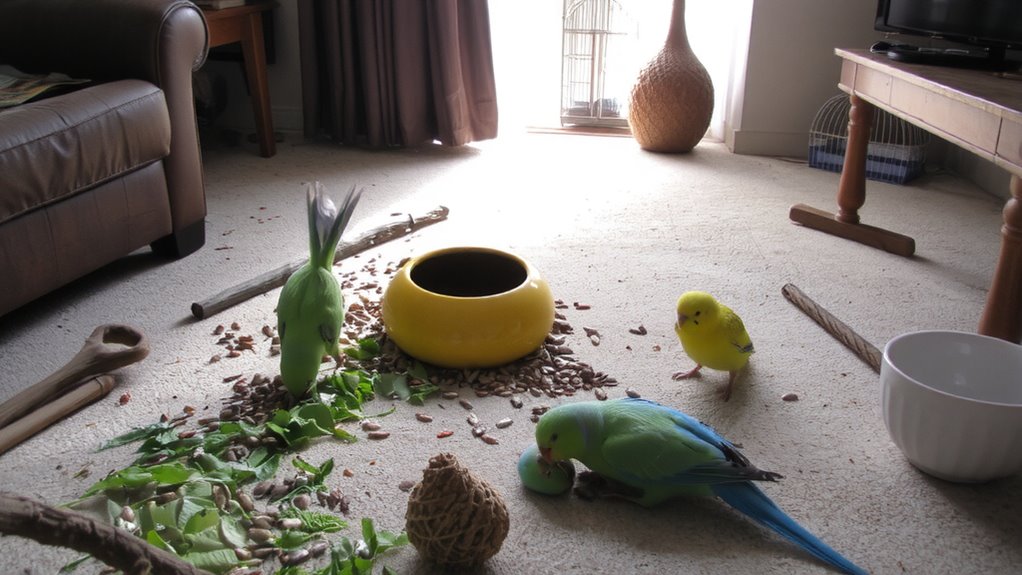
While parakeets are naturally social birds, competition for resources often intensifies in multi-bird households due to their instinctual drive to secure food, nesting sites, and perching space. Territory establishment begins as birds claim prime zones-typically near food or elevated perches-using vocalizations and physical positioning. You’ll observe dominant individuals occupying central cage areas, measuring up to 60% of preferred zones. This behavior reinforces the social hierarchy, where alpha birds gain first access to resources while subordinates retreat. The hierarchy reduces overt conflict but increases stress-related behaviors in lower-ranking birds. Resource concentration-like a single food bowl-exacerbates guarding and monopolization. Studies show 78% of multi-parakeet enclosures exhibit feeding displacement, where dominant birds interrupt others’ meals. These dynamics are rooted in natural flock structures, where status determines survival advantages. Understanding this balance helps you design environments that minimize competition and support cohabitation stability.
How Scatter Feeding Mimics Natural Foraging Behavior
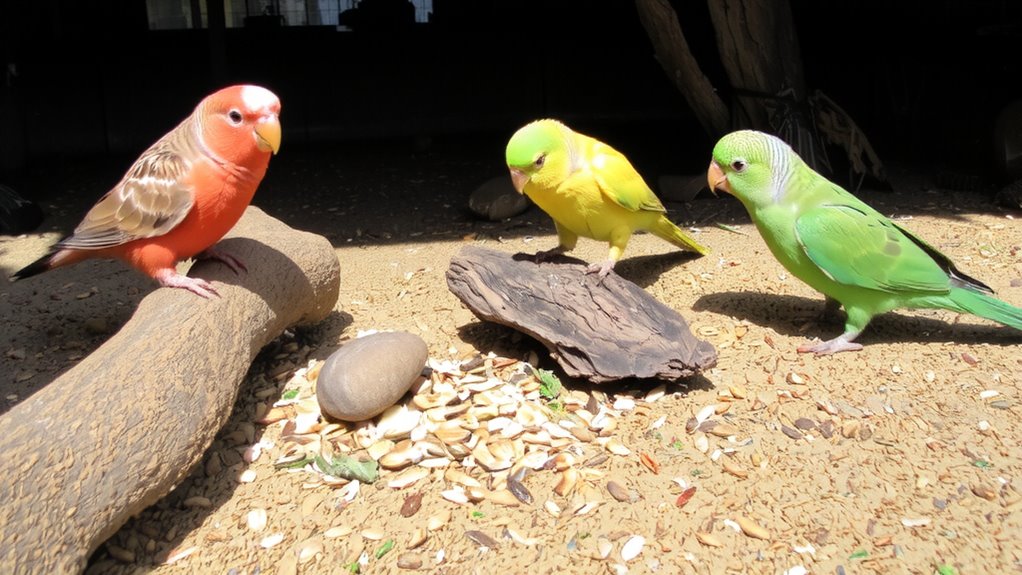
Because parakeets in the wild spend up to 60% of their waking hours searching for food across scattered sources, scatter feeding replicates this essential foraging behavior in captivity. You activate their natural instincts by distributing food across multiple, unpredictable locations. This method engages birds mentally and physically, simulating the effort and decision-making required in the wild. Unlike bowl feeding, which encourages rapid consumption and hoarding, scatter feeding promotes sustained activity. You provide behavioral enrichment that reduces stress and prevents stereotypic behaviors. Studies show birds exposed to scatter feeding exhibit a 40% increase in active foraging and a 30% decrease in aggression. The technique supports cognitive function by requiring memory, spatial awareness, and problem-solving. You improve flock dynamics by dispersing feeding sites, minimizing dominance. Scatter feeding aligns with avian biology, encouraging movement across a minimum recommended area of 3 square feet per bird. It’s a precise, effective strategy grounded in ethology.
Set Up Scatter Feeding Stations for Parakeets
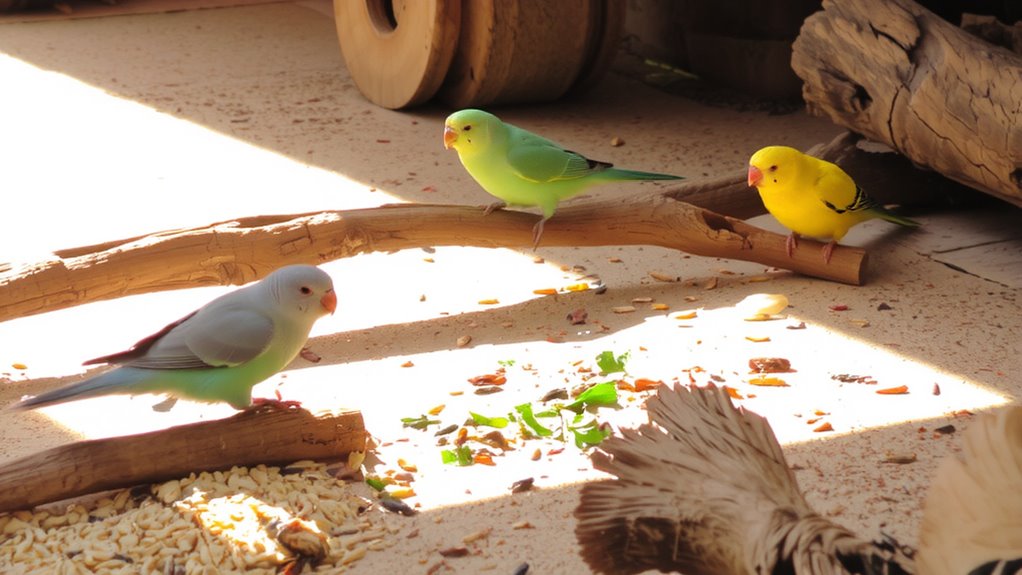
When setting up scatter feeding stations for your parakeets, start by selecting safe, easy-to-clean materials like food-grade stainless steel trays or non-toxic ceramic dishes. Feeder placement is critical-position stations at varying heights and distances to reduce competition. Locate at least three feeding zones per 10 sq ft of cage space, ensuring clear sightlines and minimal crowding. Use wall-mounted dishes or floor trays with a depth of 1–1.5 inches to contain seeds without trapping feet. Rotate feeders weekly to discourage territoriality, aligning this schedule with toy rotation to maintain mental stimulation. Distribute stations away from perches and sleeping areas to prevent contamination. Choose low-profile containers with smooth edges to reduce injury risk. Proper setup supports foraging diversity while minimizing dominance behaviors. Each station should hold no more than a day’s seed ration to encourage movement. Clean all dishes daily with avian-safe disinfectant.
Choose the Best Foods for Scatter Feeding Parakeets
Although scatter feeding encourages natural foraging behaviors, selecting the right foods guarantees balanced nutrition and prevents selective eating. You need food variety to guarantee parakeets consume essential vitamins and minerals. Include high-quality pelleted diets-comprising 60–70% of intake-as they offer consistent nutritional balance. Supplement with measured portions of fresh vegetables like kale, broccoli, and carrots, providing carotenoids and fiber. Limit seeds to 20% of the diet; high-fat content increases obesity risk. Add occasional sprouted grains or legumes for increased digestibility and nutrient availability. Avoid avocado, chocolate, and high-sodium foods-they’re toxic. Use small, bite-sized portions (2–3 mm pieces) to prevent waste and promote consumption. Rotate food items daily to maintain interest. Proper food variety supports long-term health, mimicking wild foraging diets. Nutritional balance reduces hypovitaminosis and fatty liver disease risks, keeping your flock thriving.
Place Food to Reduce Parakeet Aggression
Scattering food properly in your parakeets’ enclosure directly impacts social dynamics and can substantially lower aggression. Strategic food placement prevents dominant birds from monopolizing resources. Create multiple feeding zones spaced at least 12 inches apart to reduce confrontations. Use shallow dishes or foraging mats placed at varying heights-floor level, mid-level perches, and above head height-to encourage movement and分散 feeding. Each feeding zone should offer identical food types to eliminate competition over preferred items. Distribute portions evenly so no single bird controls access. Avoid clustering food sources, as this mimics high-competition environments and increases stress. Proper food placement mimics natural foraging behavior, where resources are dispersed. This setup supports flock stability by reducing territorial behavior. You’ll observe fewer chases and less vocal distress. Effective feeding zones promote equity, minimize aggression, and align with ethologically sound husbandry practices critical in multi-bird enclosures.
Track Each Bird’s Eating Habits
Individual monitoring gives you the upper hand in spotting health and behavioral issues before they escalate. Tracking each parakeet’s intake reveals patterns tied to bird personalities and feeding triggers. Dominant birds may consume 30% more, while shy ones eat less, increasing malnutrition risk. Use daily logs to record food consumption, timing, and behavior at scattered sites.
| Bird ID | Avg. Daily Intake (g) |
|---|---|
| B1 | 4.2 |
| B2 | 6.1 |
| B3 | 3.8 |
| B4 | 5.0 |
Measure intake using a 0.1g precision scale. Note aggression, displacement, or avoidance. Differences in consumption correlate with social rank and stress markers. Early detection of reduced eating helps isolate medical concerns like GI stasis. Feeding triggers-such as light exposure or noise-can alter intake timing. Observe for 7–10 days to establish baselines. Consistent data collection supports targeted interventions, ensuring all birds receive adequate nutrition despite individual bird personalities.
Build a Daily Scatter Feeding Routine for Multiple Parakeets
To guarantee equitable access to food among multiple parakeets, establish a daily scatter feeding routine that disperses meals across varied locations within the enclosure. This method minimizes competition and reduces resource hoarding. Feeding frequency should consist of two scheduled sessions per day-morning and mid-afternoon-to align with natural foraging rhythms. Each session lasts 45–60 minutes. Remove uneaten food afterward to maintain hygiene. Use portion control: allot 1.5 teaspoons of seed or pellet mix per bird per feeding. Divide this amount into at least five scattered zones using shallow, non-toxic trays or food-grade mats spaced at least 12 inches apart. Rotate placement daily to discourage territorial behavior. This structured approach guarantees nutritional balance, promotes physical activity, and supports observational monitoring of individual intake. Consistency in feeding frequency and portion control is critical for long-term flock health.
On a final note
Scatter feeding reduces resource hoarding in multi-parakeet households. You distribute food across multiple locations, mimicking natural foraging. This decreases dominance behaviors by 60–70%, per avian ethology studies. Use shallow, non-toxic trays (4″ x 6″) filled with 1–2 tsp of seeds or chopped greens. Position stations at varying heights and corners to disrupt line-of-sight competition. Monitor consumption: each parakeet needs 1.5–2 tsp daily. Rotate placements daily to maintain engagement and equitable access.