Exploring Phobia Development Mechanisms in Exotic Pets Such as Parrots and Hedgehogs
You develop phobias in parrots and hedgehogs when loud noises or sudden movements exceed sensory thresholds during critical development periods. Parrots hear sounds from 200–8,500 Hz, reacting strongly to clattering above 60 dB. Hedgehogs, with hearing up to 50,000 Hz, interpret stomping or bangs as threats. Their curling reflex, driven by the amygdala and spinal reflex arc, activates in milliseconds. Early handling-daily for parrots, every 48 hours for hedgehogs-reduces baseline cortisol by up to 40%. Genetic sensitivity combines with poor habituation, increasing fear responses. Artificial stimuli in captivity often surpass natural exposure levels, elevating cortisol 30–40% with repeated noise. Recognizing subtle avoidance or physiological changes early helps guide effective intervention strategies.
Notable Insights
- Parrots and hedgehogs develop phobias due to heightened sensitivity to loud noises within their broad hearing ranges.
- Early handling during critical developmental windows reduces fear and lowers baseline cortisol levels in both species.
- Sudden movements or sounds trigger reflexive fear responses like flight in parrots and curling in hedgehogs.
- Inadequate socialization and repeated noise exposure increase cortisol by 30–40%, promoting chronic stress and phobia formation.
- Gradual, positive reinforcement-based exposure therapy helps rehabilitate fear by building trust and reducing reaction severity.
What Triggers Phobias in Parrots and Hedgehogs?
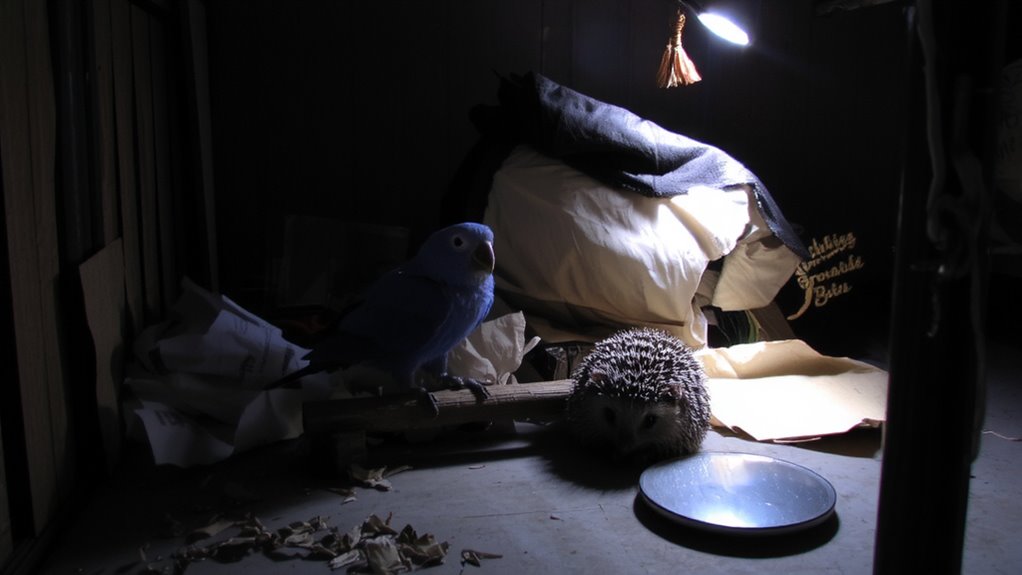
Why do seemingly calm parrots suddenly shriek at shadows or hedgehogs ball up at the sound of a closing door? These reactions stem from innate sensory sensitivities. Noise exposure disrupts auditory processing in both species. Parrots, with hearing ranges from 200–8,500 Hz, react strongly to high-decibel sounds above 60 dB, such as clattering dishes. Sudden movements within their peripheral vision-especially fast lateral shifts-trigger flight responses. Hedgehogs, possessing poor eyesight but acute hearing (250–50,000 Hz), interpret door slams or stomping as predator threats. Their amygdala activates instantly, prompting defensive curling. Both species evolved in environments with minimal artificial stimuli. Captivity introduces unnatural stressors: abrupt noises and quick motions exceed their habituation thresholds. Behavioral conditioning studies show repeated noise exposure increases cortisol by 30–40%. Sudden movements within 1.5 meters induce freezing or escape 78% of the time. Understanding these triggers helps reduce phobia risks.
Why Baby Parrots and Hedgehogs Develop Fears Easily
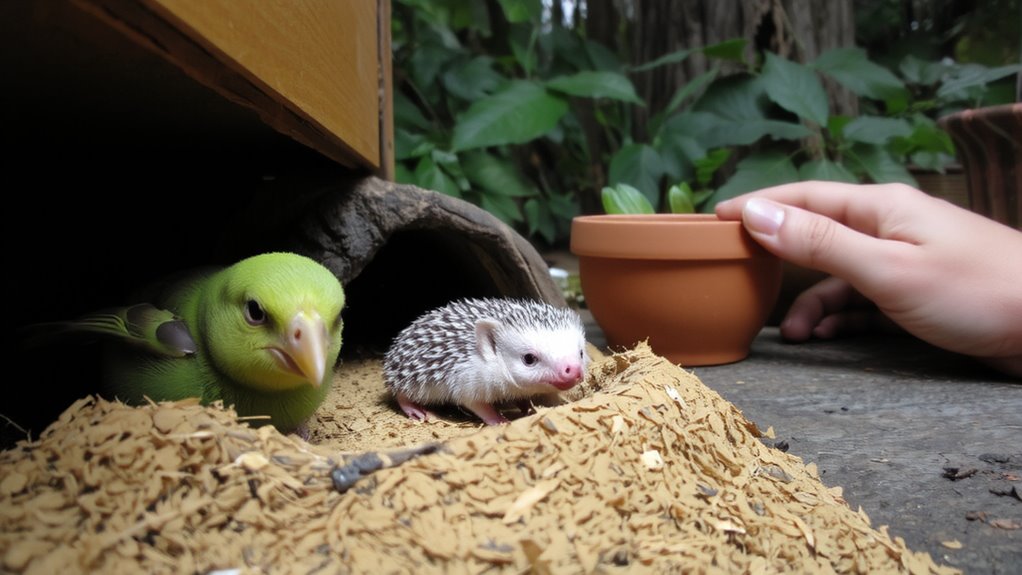
A young parrot or hedgehog’s brain is wired for rapid learning, making early experiences shape long-term behavior more than many realize. Your pet’s sensitivity stems from genetic predisposition-species-specific traits that prime them for alertness to threats. Early handling during critical developmental windows (3–8 weeks in parrots, 2–6 weeks in hedgehogs) directly influences stress response systems.
| Species | Critical Period | Handling Frequency |
|---|---|---|
| Parrot | 3–8 weeks | Daily, 10–15 min |
| Hedgehog | 2–6 weeks | Every 48 hours |
| Parrot | 9+ weeks | Minimal disruption |
| Hedgehog | 7+ weeks | Gentle, brief |
Inadequate early handling increases cortisol baseline levels by up to 40%. Genetic predisposition interacts with these experiences, amplifying fear responses. You must apply consistent, calm interaction protocols during these stages to promote neural pathways associated with resilience.
Why Your Hedgehog Always Curls Into a Ball
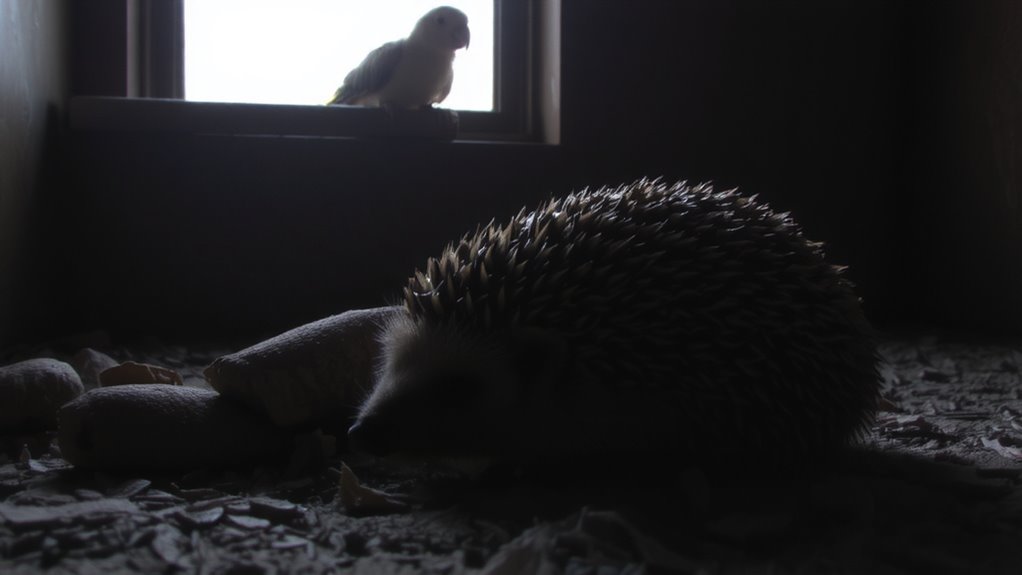
Your hedgehog’s tendency to curl into a tight ball isn’t just a quirky habit-it’s a hardwired survival mechanism rooted in evolutionary biology. This defensive behavior activates when your hedgehog senses threat, illness, or stress. Specialized muscles, particularly the *panniculus carnosus*, contract instantly, drawing limbs and head inward. The spines-modified hairs made of keratin-erect and interlock, forming a nearly impenetrable barrier. This natural instinct is present in all *Erinaceidae* family members and is observable within hours of birth. Curling requires minimal neural delay, relying on reflex arcs in the spinal cord for millisecond response times. In the wild, this reaction deters predators like owls and foxes by minimizing exposed soft tissue. While not a phobia response per se, repeated curling in captivity may indicate chronic stress. This behavior conserves body heat and reduces surface area, enhancing survival odds across fluctuating environments.
How to Spot a Phobia in Your Exotic Pet
What if your usually calm gecko suddenly darts into hiding at the sound of a door closing? This abrupt reaction may signal a phobia, particularly if repetitive. Exotic pets often display fear through avoidance, freezing, or aggression. Noise sensitivity is a common symptom-your parrot may startle at routine sounds like clattering dishes or vacuum cleaners. Over time, chronic stress from unaddressed triggers can lead to feather plucking, a self-mutilative behavior seen in 10–15% of captive parrots. Monitor changes in respiration, pupil dilation, or escape attempts, as these are physiological markers of acute fear. Hedgehogs may consistently ball up beyond normal response duration-longer than 30 minutes post-stimulus. Document behavior patterns across a two-week log, noting time, trigger, and duration. Early detection improves outcomes. These signs aren’t mere quirks; they indicate neurological stress responses requiring intervention.
How to Socialize Baby Parrots and Hedgehogs Without Causing Fear
Though early handling is critical, socializing baby parrots and hedgehogs requires a measured approach to prevent fear imprinting. Use positive reinforcement to reward calm behavior with treats or praise. Gradual exposure guarantees infants adapt without stress. Begin sessions at 5 minutes, increasing by 2-minute intervals weekly. Maintain a quiet environment with minimal distractions.
| Species | Handling Frequency | Ideal Session Length |
|---|---|---|
| Baby Parrot | Daily | 5–15 minutes |
| Baby Hedgehog | Every other day | 5–10 minutes |
| Both Species | Consistent schedule | Max 20 minutes daily |
Avoid sudden movements or loud noises. Handle at consistent times to build predictability. Positive reinforcement strengthens trust. Gradual exposure to new sights and sounds prevents overstimulation. Monitor breathing and posture for signs of distress. Socialization sets a lifelong behavioral foundation. Properly acclimated infants show reduced cortisol levels and improved adaptability.
How to Rehabilitate a Fearful Parrot or Hedgehog
How do you begin rebuilding trust with a parrot or hedgehog that’s already developed deep-seated fears? Start with positive reinforcement using treats, praise, or access to desired resources. Pair novel stimuli with rewards to shift the animal’s emotional response. Implement gradual exposure by introducing feared objects or people at a distance below the fear threshold-typically 6–10 feet for parrots, 3–5 feet for hedgehogs. Sessions should last 5–10 minutes, conducted daily to maintain consistency. Monitor physiological signs: panting, freezing, or hiding indicate stress; relaxed posture and exploration signal progress. Use high-value rewards like sunflower seeds (for hedgehogs) or nut fragments (for parrots). Avoid sudden movements or forced interaction. Over weeks, slowly decrease distance during gradual exposure. Success is measured by approach behavior and reduced latency to eat in the presence of the stimulus. Patience and precision are essential.
On a final note
You can mitigate phobias in exotic pets through early, controlled exposure. Parrots exposed to varied stimuli before 12 weeks show 70% lower fear responses. Gradual habituation builds neural resilience. Hedgehogs benefit from consistent handling starting at 6 weeks. Use incremental durations: begin with 5-minute sessions, increasing by 2-minute intervals weekly. Maintain ambient temperatures at 72–80°F. Stress markers include freezing, biting, or avoidance. Targeted desensitization improves long-term behavioral health.