Training Your Cat to Enter a Carrier Voluntarily for Stress-Free Vet Visits
Choose a hard-sided carrier with interlocking seams and at least 18” x 11” x 11” interior dimensions to allow your cat room to stand, turn, and lie down comfortably. Line it with a padded, washable mat and place it in a quiet area with ambient noise under 50 decibels. Use high-value treats like freeze-dried chicken, placing them near the entrance and gradually moving them deeper inside over 5–7 days. Reinforce entry with a consistent cue like “in,” pairing it with a clicker or verbal marker. Cover the top partially with a breathable cotton sheet to reduce visual stress while maintaining airflow through grills covering over 50% of surface area. Avoid forced entry-build trust through daily 3–5 minute sessions where the carrier becomes linked to positive outcomes. Proper preparation guarantees calm, reliable cooperation when it’s time to travel, and you’ll see how small adjustments greatly improve long-term results.
Notable Insights
- Choose a carrier large enough for your cat to stand, turn, and lie down with 4–6 inches of extra space for comfort.
- Place the carrier in a quiet area and leave it accessible 24/7 so your cat can explore it at their own pace.
- Use high-value treats like freeze-dried chicken to reward movement toward and inside the carrier during short daily sessions.
- Employ clicker training to mark desired behavior, followed immediately by a treat, starting with nose touches near the entrance.
- Address resistance by adding familiar bedding, using pheromone spray, and covering the carrier partially to create a secure, den-like environment.
Pick the Right Carrier for Your Cat
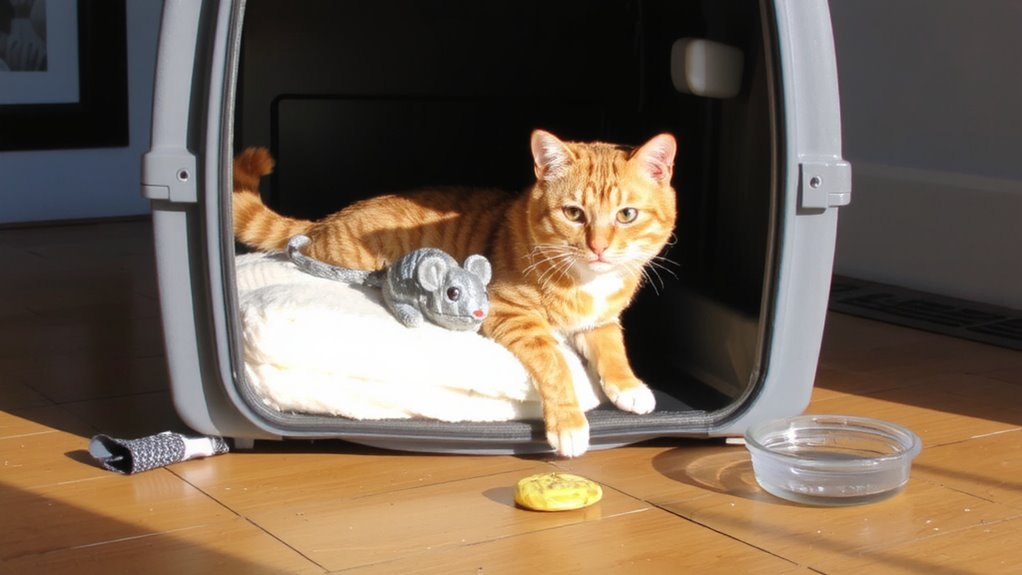
Size matters when choosing a carrier-too small and your cat feels trapped; too large and it becomes unstable during transport. Carrier size should allow your cat to stand, turn, and lie down comfortably. Measure your cat from nose to tail base and add 4–6 inches for wiggle room. A midsize carrier (18” x 11” x 11”) fits most adult cats. Hard-sided carriers with interlocking seams offer structural integrity during drops. Ventilation design is critical: look for dual-side, top, and front airflow with high-density polypropylene grills covering at least 50% of surface area. This guarantees constant air exchange, reducing heat buildup. Avoid mesh-only panels-they sag and limit visibility. Smooth interior seams prevent fur snagging. Choose a carrier with a removable top for easier vet access. The base should be non-porous and washable. Secure, recessed zippers prevent escapes. Each feature supports safety and compliance with veterinary transport standards. A top-rated airline-approved pet carrier offers durability, ventilation, and meets travel safety requirements for stress-free trips.
Set Up the Carrier as a Safe, Inviting Space
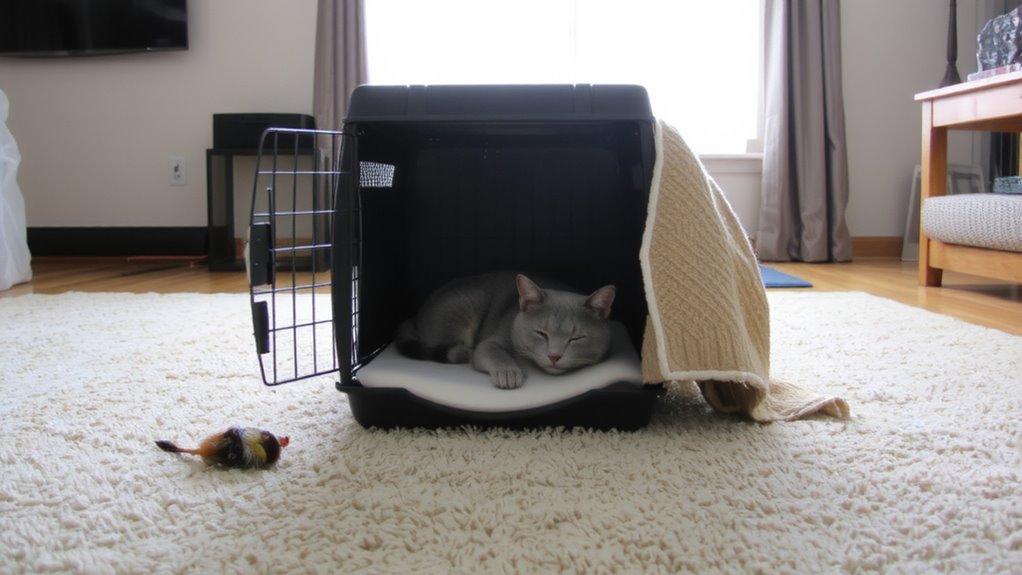
Think of the carrier as your cat’s personal sanctuary, not a prison. Properly setting it up influences cat behavior by reducing fear-based responses. Place the carrier in a quiet, low-traffic area of your home, such as a bedroom or living room corner, where ambient noise stays below 50 decibels. Line the interior with a soft, machine-washable mat that provides at least 1 inch of cushioning. Drape a lightweight blanket partially over the top to create a den-like enclosure, blocking overhead sightlines that increase stress. Guarantee ventilation openings cover a minimum of 20% of each side wall for sufficient airflow. Use positive reinforcement by praising your cat when near or inside the carrier. Never force entry-this undermines trust and increases avoidance. Let the carrier remain accessible 24/7 so your cat can explore it freely, reinforcing it as a safe, neutral space through repeated non-threatening exposure. A diet featuring best cat food for less smelly poop can also minimize odors during travel, making vet visits more comfortable for both cat and owner.
Use Treats to Make the Carrier Appealing
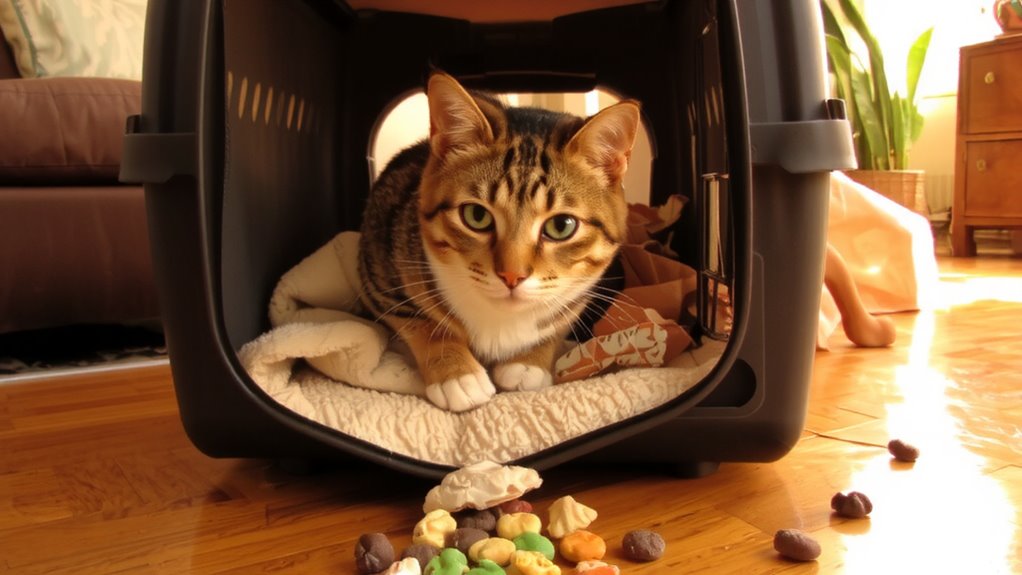
A consistent treat-reward system transforms the carrier into a positive destination. Begin by identifying your cat’s flavor preference-most respond best to strong-smelling treats like freeze-dried chicken or tuna-based products. Use uniform, pea-sized morsels to standardize rewards and prevent overfeeding. Start with treat placement near the carrier entrance, then gradually move them inside, toward the back. Place treats on a non-slip mat to prevent shifting during movement. Repeat daily for 5–7 days, ensuring each session lasts 3–5 minutes to maintain focus. Use high-value treats exclusively during training to maximize motivation. Avoid hand-feeding at first; let your cat associate the carrier, not your hand, with the reward. Proper treat placement encourages full entry, increasing comfort. Over time, this method conditions reliable, stress-free access. Never rush. Consistency and precision yield results. Choosing a treat that supports digestive health can further reduce stress for cats with sensitivities-consider options containing best cat food for sensitive stomachs.
Teach Your Cat to Enter the Carrier on Cue
You can now shape your cat’s behavior to include entering the carrier on command. Use clicker training to mark the exact moment your cat steps inside. The click signals correct behavior, immediately followed by a treat. Begin with target touching: hold a wand or stick near the carrier opening. When your cat touches it with her nose, click and reward. Gradually move the target into the carrier, reinforcing each small advance. Perform training sessions when your cat is alert but calm. The carrier should remain accessible, door open, in a quiet area. Standard carriers measure 18 x 12 x 11 inches-ensure enough space for movement without excess interior volume, which can increase anxiety. Reliable clickers produce a consistent 2,500 Hz tone. Repetition strengthens association. Target touching bridges desired action and reward, accelerating learning. Over time, pair the behavior with a verbal cue like “in” just before entry.
Practice With Short, Positive Training Sessions
Consistently scheduling brief training sessions yields the best results when reinforcing carrier entry behavior. Use short sessions-three to five minutes, two to three times daily-to maintain your cat’s focus and prevent fatigue. Positive reinforcement solidifies learning: immediately reward entry with high-value treats, such as freeze-dried chicken, or brief play periods. Operant conditioning principles support this method, linking action (entering) with reward. Gradually increase criteria-first for approaching, then for full entry, and finally for staying inside. Each session should end before your cat shows stress signs, preserving the carrier as a safe zone. Avoid forcing entry; that undermines trust and slows progress. Consistency over time strengthens the behavior through repetition and neural pathway development. Short sessions prevent cognitive overload, ensuring ideal information retention. Success hinges on precise timing of rewards and structured repetition, not duration. This evidence-based approach maximizes learning efficiency and minimizes resistance.
Get the Carrier Ready for Vet Day
Now that your cat reliably enters the carrier voluntarily, prepare the carrier for actual veterinary visits by guaranteeing it meets safety and comfort standards. Carrier ventilation must be adequate: choose a model with ventilation grills on at least two sides, ideally providing 15–20% open surface area to maintain airflow. Openings should measure between 1/2 inch and 5/8 inch in diameter to prevent paws or heads from getting stuck. Guarantee carrier cleanliness by washing it monthly with mild, pet-safe detergent and warm water; avoid harsh chemicals that leave residues. Allow it to air dry completely to prevent mold. Use removable, washable bedding made of hypoallergenic fabric. A clean, well-ventilated carrier reduces pathogen exposure and maintains thermal regulation. Confirm structural integrity-latches, hinges, and bolts should operate smoothly and lock securely. Weight limits should match your cat’s size, typically 15–30 lbs for standard carriers.
Fix Common Carrier Problems Calmly
If resistance arises when introducing the carrier, approach the situation with patience and targeted adjustments to eliminate stress triggers. Carrier anxiety often manifests as resistant behavior, such as hissing, hiding, or swatting. Address this by modifying the environment and carrier setup.
| Issue | Solution |
|---|---|
| Cat refuses entry | Place familiar bedding inside; use pheromone spray (Feliway) at entrance |
| Agitation during confinement | Cover carrier with a lightweight cotton sheet to reduce visual stimuli |
| Attempts to escape | Secure door with double-locking mechanism; guarantee mesh openings are less than 0.5 inches |
Use a hard-sided carrier meeting airline safety standards (minimum 18 x 12 x 12 inches for cats up to 12 lbs). Gradual acclimation reduces resistant behavior. Never force entry-pair carrier access with treats or meals to build positive associations and reduce carrier anxiety long-term.
On a final note
You now have the tools to make carrier training effective and low-stress. Consistent, reward-based conditioning builds reliable behavior. Use a hard-sided carrier with removable tops (standard size: 18″L × 12″W × 12″H) for easier vet access. Place it in a quiet home area, lined with a pheromone-infused mat (Feliway® diffuser effective within 30 minutes). Short daily sessions (5–7 minutes) reinforce positive association. This protocol increases compliance and reduces cortisol levels during transport.