Using Novel Movement Like Spinning Toys for Indoor Cats
You need spinning toys to satisfy your indoor cat’s hunting instincts with lifelike motion. These toys rotate at 30–120 RPM, mimicking prey escape patterns through erratic movement and sudden stops. They trigger the optokinetic response with visual tracking across a 60-degree field. Powered by quiet DC motors (under 30 dB), models run on AA/AAA batteries or USB power. Use 10–12 minute sessions to avoid overheating. Choose variable-speed, UL-certified designs with secure battery compartments. More details on matching models to your cat’s behavior follow.
Notable Insights
- Spinning toys mimic prey motion with 30–60 RPM rotations, stimulating indoor cats’ hunting instincts.
- Erratic movement and sudden stops activate cats’ visual tracking and full predatory sequence.
- Choose low-noise, variable-speed toys to match individual play styles, from shy to bold hunters.
- Use UL-certified, battery-operated models with secure compartments for safe, short-play sessions.
- Rotate toys weekly and inspect for wear to maintain engagement and prevent motor overheating.
Why Indoor Cats Need Novel Movement: and Why Spinning Toys Help
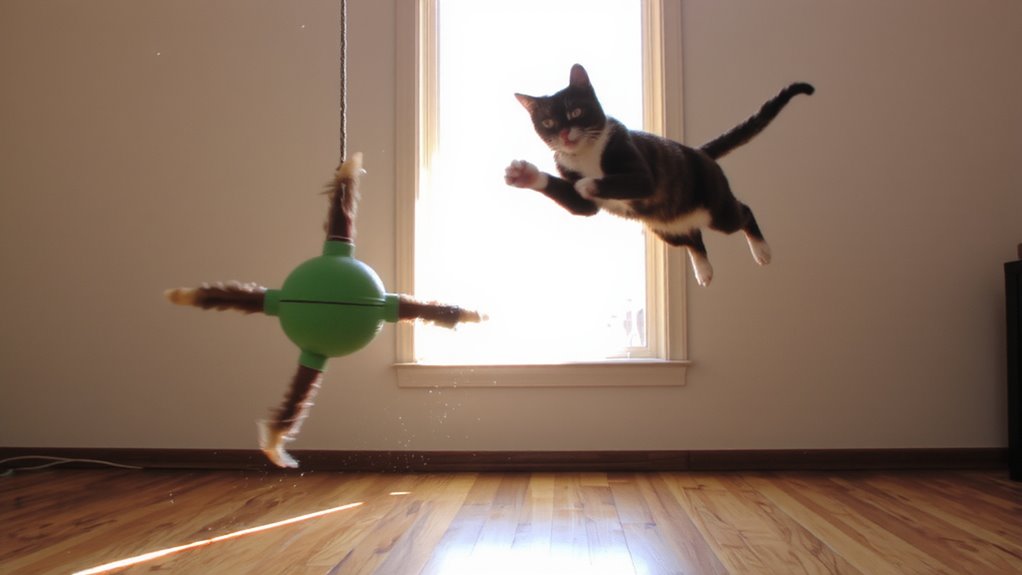
While domesticated cats retain the hunting instincts of their wild ancestors, their indoor environments often lack the dynamic stimuli needed to engage these behaviors. You must provide sensory enrichment to mitigate cat anxiety and support natural activity patterns. Spinning toys offer novel movement, simulating prey motion through unpredictable rotational paths at speeds of 30–60 RPM. These motions trigger visual tracking, activating the feline optokinetic response. Units typically rotate on low-friction ball bearings, ensuring smooth 360-degree movement. Most models measure 6–10 inches in diameter and use quiet, battery-operated motors (AA or AAA) lasting 20–40 hours. Materials include BPA-free plastics and non-toxic feathers. The intermittent motion pattern-alternating 10-second spins with 20-second pauses-mimics prey behavior, sustaining attention. This structured stimulation reduces stress markers and promotes mental engagement. Effective sensory enrichment doesn’t require space; even small apartments benefit from vertical or wall-mounted variants operating within 12-inch clearance zones.
How Spinning Toys Stimulate Hunting Instincts
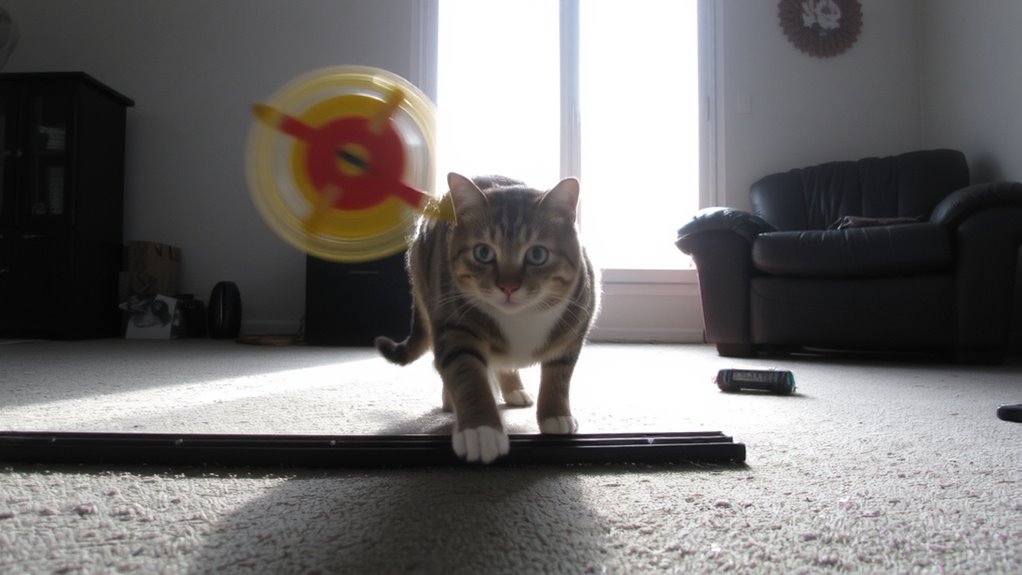
Because spinning toys replicate the erratic motion of fleeing prey, they effectively trigger your cat’s innate hunting sequence. These toys provide realistic prey simulation through unpredictable rotational speeds, typically ranging from 30 to 120 RPM, mimicking the escape behavior of live quarry. Your cat’s visual system is highly attuned to motion tracking, particularly detecting rapid lateral shifts within a 60-degree field of view. The spinning appendages, often reaching diameters of 8–12 inches, create dynamic visual stimuli that sustain engagement. Movement patterns are engineered to include sudden stops and directional changes, enhancing cognitive stimulation. The toys activate all phases of the predatory sequence: orientation, stalking, pouncing, and biting. Rotational consistency is maintained via low-friction bearings, ensuring minimal mechanical resistance. This precise motion profile sustains high levels of attention, meeting your cat’s instinctual need for interactive prey simulation without reliance on external rewards. Best cat training toys combine these motion features with durable materials to support consistent, enriching play.
5 Types of Spinning Cat Toys That Work
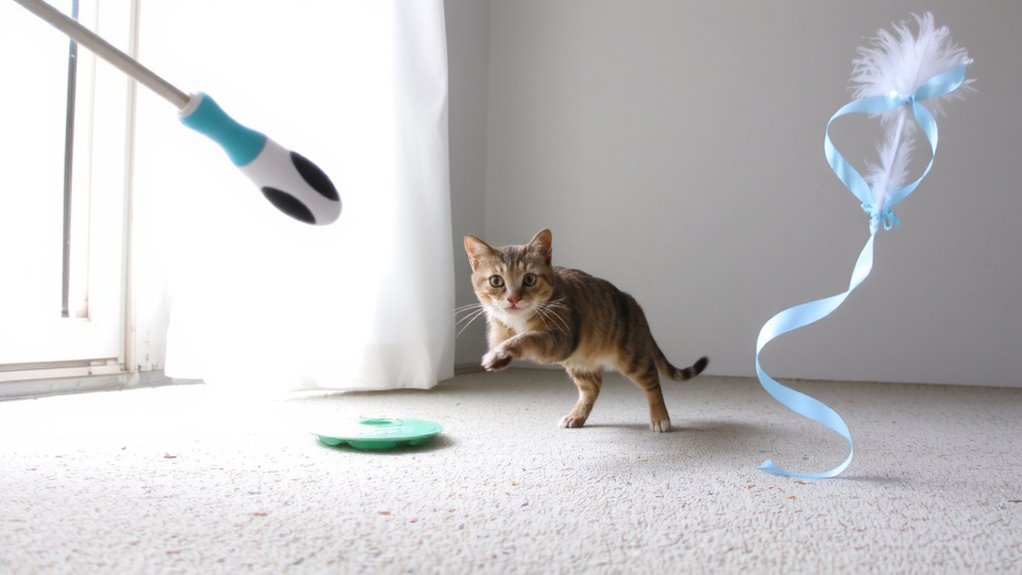
Spinning toys come in several functional designs, each tailored to exploit your cat’s instinctive response to movement. Motorized track balls, wand-activated spinners, and automated laser units deliver unpredictable motion patterns proven to trigger pounce, chase, and bat behaviors. Below outlines key types, power sources, and compatible play methods:
| Toy Type | Power Source | Compatible Play Method |
|---|---|---|
| Motorized Track Ball | Battery (AAA x3) | Independent play, 8–10 min cycles |
| Magnetic Wand Spinner | Manual operation | Magnetic wand play, 360° rotation |
| Automated Laser Disc | USB rechargeable | Laser pointer games, random dot path |
Each model uses variable speed controls and rotational mechanics to simulate prey-like motion. Magnetic wand play allows real-time trajectory adjustments. Laser pointer games rely on reflection dynamics across flat surfaces. These toys support repetitive engagement without habituation when used intermittently.
Picking the Right Spinning Toy for Your Cat’s Play Style
The right spinning toy can considerably enhance your cat’s indoor activity levels when matched to their natural play preferences. Assess your cat personality first-shy cats prefer slow, predictable motion, while bold hunters enjoy erratic speeds and sudden changes in direction. For cautious cats, choose a motorized spinner with adjustable RPM, operating between 15–30 rotations per minute, and a low-noise DC motor under 30 dB. Active cats respond best to toys with randomized spin patterns and LED light attachments that simulate prey movement. Guarantee toy variety includes wand-integrated spinners, battery-powered base units (measuring 4.5–6 inches in diameter), and replaceable attachments like feather dusters or silicone tendrils. Models with anti-tip weighted bases improve stability. Rotate spinning toys weekly to maintain engagement. A well-matched spinning toy promotes sustained predatory sequence expression-stalking, pouncing, batting-for maximum mental and physical stimulation.
Safe Ways to Use Spinning Cat Toys
While keeping your cat engaged is important, safety must guide how you deploy spinning toys in your home. Always prioritize battery safety by using only the manufacturer-recommended cells and checking for swelling or leakage monthly. Replace batteries promptly if corrosion appears to prevent hazardous chemical exposure. Make certain toys are UL-certified and contain sealed battery compartments requiring a screwdriver to open. Conduct regular toy supervision during use to prevent ingestion of detached parts or entanglement. Never leave spinning toys unattended for more than 15 minutes at a time. Limit play sessions to 10–12 minutes to reduce motor overheating, which occurs in plastic-bodied units above 104°F surface temperature. Choose models with automatic shut-off timers after 15 minutes. Avoid toys with rotating elements exceeding 3,000 RPM, as high-speed spin increases projectile risk. Inspect for wear every three weeks.
Make Your Own Spinning Cat Toy
You can build a safe, effective spinning cat toy at home using basic materials and precise engineering controls. This project requires minimal DIY materials and allows for custom creative designs tailored to your cat’s play style. Guarantee all components are non-toxic and securely fastened to prevent choking hazards. Use a low-friction bearing or pivot point to maintain consistent rotation. Balance the spinning arm to prevent wobbling and guarantee smooth, predictable motion that mimics prey movement.
| Component | Specification | Purpose |
|---|---|---|
| Base | 6″ diameter, 1″ thick | Stabilizes structure |
| Spinning Arm | 8″ rigid plastic rod | Transfers rotational force |
| Pivot Point | Ball bearing or eyelet | Reduces rotational friction |
| Attachment Loop | 4″ nylon cord | Connects to dangling toy |
| Toy Element | Felt mouse or feather | Stimulates hunting instinct |
On a final note
You now understand how spinning toys support your cat’s instinctual behaviors. These devices simulate prey-like motion through rotational speeds of 30–60 RPM, triggering focused attention. Models with variable speed settings (12V DC motors) adapt to different play styles. Durable polycarbonate bodies withstand impact. Timed operation (5–15 minute cycles) prevents overstimulation. Proper supervision guarantees safety. Incorporating these tools improves mental engagement. Choose models with enclosed mechanisms and non-toxic finishes for best results.